
Join us at our brand new blog - Blue Country Gazette - created for those who think "BLUE." Go to www.bluecountrygazette.blogspot.com

YOUR SOURCE FOR TRUTH

Tuesday, June 30, 2026

Climate Activists Take on a New Foe: Data Centers

Climate Activists Take on a New Foe: Data Centers  
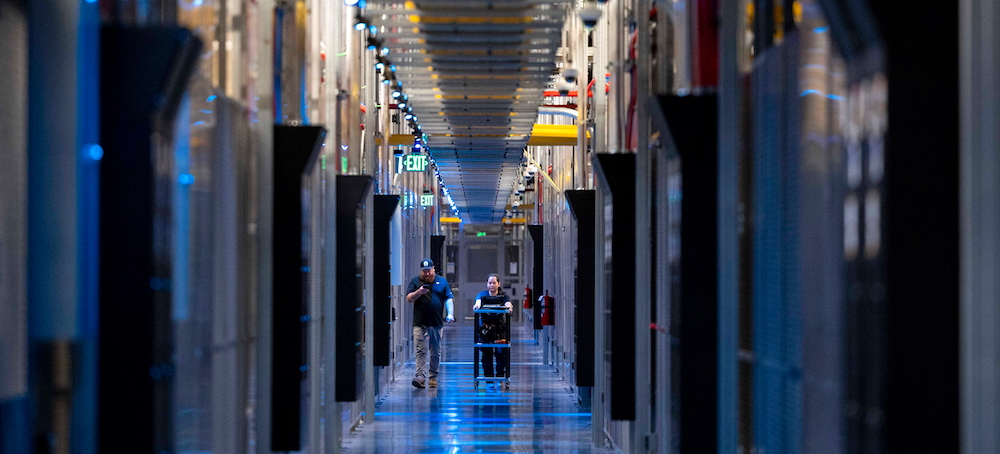
People walk through the hallways at a data center. (photo: Amanda Andrade-Rhoades/WP/Getty Images)
 
 As Trump kills climate action, the movement is finding new energy in local fights to stop polluting, power-hungry facilities.
 
 Kate Yoder / Grist

Amid the many political casualties of 2025 — mass federal layoffs, shuttered agencies, and clean energy spending cuts — the passing of one of the last decade’s defining political projects went almost entirely unnoticed. On December 31, 2025, the Green New Deal Network, a coalition of climate, labor, and social justice organizations, officially died.

The coalition wasn’t intended to last forever, but its demise was sped up by the political mood that got President Donald Trump reelected in 2024, when the momentum that the movement had enjoyed under Joe Biden’s administration seemingly evaporated overnight. 

As Trump launched an all-out assault on environmental regulations and climate policies, the climate movement was left at a loss, unsure how to push for change with the public increasingly focused on other issues, like the cost of living, and a federal government hostile to its cause.

“The conditions under which the Green New Deal Network was founded have fundamentally changed,” the coalition’s site said, explaining its decision to fold. “The mission of climate, jobs, and justice is far from over — but the structure built to win a specific moment is no longer the right vehicle for what comes next.”

Saul Levin, who was the network’s director of campaigns and politics, knew what was next for him personally: fighting AI data centers. 

The artificial intelligence boom has created a surge in construction of giant facilities that process digital information, and communities across the country are working to stop them from being built, concerned about water usage, soaring energy bills, and Big Tech taking over. 

Over a year ago, Levin had started a Signal chat to help people opposing data centers get organized. Now his chat has about 350 members across 40 states, and he’s busy with his new podcast, “The Hum,” capturing their stories and highlighting successes.

Many climate activists are following a similar path. Concerns about greenhouse gas emissions, air and water pollution, and social justice fit organically into the growing anti-data center movement, which has attracted a much broader, bipartisan coalition than the Green New Deal ever did. 

“The climate movement is increasingly realizing that this is a fight that’s both an important fight and a strategic fight,” said Evan Sutton, an anti-AI advocate who’s helping connect people who oppose data centers.

Take the Sunrise Movement, whose members stormed Representative Nancy Pelosi’s office in 2018 to demand a Green New Deal, catapulting the idea into the national conversation. “We’ve definitely seen a surge of interest in data center fights around the country,” said Aru Shiney-Ajay, the group’s executive director. Local Sunrise hubs have been mobilizing to stop data centers in Dallas, Denver, Pittsburgh, and Lansing, Michigan, Shiney-Ajay said.

There’s a logical reason for the climate movement to get involved: These hyperscale data centers are poised to cause carbon emissions to spike. A new report from the Lawrence Berkeley National Laboratory found that data centers could account for about one-third of the growth in U.S. electricity demand between 2024 and 2030. 

This thirst for energy is driving the expansion of infrastructure for natural gas, a fossil fuel. A typical AI data center demands as much electricity as 100,000 households, but some of the largest ones being built may use up to 20 times that, according to the International Energy Agency. 

The rapid expansion of data centers threatens to “undo a huge amount of the progress that we made in terms of moving toward clean energy,” Shiney-Ajay said. “If we don’t really seriously start to pass policy that mitigates that, then they could be a disaster for our climate.”

Some established environmental organizations have gotten on board with suspending hyperscale data center construction. A letter sent to Congress this month calling for a nationwide moratorium was signed by more than 500 groups, most of them related to the environment, climate change, or environmental justice — such as Greenpeace USA, Third Act, GreenLatinos, and Food and Water Watch. But some of the biggest names of the U.S. environmental movement were absent from the list, including the Sierra Club, the Natural Resources Defense Council, and the Nature Conservancy.

That’s not to say they’re pro-data center, though. “The speculative rush to build data centers is harming ratepayers, our climate, and community health, which is why we urgently need protections from states and the federal government,” Jeremy Fisher, the Sierra Club’s principal advisor, said in an emailed statement. The organization advocates for holding Big Tech to a higher standard in terms of environmental and health impacts and argues that companies should invest in clean energy to run their facilities instead of fossil fuels. “Data centers can and should be powered with renewable energy that does not threaten our environment and our health, our wallets, or our environment,” Fisher said.

Thomas Meyer, the organizing projects director at Food and Water Watch, which led the letter to Congress, said that powering data centers with clean energy doesn’t solve the problem. In Washington state, for instance, Amazon outbid the utility Puget Sound Energy in an auction for an enormous Oregon solar farm, leaving the utility concerned about competition for renewable resources as Amazon races to build energy-hungry data centers. “What about the things that that solar power would have gone to power instead?” Meyer said. “You haven’t grown the pie. You’ve just shifted it from one place to another.”

Big green groups may also be taking cues from Democratic politicians, many of whom, like Michigan Governor Gretchen Whitmer, have been friendly to data center development. “The unfortunate reality is that some organizations tend to follow rather than lead, especially when it comes to mainstream positions of Democratic Party leaders or elected officials,” Meyer said.

Meyer witnessed a similar dynamic a decade ago when working as a field organizer on campaigns to ban fracking: a disconnect between grassroots energy and mainstream institutions. Established environmental groups tend to move more slowly than bottom-up movements, said Valerie Costa, co-executive director of the Oil and Gas Action Network, a nonprofit that supports grassroots groups working to move the U.S. beyond fossil fuels. “One of the things that grassroots movements do really well is shifting when there are more immediate threats, and being able to respond quickly,” Costa said.

That was recently in play in Seattle, where the climate activist group 350 Seattle joined the push to pass a moratorium on new large data centers after the news broke this spring that five major facilities could be coming to town. If all the projects were actually built, they would require about one-third the amount of power that Seattle uses on a typical day. The Seattle City Council passed the moratorium unanimously earlier this month, making it the largest city in the U.S. so far to suspend approvals. For local activists working on an issue as amorphous and overwhelming as climate change, it was invigorating to get involved in a mission with a concrete, local outcome.

“For us, it was a very good on-ramp for people who just want to do something and want to turn that powerlessness into something meaningful,” said Nivi Achanta, the founder and CEO of Soapbox Project, a local climate action group that advocated for the moratorium. The group’s Signal chat buzzed as the city council weighed the policy: “People were, like, pulling out drinks and grabbing their popcorn and actually watching these city council politics unfold in a way that’s so much more fun than anything I’ve experienced outside of this, in the general climate movement,” Achanta said.

In Washington state, known for its progressive climate policies, new natural gas infrastructure driven by power-hungry AI data centers threatens to produce an additional 13.5 million metric tons of carbon dioxide each year, about 14 percent of the state’s current annual emissions. That could derail its attempt to cut greenhouse gas emissions by 95 percent below 1990 levels by 2050, as required by the state’s Climate Commitment Act. Even in a blue state, there’s an understanding that opposition to data centers has to be bipartisan if it’s going to be successful, especially since most data centers are being proposed in rural areas. “We can’t just rely on the West Coast, or on the blue corridor from Bellingham down to Vancouver, Washington, to get something done,” said Lauren Redfield, a voluntary organizer with the Washington AI Resistance.

As climate activists join local fights, they may find themselves teaming up with people they don’t agree with on everything, or on much at all. Data centers are a rare issue that unites Americans across the political spectrum, with 75 percent of Democrats and 63 percent of Republicans opposed to building data centers in their area, according to polling from Gallup. All kinds of people — punk musicians in Utah, farmers in Oregon, beauty salon workers in Maryland — are coming out for all kinds of reasons, according to Levin, the host of “The Hum.” But their differences aren’t stopping them from working together.

“Again and again, we hear from organizers who are like, ‘I don’t care if you’re here for climate change, and I’m here because I think it’s going to be ugly, and that person’s here because they hate AI’ — all of us think this is a bad project,” Levin said.

In the first three months of this year, data center opponents blocked or delayed at least 75 facilities worth nearly $130 billion. One reason this resistance has been effective is because of its people power — the hundreds of thousands of people who are turning out to town halls, meeting up on porches, and otherwise showing up to fight. In an age of loneliness and political disillusionment, it’s a sign that something is changing.

“I’m really hopeful that this is the thing that gets communities re-engaged in local politics,” Redfield said. “We’ve seen a lot of apathy over the last several years, and I’m really hoping that this civic engagement can help us build that community that can help us stitch our society back together.”


Saturday, June 27, 2026

Solar Is Booming — Despite Trump’s Best Efforts

 Solar Energy Is Booming — Despite Trump’s Best Efforts (photo: iStock)

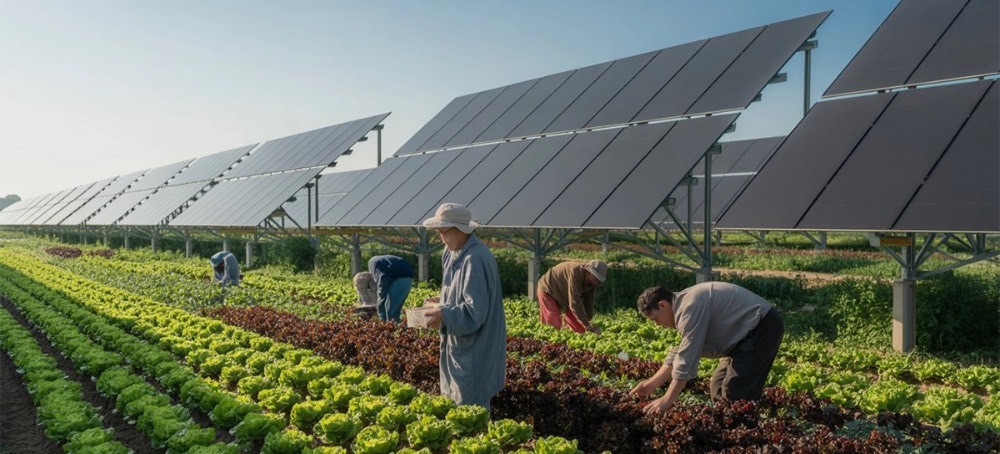
The president and his administration wants to kill clean energy and boost fossil fuels, but it can’t stop solar. (photo: iStock)

Thor Benson / Rolling Stone 

 27 june 26

Donald Trump has been doing everything he can to undermine the renewable energy industry and boost fossil fuels. 

He’s been especially aggressive towards wind power — so much so that the administration recently decided to pay nearly $800 million to cancel wind energy projects, which is the third time it’s shelled out taxpayer money to kill a clean energy initiative that had already been in the works.

Trump has been noticeably less focused on solar energy, but he has still attacked the industry and made moves to hinder its growth, along with other sources of clean energy.

Last August, the president wrote that solar energy, along with wind, was the “SCAM OF THE CENTURY,” and that his administration would not approve any “farmer-destroying solar.”

The industry has been booming anyway.

Solar is now starting to outperform coal in terms of energy production, and according to the energy think tank Ember, it met 61 percent of U.S. electricity demand growth last year. The U.S. installed 43 gigawatts of solar power in 2025, which was down from a record-breaking 50 gigawatts the year before, but that’s still a huge number of installations. New solar was being installed every 59 seconds throughout last year.

“For whatever reason, Trump has a much stronger antipathy toward wind than he does solar,” Ryan Kellogg, a professor of climate and energy policy at the University of Chicago, tells Rolling Stone. “Especially for offshore wind, there’s no getting around the fact that you need a whole slew of federal permits. You need to get the Department of Defense involved.”

With solar, things are significantly easier, Kellogg says. You can buy up some private land and put down a solar farm, and no one’s going to say it’s blocking their view. They might not like it if it is visible, but it’s not a behemoth that’s altering the skyline, which has been one of the president’s many criticisms of wind energy.

“They’re certainly not as visible as the big megawatt wind turbines, which you can see for miles around,” Kellogg says. “Wind turbines generate noise and [shadow] flicker. That’s much less true of a solar facility.”

There’s also a lot more land that can be used for solar energy, Kellogg says. While solar panels can generate energy anywhere there is sunlight, wind farms have to be placed in areas with lots of wind, which is largely in the middle of the country or offshore.

“A lot of folks very much support private property rights, especially in red states where these solar projects get proposed,” adds Gilbert Michaud, an assistant professor of environmental policy at Loyola University Chicago. “In theory, a farmer should be allowed to lease or sell their land to a private renewable energy developer. Long story short, it’s a lot easier than offshore wind when you’re just building a medium-scale solar farm on leased agricultural land.”

Solar is also succeeding because of the economics. While the cost of building out wind farms has decreased in recent years, the cost of solar has gone down significantly more. Solar will continue to decrease in price as the market grows and the solar panels themselves become more effective at capturing energy.

Trump has targeted solar in numerous ways since returning to office. Tax incentives have historically contributed to making solar power cheap, and some of those are being phased out because of the Trump administration’s dismantling of the Inflation Reduction Act. Trump signed an executive order in July of last year that made it even more difficult for solar companies to obtain tax credits. The administration has also made it harder for the industry to work with manufacturers in China, where most solar panels are produced. These actions have certainly affected the industry, as evinced by the amount of new solar installations decreasing from 2024 to 2025.

“Without the tax credits, we’re going to see how renewables stand on their own,” Michaud says. “Solar is still going to grow, but at a decreasing rate — the curve won’t be exponentially increasing the way it was under the Biden-era credits.”

Nevertheless, the solar industry is expanding. It’s not just through big solar farms; millions of homes are now equipped with rooftop solar. There’s also increasing interest in what’s called “balcony solar,” which can allow people who can’t install rooftop solar to still generate solar power at home.

Energy demand is only going to increase as massive AI companies continue to build energy-hungry data centers around the country. The solar industry could help meet a lot of that demand, as well.

“Energy demand is growing, and a lot of AI and data center facilities are going into red states,” Michaud says. “If a state can attract those firms by offering 100 percent renewable energy, that becomes part of a broader economic development strategy.”

The future is bright for solar, and not even the Trump administration’s vendetta against clean energy can change this fact. It may be easy for the government to tell Americans they can’t build a set of giant wind turbines, but it’s harder to tell them that they can’t throw up some solar panels and start generating electricity — especially when they’re already angry about high energy costs.

Trump really hates wind: Remember, your idiot president claims these babies cause cancer and kill birds.  Who cares if one day they might just save the planet.

Thursday, June 25, 2026

Everything Trump touches dies—except for algae in the Reflecting Pool

 
The newly refurbished green algae contaminated Lincoln Memorial Reflecting Pool, the War II Memorial, foreground, and the Lincoln Memorial, as seen from the Washington Memorial on the National Mall, Wednesday, June 17, 2026, in Washington.Green algae-contaminated Lincoln Memorial Reflecting Pool.

Latest boondoggle reaction right out of North Korea playbook.

President Donald Trump gave a sweetheart, no-bid, $13 million contract to a vendor who handles the pools at his tacky Trump-branded properties to “renovate” the Lincoln Memorial Reflecting Pool on the National Mall, painting the bottom of the massive basin of sitting water a dark “American flag blue” and allegedly fixing the filtration system so that it will have “clean, beautiful water.”

But, as pool experts and scientists alike predicted, the millions of gallons of water between the Lincoln Memorial and the Washington Monument are already filled with algae

The new, darker color of the basin absorbed more sunlight, heating up the water and leading the neon-green scum to return with a vengeance.

In fact, The Washington Post reported on Thursday that there is now more algae in the pool than “at any recorded point in the month of June for at least five years.”

Even worse: The countless gallons of hydrogen peroxide National Park Service workers are pouring into the water to try to rid it of this new algae bloom are now causing the new paint to peel away from the concrete.

In sum, the reflecting pool has turned into the latest expensive boondoggle Trump has wasted taxpayer dollars on to create.

The failure is obviously bothering Trump, who has clearly demanded that the Interior Department that oversees national monuments lie about what Americans can see with their own eyes.

“The Reflecting Pool water is crystal clear, and our National Park Service team is now vacuuming up the dead algae resting on the bottom of some parts of the Reflecting Pool—just like the destroyed Iranian Navy resting on the bottom of the Persian Gulf,” the Interior Department’s press account wrote in a post on X. 

It’s the kind of propaganda you’d imagine would come from North Korea, not the United States.

Members of the National Park Service clean algae from the Lincoln Memorial Reflecting Pool, Tuesday, June 16, 2026, in Washington.
National Park Service workers clean algae from the Lincoln Memorial Reflecting Pool on June 16 in Washington.  AP

The account went on to attack former President Barack Obama, whom Trump will never be as popular as, for not caring for the pool properly. But in fact, Obama renovated the pool in 2012 to change its water source from Washington, D.C.’s drinking water to water from the tidal basin, saving the city millions of gallons of potable water.

“Previous administrations—most notably under Obama—failed to maintain the Reflecting Pool, and after refilling the pool, the water would quickly become murky and thick with massive clumps of algae floating on the surface,” the Interior Department press account continued. “As our National Park Service team noted, the Reflecting Pool is now so ‘blue’ that the Fake News Media, which has been staked out at the Reflecting Pool for weeks, has fled!”

Of course, reporters have not fled. The anti-Trump outlet The Bulwark showed live on video on Thursday that the pool is once again algae filled and already peeling.

Meanwhile, right-wing pundits are coming to Trump’s rescue, concocting insane and wildly stupid conspiracy theories to try to blame the algae overgrowth on Democrats. 

“President Trump fixes the reflecting pool and a week later it’s green again, loaded with algae … Sabotage … Vandalism? I believe it is,” conservative commentator Grant Stinchfield wrote in a post on X when the algae began to return. “The left can’t stand Trump, American greatness and his quest to make DC beautiful again. What a shame!"

Hey Grant, if Democrats were so powerful enough to cause the biggest algae bloom in years in the reflecting pool just hours after it was refilled, they wouldn’t have lost the 2024 election. The real reason the pool is once again green is science, as algae thrives in hot water. But I guess we shouldn’t expect a halfwit like you to understand that.


Related | Trump happy to waste more money on Reflecting Pool paint job


Democrats, however, are using this latest debacle to call attention to the fact that Trump is more consumed with vanity construction projects than helping Americans afford the skyrocketing cost of living he exacerbated with his idiotic war in Iran.

“The President said it’d be the most beautiful reflecting pool anyone’s ever seen. $14 million later, it turned green with algae in days,” Sen. Amy Klobuchar of Minnesota wrote in a post on X on Thursday. “Americans need lower costs, not expensive distractions and misplaced priorities.”

Rep. Ritchie Torres of New York echoed those sentiments.

“The Reflecting Pool is a fitting metaphor for Donald Trump’s presidency. Trump ran for office promising to ‘drain the swamp.’ Instead, he became the swamp,” Torres wrote in a post on X, along with video of the green water and peeling paint.

Everything he touches dies: The Midas Touch he hasn't.

Monday, June 22, 2026

Trouble Is Brewing in American Elections

Stormy Daniels and the Donald. 

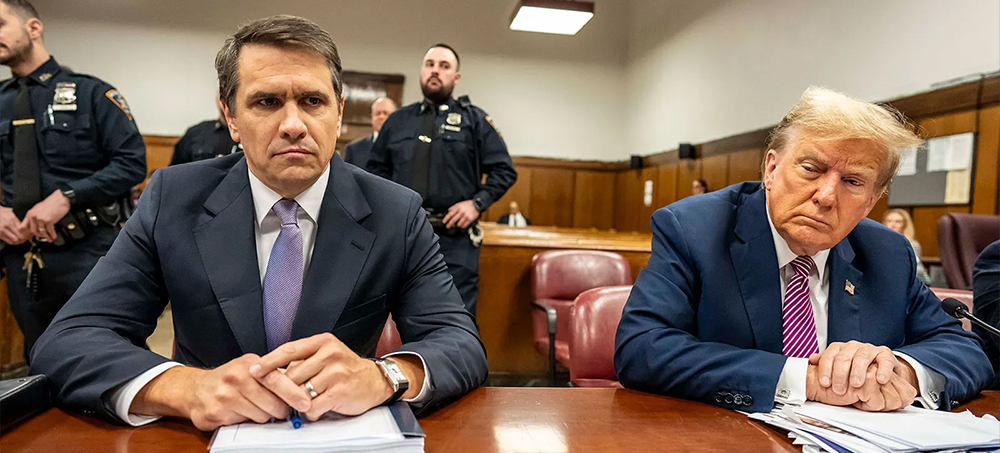
 Trouble Is Brewing in American Elections May 2024: Former high ranking federal prosecutor turned defense attorney Todd Blanche sits beside his client Donald Trump during the Stormy Daniels hush money trial.  Blanche is now Acting Attorney General. (photo: AP Pool)

Trump and his enabler lackeys are deadly serious about disrupting or even cancelling mid-term election
 
Marc Ash / Reader Supported News

The only way Donald Trump can lose power at this stage is by losing elections. He may not be able to stop that process but he is without any doubt going to try during the course of the upcoming 2026 midterm elections.

Political pundits love to cite historical trends, electoral metrics and patterns that have borne out consistently over time. It’s probably going a bit far to say that none of that matters in this age of shredded traditions but the forces affecting voters decision making in 2026 may be quite a bit different than what we have seen in the past. The wild card is also the joker, Donald J. Trump.

Trump is creating a never before seen political dynamic in the U.S. Effectively Trump and his entourage are endeavoring to end or at least render moot the American electoral process writ large. Or in effect end the American Republic as we know it. Their methods are ham handed and in many cases seemingly far-fetched. But there should be no mistake, Trump and his enablers are deadly serious.

Canceling elections outright is not a thing easily or quickly accomplished. Trump appears to be relying on two strategies one legislative and the other quasi-legal. The legislative menace is the SAVE Act. The SAVE (Safeguard American Voter Eligibility / SAVE America) Act might better be called the Desperate Attempt to Preserve Republican Majorities Act, because that’s essentially its purpose. 

The SAVE Act is deeply problematic. It would require among other things proof of citizenship, prohibit or greatly impede voting by mail and eliminate online or mail-in registration. If enacted the SAVE Act could disenfranchise tens of millions of voters, Democrats and Republicans alike.

The legislation has already passed the House but looks stalled in the Senate. Donald Trump is ramping up pressure tactics on Senate Majority Leader John Thune and other Republican leaders to push the legislation through at all costs. But the path to passage remains steep and rocky. The Act is deeply unpopular with voters and it’s not at all clear whether it would harm Democratic or Republican turnout more.

The next threat is far more likely to become real. It relies on two long standing governmental organizations. The first and most concerning is the U.S. Department of Justice, (DoJ). The DoJ is currently overseen by Acting Attorney General Todd Blanche. For the record, Blanche was Trump’s personal criminal defense attorney in the so called Stormy Daniels hush money case in New York state. It also bears repeating that Blanche has not been confirmed by the Senate. He is as his title suggests an Acting AG wielding the full authority and power of that office.

Blanche and his FBI counterpart Kash Patel appear to be in the early stages of using the substantial powers and capabilities of federal law enforcement to effect a campaign of what amounts to electoral intimidation. 

This is a complete and total departure from the traditional hands off approach the DoJ has taken towards American elections in the past. What could the DoJ actually do? We already have samples of what may be to come.

On 28 January 2026 the FBI raided the Fulton County, Georgia elections office seizing ballots and ballot records. Sheriff Chad Bianco of Riverside County, California a staunch Trump supporter took it upon himself to conduct a raid and seize 650,000 ballots from the 2025 California Redistricting election. A DoJ official in California, Bill Essayli brazenly predicted charges would be forthcoming in what he calls a voter fraud investigation there. 

Ruby Edlin writing for the Brennan Center for Justice notes a pattern: “The seizure follows a new playbook for election denial: Amateur, citizen activists claim election fraud. Refutations of the claims or contradictory evidence are ignored. These same unfounded claims are used as the basis of official law enforcement action.”

The Justice Department wasn’t the only governmental agency involved in electoral subterfuge. Standing in the shadows at the Fulton County election center raid was then Director of National Intelligence (DNI), Tulsi Gabbard. Gabbard would later say that she was there on direct instructions from Trump. Gabbard resigned shortly thereafter leaving the door open for a new DNI. Trump’s number one pick was real estate developer Bill Pulte.

Trump had previously appointed and the Republican led Senate confirmed Pulte to be the director of the Federal Housing Finance Agency. Once in that post he appears to have appointed himself chairman of government sponsored mortgage guarantors, Fannie Mae and Freddie Mac. From there he had broad access to mortgage application records.

Almost immediately under the auspices of combating mortgage fraud Pulte began to coordinate investigations into several high profile Trump political opponents. New York Attorney General Letitia James, who filed the civil fraud case against Trump in state court. Senator Adam Schiff who was the lead impeachment manager at Donald Trump's first Senate impeachment trial. Federal Reserve Board member Lisa Cook who refused to step down when Trump demanded it. Then congressman Eric Swalwell, another Trump impeachment trial manager. All high profile Democratic opponents of Trump. 

Pulte has proven that he will use whatever governmental authority he is given to aggressively pursue Trump political opponents.

As the director of national intelligence Pulte will have vast powers. Such powers are normally only granted to experienced and highly qualified national security career professionals, with long standing security clearances. All of that goes right out the window as Pulte takes over as Acting DNI, again without Senate confirmation, something Capitol Hill experts doubt he would get.

All of that amounts to a very challenging 2026 Midterm electoral environment for American voters. What can you the perspective voter do? Number one, be prepared for any and all challenges to your rights. Read this piece by Bogáta Timár about the challenges voters in Hungary faced in throwing out their autocratic and highly corrupt prime Minister Viktor Orban. Could we we do what they did? Do we have that strength, that courage? Be Prepared.

Friday, June 19, 2026


Capitulation Day

 
High gas prices are just the beginning.  Turns out Generalissimo Trump doesn't know the first thing about fighting a war or making a deal, and now we reap even more consequences.  

Once Iran closed the Straits of Hormuz, the war was over, and they had won

Timothy Snyder / Substack 

 19 June 26

ALSO SEE: Thinking About, Timothy Snyder on Substack

The United States has capitulated to Iran. There is a “deal,” which has been signed, on terms that can only be described as those of complete Iranian victory.

The US-Iranian talks that were supposed to begin today were cancelled, so today is as good a day as any to discuss the signed “memorandum of understanding” and mark the completion of the disaster. We have what we have: humiliation.

War, as some people apparently needed to learn, is not about the pleasure one takes in watching things blow up. It is politics by other means. To win a war means changing the politics of the enemy such that they must surrender. That is what Iran just did to the United States.

This war was a parade of Trump’s incompetence at every possible level from the beginning. 

To win a war requires understanding the politics of the other side and how it might be changed. Trump, Hegseth and the others treated the Iranian leadership as cartoon characters who would immediately do what Americans wanted as soon as the bombs fell. 

The Americans had no strategy -- no sense of how violence could change politics -- and it did not occur to them that the Iranians would have one. Once the Iranians did the obvious, which was to respond to American long-range strikes with their own, and close the Straits of Hormuz, the war was over, and they had won. The Americans had no second move, except to claim that they had won when they had lost (which they are, laughably, still doing).

 It matters that we no longer employ qualified people to handle matters of war and peace, but leave war planning to entertainers and negotiations to profiteers.

We seem to still be under the sway of the fairy tale that Trump himself can negotiate. He cannot and he never could. That was a character he played on television. He himself, and the people around him, talk big in front of the cameras in the safety of their studios, but know nothing about the actual workings of world power. 

Trump is vulnerable to flattery, always in a hurry, unable to focus, and indifferent to any issue beyond his own comfort. He started the war for personal pleasure, and then he surrendered to Iran for personal convenience: he wants to stay in the White House forever, and so he wants gas prices down, and so he gave Iran everything.

Until now, I tended to think that Trump’s geopolitical legacy would be as a footnote in the Russo-Ukrainian war, as a wannabe oligarch who artificially extended a real oligarch’s war of aggression. 

Now Trump has found his way into the main text of the history of Russia’s ally Iran, as the architect of the renewal of the atrocious regime in Tehran. By attacking Iran he generated sympathy for torturers and murderers. By losing to Iran he expanded its power profile in the Middle East. And by capitulating to Iran he created an enduring power base for Iran’s rulers. 

Iran will charge fees for transit through the Straits of Hormuz, and the United States will unfreeze Iranian assets and pay three hundred billion dollars in reparations. Thanks to Trump, the United States no longer has any leverage to prevent Iran from building a nuclear weapon.

We make a mistake, I think, in how we think about evil and folly. We tend to think that one excludes the other: if it is evil, it must serve some intelligent purpose; if it is foolish, it must not be very malicious. The truth, as this war shows, is that evil and folly can march hand in hand along the path to national self-destruction. 

This war was a strategic disaster, but it was also an ethical disaster. Fighting an undeclared and illegal war of aggression, flaunting the laws of war, and killing scores of civilians does not bring victory. 

Taking pleasure in doing those things is not a sign of canny calculation. It is simply wrong. To be hard-hearted is not to be hard-headed. One can enjoy violence and still be a loser. One can be hard-hearted and soft-headed, as Trump and Hegseth have just proven.

There is, in other words, no consolation. It is not that we used evil means to some good purpose. We used evil means foolishly and left the world far worse than it was before, in every conceivable respect. 

Aside from the economic consequences that we already feel and the strategic weakness that we have demonstrated, we have created a more disorderly and dangerous globe, one less bound by law and order, one more like the model that the regimes in Beijing and Moscow (and for that matter Tehran) want.

There is, however, a lesson. If evil and folly can march together, then so can good and wisdom. The United States got to a place where a war like this was possible because we allowed too much power to be concentrated in too few hands -- too much political power, too much economic power, too much media power. 

The capitulation to Iran, in other words, was not just the result of an error by a few self-absorbed incompetents, but of structures in which such people could attain power. Wars of whimsy are a symptom of tyranny, and a warning for those who prefer republics. They must be opposed, but more fundamentally they must be prevented: be removing money from politics, by addressing basic inequalities, by breaking up monopolies, by enabling social mobility.

Iran had no difficulty winning this war, because to do so it had only to prick the self-interest of an aspiring tyrant. To build an America that does not capitulate, as Trump and Hegseth and the rest have just proven, is not a matter of being hard-hearted and soft-headed. It really is the opposite -- and that is on us. 

We really should have harder heads, valuing leaders who have achieved something good in their lives, and resisting the easy charisma of the people who want their hands in our pockets and our children dying in some desert. And we should have softer hearts, caring more about one another, and thinking of our government as enabling better lives for all of us.

Alright Cuba, you're next.  Let's hope he doesn't give away Florida.  On second thought, what has ruby red Florida done for us lately?

Wednesday, June 17, 2026


Even the White House is struggling to defend Trump’s crappy Iran deal

APPresident Donald Trump talks with reporters before boarding Air Force One at John F. Kennedy International Airport on June 9.
 
A massive capitulation to a dangerous enemy, and an embarrassing loss for Trump.


The full text of President Donald Trump’s supposed deal to end the boondoggle of a war he started in Iran has yet to be released, with even the Republican Senate majority leader saying Tuesday that he hasn’t seen nor been briefed on what the deal includes.

But if the talking points the White House released on Tuesday on how Republican leaders and right-wing media grifters should respond to the supposed deal are any indication, the agreement is a massive capitulation to one of the United States’ most dangerous enemies, and amounts to an embarrassing loss for Trump.

The four-page “memorandum of understanding talking points” leads with the “top five message points” for Republicans to try to convince the public that the deal is good. And all five of the points are either complete lies or embarrassing spin that is unlikely to convince anyone but MAGA cultists who think Trump can do no wrong.


Related | Trump takes phony victory lap after Iran disaster


The first point is that “Iran will never have a nuclear weapon”—even though reports say that there is no deal yet on what Iran will do with its enriched uranium or its nuclear ambitions.

In fact, Trump himself on Tuesday tried to downplay the need for Iran to get rid of its uranium—even though that was the entire reason Trump started this costly mess of a war in the first place. That suggests that the deal he has yet to publicly release doesn’t actually include any agreements on Iran’s nuclear capabilities.

“You could make the case, why even bother? It’s not very valuable stuff,” Trump said Tuesday morning of the enriched uranium.

The second bullet declares that, “President Trump ended the fighting on every front, including Lebanon. No forever war.” 

First of all, ending the fighting that you started is not a flex. But more than that, it’s not even true!

The Times of Israel reported that Hezbollah launched rockets from Lebanon just this morning. And Israel reportedly said the deal is “vaguely worded” and they could keep launching attacks on the country. 

What’s more, even Trump sycophants said that including Lebanon in the deal isn’t something Trump should brag about.

A cartoon by Clay Bennett of President Donald Trump using a Magic 8 Ball to determine a peace deal with Iran.
Clay Bennett/Tribune Content Agency

“Getting Lebanon included in the Vance peace deal was an Iranian objective, not the U.S.—and one the U.S. initially resisted when the ceasefire was announced. To spin this as an American achievement is Orwellian,” right-wing Washington Post columnist Marc Thiessen wrote in a post on X—using Vice President JD Vance’s name in the deal so as to not directly criticize his Dear Leader for bowing to Iran.

The White House then encourages Republicans to stress that “the Strait of Hormuz is open again, free of charge.” 

Of course, the Strait of Hormuz was open and free of charge before Trump started the war. And like the previous talking points, this is false, as Iran has said it will charge fees for passage—effectively creating a new revenue stream for a U.S. enemy.

What’s more, CNN reported that because of the war, U.S. intelligence agencies now believe that Iran knows it will be able to blockade the Strait of Hormuz in the future and use it as leverage when the country is under attack. 

“We have now handed Iran de facto control over the strait—a weapon more powerful than any nuke,” an intelligence official told CNN. Great work, Trump!

Then the talking points seek to spin the $300 billion Iran is allegedly set to receive in the deal Trump struck.

“Iran’s rewards come from its own unfrozen money, not from American taxpayers, and only after it performs,” the talking points assert.

Of course, that is the same exact thing former President Barack Obama gave Iran when he struck a deal with the country that actually got Iran to agree to stop enriching uranium. The only difference is that Trump is unfreezing more of Iran’s assets, giving the country triple the amount of cash Obama did. 

Lastly, the Trump administration tells Republicans to defend the supposed Iran deal by saying that the agreement is signed by Trump and Iran. 


Related | Trump just can’t get his Iran spin straight at G7


“Obama never even got a signed document,” the talking points allege. “President Trump did, from strength, after dismantling Iran’s program.”

Find me the voter who is okay with this deal because it got an electronic signature. I’ll wait.

Ultimately, the talking points were so bad that even Republicans mocked them.

“Shocking we will provide many x what Obama paid for pinkie promise Iran won’t enrich uranium,” Marc Short, a longtime Republican operative who served as chief of staff to former Vice President Mike Pence, wrote in a post on X.

Right-wing radio host Erick Erickson used his program on Tuesday to debunk the talking points one by one, and slammed any Republicans or right-wing media personalities who would disseminate the White House’s spin.

“Today, you’ll easily be able to discern who is carrying water and who is not by whom on TV and radio parrots this,” Erickson wrote in a post on X. “I appreciate my friends in the conservative sphere wanting to be team players, but if the deal were a good deal, it’d be released already, and we wouldn’t need multiple days for 5 measly talking points.”

At the end of the day, Trump has been desperate to end the war he started, as even his own base doesn’t support the conflict and is angry that it caused gas and grocery prices to spike. 

It seems he didn’t take the advice he gave in 2015, when Obama was negotiating the Iran deal Trump later tore up.

“Message to Obama re: Iran,” Trump wrote on Twitter. “‘The worst thing you can possibly do in a deal is seem desperate to make it.’ – The Art of the Deal.”

"Trump is unfreezing more of Iran’s assets, giving Iran triple the amount of cash Obama did."

Monday, June 15, 2026

Trump's weeklong election spiral explodes after Newsom drops a prison threat and dares him to say one more word


“FAFO, Donald,” Newsom states, using a military term that means "f-ck around and find out."
 
Story by Shelby Erdman

President Donald Trump has been crowing for a week about California’s primary, accusing the state of voter fraud over the slow pace of mail-in ballot counting as Gov. Gavin Newsom issues a stark warning to politicians about “spreading election lies.”

Voters in the Golden State went to the polls a week ago on Tuesday, June 2, yet the vote count is still slowly trickling in with mail-in ballots taking longer to count, which is a completely normal part of the election process, but it’s something Trump has falsely pounced on as an example of Democrats’ “rigging” the election.

Newsom, a longtime Trump archrival, slapped back at Trump and other Republicans in a social media post Tuesday, June 9, alleging they are trying to interfere in California’s primary with what critics call their blatant election lies.

President Donald Trump called out a nickname for a woman once married to Gavin Newsom and who almost married one of his sons. (Photos by Alex Brandon-Pool/Getty Images; Tayfun Coskun/Anadolu via Getty Images)

The governor, in turn, made an ominous warning about pursuing charges against this type of willful misinformation.

“Trump says voter fraud should land people in prison,” Newsom began.

“Agreed. And let’s start with the politicians spreading election lies with the goal of illegally interfering with counting ballots,” he continued.

In California, I just signed a law making that punishable with up to three years behind bars. More to come,” he stated before throwing back an acronym that Trump’s Defense Chief Pete Hegsth has thrown around.

“FAFO, Donald,” Newsom stated using a military term that means “f-ck around and find out.

Social media erupted in support of Newsom.

“Yes, it should be illegal for a current politician serving the people of United States to knowingly lie or spread lies . Should lose their job and go to jail. Enough with them being able to knowingly lie to the American public,” a Threads user agreed.

Another poster is still worried. “They are literally rigging it through gerrymandering while forcing everyone to argue that it’s not rigged. commonly referred to as a ‘commitment trap’ or ‘rhetorical trap.’ Propaganda is powerful. They are running a masterclass. This will make it impossible to come back later with credible evidence.”

This Threads user chimed in, “Well good, so trump’s ready to go to jail now. Nobody frauds like this fool in the white house.”

Newsom’s comments follow a Truth Social post Trump made Monday, June 8, about GOP reality TV star Spencer Pratt’s campaign for Los Angeles mayor.

After the initial vote count of poll ballots, Pratt was in second place behind incumbent Mayor Karen Bass, but as officials began counting mail-in ballots, Pratt’s lead over progressive City Councilwoman Nithya Raman began to evaporate.

On Monday, June 8, The Associated Press declared Raman the second place finisher behind Bass and not Pratt, setting up a November runoff between Bass and Raman.

A furious Trump revealed what his mid-term strategy might be, lambasting the state and falsely accusing Democrats once again of “Rigged Elections” because he doesn’t like the outcome.

Not possible for Spencer Pratt to have lost the L.A. runoffs after the big lead he had,” Trump falsely raged. “3rd World Nation. Rigged Elections!”

Los Angeles is a heavily Democratic city, so Trump’s claims of a “rigged election” fall flat, and opponents say he’s using his playbook after his 2020 loss to former President Joe Biden spreading falsehoods and lies in an attempt to undermine the primary results despite no evidence or proof.

Opponents point to Trump’s first-term chief of staff Mark Meadows as an example of true election fraud.

Meadows, another 2020 election denier, was registered to vote in three states in 2020, according to reporting from WLOS TV in western North Carolina.

Although North Carolina decided not to prosecute Meadows on state charges, courts in Georgia and Arizona did indict Meadows for attempts to overturn the 2020 election.

Giving Trump a taste of his own medicine.

Saturday, June 13, 2026

Trump's name removed from Kennedy Center after blowing past deadline

 Protesters wave a US flag and hold a sign reading "you're no JFK" as workers build scaffolding near the signage for the "Donald J. Trump and John F. Kennedy Memorial Center for the Performing Arts" in Washington, DC, on June 12, 2026.
 
Hundreds on hand during the balmy DC evening chant "take it down." 
 
Story by Joey Garrison, Susan Page, Michael Loria and Aysha Bagchi
June 13, 2026

USA TODAY

Workers in the early morning of June 13 took down the president's signage after blowing past a June 12 deadline to comply with a judge's order.

Construction crews first showed up at the iconic arts institution on the afternoon of June 12, mounted scaffolding and and geared up to take down the president's name ‒ letter by letter ‒ from the sign on the building's facade.

Yet for several hours, the scaffolding sat there with no action. The center's Trump-appointed leadership waited until after an end-of-day deadline for workers to remove Trump's name. 

Work to take down the letters finally got underway at 3:10 a.m. ET, lasting about 30 minutes. A tarp was placed on parts of the scaffolding, seemingly to block views of Trump's name disappearing from the venue.

After losing multiple, last-ditch requests to be permitted to keep the name up, Trump and the Kennedy Center's board asked the judge late on June 12 for an additional 12 hours, saying thunderstorms caused delays.

The judge approved that request early June 13, after the original deadline had passed. The DOJ, which is representing Trump and the Board, confirmed in the late morning that the name has come down.

Hundreds of onlookers

Ahead of the drawn-out removal, the scene outside the Kennedy Center turned into a spectacle.

Hundreds of onlookers cheered and sang God Bless America as workers in hard hats with bungee lanyards clipped to their fluorescent yellow vests prepared to remove Trump's name. Many in the crowd were dressed as if for a performance at the stately Washington, DC, venue. Onlookers were festive and chatty amid thunderstorms that threatened to delay the work. Passersby honked their car horns in approval. 

The hundreds on hand during the balmy DC evening chanted "take it down."

Carolina Clarence, an area resident, came to watch with her dog, Ruffino. The retired kindergarten teacher called it "ridiculous" that Trump’s name was put up at all.

"We’re going to see this coming down," said Clarence, adding that Trump's name on the building hurt the storied institution as artists cancelled shows and donations fell. "They’re going to destroy the Kennedy Center."

Workers arrived on site shortly after the last-minute bids to keep the name up were rejected.

U.S. District Judge Christopher Cooper, in a May 29 ruling, said adding Trump's name to the center was illegal and ordered it be stripped from official materials and eliminated from signage within 14 days, by June 12.

In his June 12 denial of the Justice Department's request for a pause on his earlier ruling, Cooper said the defendants failed to prove their appeal would be successful and failed to show that the Kennedy Center would be "irreparably harmed" by following through with his order.

With the clock ticking toward an end-of-day deadline, the Trump administration later filed an emergency petition with the U.S. Court of Appeals, requesting that it intervene to pause Cooper's order before 7 p.m. ET, but the panel of judges denied the request, paving the way for the removal of Trump's name from the building.

Blow for Trump

Earlier this week, the Kennedy Center's attorneys advised staff to adhere to the judge's order. Trump's name was quickly removed from the center's website and scrubbed from employees' email signatures. The center, however, waited until the judge reviewed a last-minute request to suspend the order before taking down the most visible display of Trump's attempted takeover of the center ‒ a large all-caps sign on the exterior of the building's marble facade that said, "THE DONALD J. TRUMP AND," above the old signage saying, "THE JOHN F. KENNEDY MEMORIAL CENTER FOR THE PERFORMING ARTS."

The removal of the president's name from the center is a visibly striking blow to Trump's efforts to remake the center to his liking.

The Kennedy Center voted in December 2025 to rename the venue in honor of Trump, arguing he helped secure federal funding critical for the center's transformation. His name was added to the building's exterior sign less than 24 hours later.

Cooper, an appointee of former President Barack Obama, ruled that the Kennedy Center's board of trustees, made up of primarily Trump loyalists, violated the 1964 federal law that created the center to honor the late President John F. Kennedy when it voted to add Trump's name. The judge said the statute makes clear "the Kennedy Center must be named for, and is meant to honor, President Kennedy alone."

The judge's order came in a case brought by Rep. Joyce Beatty, D-Ohio, an ex officio board member at the Kennedy Center, who sued to stop Trump's rebranding and attempted two-year closure for renovations.

Trump plans to close center blocked

In his ruling, Cooper also overturned Trump's plans to close the Kennedy Center for two years beginning in July to accommodate massive renovations to the building.

The closure was approved in a March vote by the Kennedy Center's board of trustees. In his 94-page opinion, Cooper questioned the credibility of the conclusion from Matt Floca, the center's executive director, that renovations couldn't be carried out without shutting down the center for the public.

The judge also said the center's board "lacked any meaningful say" in the matter when it voted for the closure on March 16. Trump already announced the closure plans on Truth Social on Feb. 1.

 
We can take his name off the Kennedy Center, but he always finds places to put the awards he gives himselfl 

Reuters contributed to this report. Reach Joey Garrison on X @joeygarrison.

This article originally appeared on USA TODAY: Trump's name removed from Kennedy Center after blowing past deadline