
More protests March 28 than any day in American history. Join us.

|


|
Pope Leo XIV has officially dissed Catholic JD Vance’s formal invitation to the upcoming July 4th 250th festivities in the United States. Instead, the Pope, formerly of Chicago, will be celebrating that day “on the tiny Italian island of Lampedusa — a migrant gateway in the Mediterranean,” reports Christopher Hale, who chronicles the Vatican’s doings with his “Letters from Leo” reports.
Back in May 2025, JD Vance personally invited Pope Leo to take part in the anniversary celebrations. Many assumed Trump and Vance would welcome the first American pope with open arms during this historic jubilee. But Pope Leo never accepted the offer, reports Hale, adding that the rejection came days after the Vatican also rejected an invitation to President Donald Trump’s “Board of Peace.”
Worse, the Vatican quietly confirmed the pope has no plans to visit the United States at all in 2026.
“Instead, on the very day of America’s 250th, [the pope] will kneel on a rocky outcrop closer to Tunisia than to Washington, bearing witness to those dying in desperate search of freedom,” said Hale. “The contrast could not be sharper. President Trump envisions F-35 flyovers and fireworks in the capital’s sky; Pope Leo will stand under the same sun on Lampedusa, greeting strangers at the door.”
“Trump wraps himself in the trappings of national glory, while Leo embraces what he calls the ‘moral obligation’ to welcome the migrant and refugee. Their clashing itineraries speak volumes about their clashing values,” Hale said.
This is not the first rebuke Pope Leo has dished to Trump. On June 14, 2025 Trump ordered a military parade for his own birthday, despite taking multiple deferments to avoid military service in his youth. That same day, Pope Leo XIV upstaged the president by appearing by video in Chicago and delivering an “uplifting message of unity and hope to 30,000 hometown faithful attending a Mass in honor of his election.”
But Hale reports Pope Leo XIV’s refusal to take part in President Trump’s 250th pageant or his Board of Peace “is not a snub for snub’s sake. It is a conscious moral stance.”
“The 70-year-old pontiff has made clear that true greatness is measured by our treatment of the least among us, not the size of our parades,” reports Hale. “He has repeatedly condemned what he calls the ‘inhuman’ persecution of immigrant families, aligning the Church firmly against the mass deportations and border cruelty of the Trump era.”
Leo recently opined that political leaders can’t rightfully claim to defend life while demeaning the lives of migrants. And in turning down Trump’s Gaza board, Hale said Leo made clear that peace built on billion-dollar buy-ins and exclusion of the weak is “not peace at all.”
“Trump may still bask in fireworks on the National Mall this July 4. But the true Independence Day message,” said Hale, “won’t be delivered from a marble podium in Washington — it will rise from a humble Mass on Lampedusa’s rocky soil.”

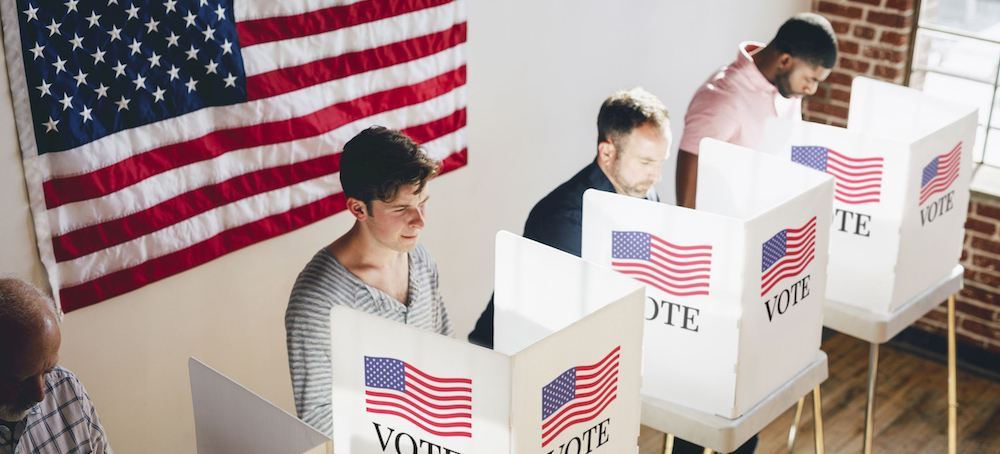 Voters at a polling precinct. (photo: City of Fenton, Michigan)
DURING HIS STATE OF THE UNION ADDRESS on February 24, President Donald Trump asked Congress to “stop illegal aliens and others who are unpermitted persons from voting in our sacred American elections. The cheating is rampant in our elections. It’s rampant.”
The accusation that there is rampant cheating in our election is dramatic, alarming, and oft-repeated. It is also totally false.
After years of audits, recounts, lawsuits, academic studies, and investigations across red states and blue states alike, there is absolutely no evidence—zero—that substantial, outcome-changing voter fraud is present in American elections. There simply isn’t proof.
It turns out that the real fraud is not at the ballot box; it’s claims like the one the president made as he addressed a joint session of Congress.
The president made this fraudulent statement for a reason. Both he and his Republican allies in Congress are trying to advance the SAVE America Act, which they have breathlessly touted as necessary to protect our elections from “rampant” fraud.
But the bill, which would place excessive new ID requirements for voting—in the process effectively disenfranchising many lawful voters—is based upon the entirely phony premise that there is a massive fraud problem to be fixed.
Every study, every lawsuit, every audit, every recount has reached the same conclusion: You are about 13,000 times more likely to be struck by lightning than to find a fraudulent vote by an undocumented immigrant.
Last year, for example, the right-leaning Heritage Foundation updated its database of voter fraud by state between 1982 and 2025. After laboring mightily, they pinpointed 1,620 cases in the entire country during the last forty-four years out of a total of more than two billion votes cast. And how many of those cases involved undocumented immigrants trying to vote? Ninety-nine. You read that right, ninety-nine out of two billion. (Those odds—99/2,000,000,000—are three orders of magnitude longer than the National Weather Service’s estimated 1/15,300 odds of being struck by lightning at some point during an eighty-year lifespan.)
Let’s look at my state of Maine. We have Election Day registration, no voter ID, no-excuse absentee voting, voting by mail, and dropboxes—in other words, all the voter fraud bogeymen. The Heritage study found two cases of voter fraud there in the past forty-four years, neither of which involved illegal immigrants. Give me a break.
The phrase “rampant voter fraud” suggests something widespread, systemic, decisive. Yet every serious investigation into this claim has come up empty. Courts have dismissed sweeping allegations for lack of evidence. (Trump was 1 for 62 in lawsuits alleging voting irregularities in the 2020 election.) Recounts have confirmed results with only minor numerical adjustments. Post-election audits consistently show extremely high accuracy rates. Republican secretaries of state, Democratic governors, and federal judges appointed by presidents of both parties have all acknowledged the same reality: There is no evidence of significant, coordinated voter fraud sufficient to alter election outcomes.
But the drumbeat continues and plenty of people seem to be marching to it.
If you convince people that the system is rotten, you do not need to prove it. Repetition can substitute for evidence. Suspicion can substitute for fact. The more frequently a claim is made, the more normal it sounds.
BUT HERE IS THE REAL DANGER: Democracy depends not only on secure systems, but on public trust in those systems. When leaders and commentators repeatedly claim elections are “rigged” without substantiation, they chip away at that trust. Citizens begin to believe their votes do not matter. Election workers—ordinary people volunteering long hours—face harassment and threats. Peaceful transitions of power become contested spectacles. The damage is not theoretical. It is real and measurable. We saw it on January 6, 2021.
Fraud is deception for gain. What do we call it when the public is told, again and again, that their elections are corrupt, despite overwhelming evidence to the contrary? What do we call it when isolated irregularities are inflated into sweeping indictments of the entire system? When normal human error is presented as proof of conspiracy?
We should call this “voter fraud fraud” what it is: a massive effort to mislead the people in order to justify taking over our elections and manipulating the results.
The SAVE America Act is a solution in search of a problem. Instead of fixing the nonexistent problem of “rampant voter fraud,” it would create real-life barriers to everyday Americans trying to exercise one of their most fundamental rights as an American citizen: the right to vote.
The bill would require American citizens to show documents like passports or birth certificates to prove their citizenship to register to vote. Other forms of identification, including the REAL ID, wouldn’t be good enough. These same documents would need to be shown anytime you update your voter registration, such as when you move and change your address, or even when you do something as simple as changing your party affiliation. Over 21 million eligible voters lack access to the necessary documents to comply with these requirements. Obtaining these documents costs time—often during working hours—and money, so the SAVE America Act would effectively create a poll tax for tens of millions of Americans.
The bill will also create unnecessary barriers for people who have changed their name. Let’s take one particular American voter, for example: our vice president, JD Vance. Vice President Vance was born James Donald Bowman and later changed his name on his birth certificate to James David Hamel after he was adopted by his stepfather. He again changed his last name to honor his grandmother, who raised him, in 2013. If JD Vance were one of millions of regular American citizens without access to a passport, the SAVE America Act would make it harder for him to prove his citizenship with documents with mismatched names, and make it that much harder for him to register to vote.
Equally problematic, the SAVE America Act would place a massive burden on state and local election officials—many of whom are volunteers trying to serve their community—and impose complicated legal risks. For example, the bill would establish criminal penalties against any election official who registers an applicant who fails to provide the right documentation to prove citizenship. These criminal penalties apply even if the individual is actually an American citizen and the official just makes a clerical error on their paperwork. I worry that this will discourage public-spirited citizens from volunteering to serve at the polls and that it will result in citizens being denied voter registration and, ultimately, their right to vote, because local officials would live in fear of running afoul of these burdensome provisions.
As if all of that weren’t reason enough to oppose the bill, the SAVE America Act would also severely restrict vote by mail, which would have an outsized impact on rural voters. It also requires states to turn over their voter rolls to the Department of Homeland Security to run through the Systematic Alien Verification for Entitlements Program, a program that was rebuilt by DOGE and has already misidentified American citizens as being ineligible to vote. I am worried that DHS will use this opportunity to purge state voter rolls, even further limiting who is able to vote.
The SAVE America Act would be, in short, not just a disaster but a direct assault on one of America’s most sacred principles.
FOR MORE THAN TWO CENTURIES, the United States has conducted elections during wars, depressions, social upheavals, pandemics, and times of intense partisan division. Power has changed hands peacefully between bitter rivals. Razor-thin margins have been recounted, litigated, and resolved within constitutional boundaries. That record does not reflect a fragile sham. It reflects a resilient framework that has endured precisely because it is structured with safeguards. And one of the primary safeguards is the decentralization of the system itself, its management at the local level. The president’s plan to “nationalize” our elections would sweep this all away.
To declare elections illegitimate without compelling evidence is not a defense of democracy—it is an assault on it.
Confidence in elections should be built on facts, not fueled by fear. Citizens deserve honesty about both the strengths and limits of the system. They deserve to know that while no system is flawless, there is no evidence to support the claim that ours is filled with rampant fraud.
The health of a democracy rests on a shared commitment to reality. And the reality here could not be clearer. Substantial voter fraud is not a significant feature of American elections. The far more dangerous threat today is the repeated assertion that it is.


ALSO SEE: Ghoshworld, Bobby Ghosh on Substack
In the days since Iran began raining missiles and drones on American military bases, Israeli cities, and the gleaming towers of the Gulf Arab states, a curious narrative has taken hold in Washington. Administration officials, we are told, were surprised by the ferocity of Tehran’s response. The White House, according to multiple reports, had not anticipated that Iran would strike so broadly, so rapidly, and so damagingly across so many countries simultaneously.
Let us be precise about what this claim requires us to believe. It requires us to believe that the people who planned and authorized a massive joint military operation against Iran — killing its supreme leader on the first day, targeting its nuclear infrastructure, its military command, its navy — did so without any serious reckoning with how Iran would respond.
That they launched what they called “Operation Epic Fury” without having read, or heeded, the library’s worth of analysis — from think tanks, from academics, from their own intelligence services, from their own Gulf allies — that described, in detail, exactly the retaliation that has now materialized.
That is not a failure of intelligence. It is a failure of attention. And there is a word for willful inattention to inconvenient information: ignorance.
Iran has never been shy about its doctrine. For years — decades, really — its officials have stated clearly what they would do if attacked. U.S. military bases in the Gulf are legitimate targets; this was not improvised after the bombs fell on February 28th. Iran’s foreign ministry spokesperson said as much in the immediate aftermath, almost word for word: “All military bases, installations and assets that in any form or manner are being used to help the aggressors are regarded as legitimate targets. We had warned often that if they start war against Iran, that war would not be limited only to Iran.” That last sentence is worth underlining. We warned you. They had, and at length.
The Strait of Hormuz threat was equally well-documented. Iran has threatened the closure of that waterway, through which a fifth of the world’s oil supply passes, every time it felt sufficiently cornered. When Trump ended sanction waivers for Iranian oil importers in 2019, Tehran’s response was to threaten the Strait. It is not a bluff that comes from nowhere; it is a standing card in a hand that Tehran has shown repeatedly. The International Crisis Group has maintained a running tracker of Strait of Hormuz flashpoints for years. The Stimson Center noted, in analysis published before the bombs fell, that Iran had “threatened repeatedly to close the Straits with mines or missiles if a major US attack occurs.” This is not obscure scholarship. It is the working consensus of everyone who has studied Iran with any seriousness.
As for Iran’s willingness to strike the oil and energy infrastructure of its Gulf neighbors, well, there is a word for that, too: precedent. In September 2019, Iranian drones and cruise missiles hit the Aramco processing facilities at Abqaiq and Khurais in eastern Saudi Arabia. The attack knocked out half of Saudi Arabia’s oil production overnight, representing five percent of global supply, and triggered the largest single-day spike in oil prices ever recorded. Washington attributed the strike to Iran. The UN eventually concurred on the origin of the weapons. Anyone — and I do mean anyone — paying attention to that attack understood that Iran had both the capability and the willingness to cripple Gulf energy infrastructure. To claim surprise in 2026 is to pretend 2019 never happened.
And then there was the dress rehearsal of June 2025. When U.S. and Israeli forces struck Iran’s nuclear facilities during the Twelve-Day War, Tehran responded by hitting Al Udeid Air Base in Qatar, the largest American military installation in the Middle East. No casualties that time, the strike was largely symbolic, but Iranian officials were explicit that any future response would be far less restrained. The lesson was there to be learned. Washington apparently filed it away without reading it.
The think-tank community, that much-derided “establishment,” had done the work. The Center for Strategic and International Studies published a detailed analysis of Iran’s retaliation options before the strikes, laying out precisely the scenarios that have since materialized: drone and missile attacks on Gulf bases, disruption of Hormuz shipping, cyber operations. The Middle East Forum’s pre-war assessment listed Iran’s “retaliation playbook” in sequence — “ballistic missiles struck at U.S. bases across the Gulf and at Israeli territory, Hezbollah opened fire from Lebanon, intelligence detected Houthi preparations from Yemen” — and watched it activate almost exactly on schedule. Responsible Statecraft had noted, in blunt terms, that Iran had “repeatedly signaled that U.S. bases in the region are legitimate targets,” citing the memory of the Al Udeid strike as still fresh in the minds of Gulf leaders.
None of this analysis came from fringe voices or contrarian provocateurs. It was the sober, mainstream assessment of serious regional experts. The American foreign-policy community, for all its many sins, has spent decades building up genuine expertise on Iran. That expertise pointed, with remarkable consistency, toward what is now unfolding.
The administration’s own intelligence was equally unambiguous. Pentagon briefings to Capitol Hill stated that Iran was not planning to attack unless struck first, directly contradicting the “imminent threat” justification offered by Secretary of State Marco Rubio. The Defense Intelligence Agency’s 2025 threat assessment said Iran was not producing nuclear weapons. Inside the White House, figures as unlikely as Steve Bannon and Director of National Intelligence Tulsi Gabbard reportedly warned against going to war with Iran. The warnings were not just in think-tank papers and academic journals. They were in the room.
Most damning of all: America’s Gulf allies said all of this to Trump’s face. In January 2026, leaders from Oman, Qatar, Saudi Arabia, and Egypt warned the president directly that an attack on Iran would have devastating consequences for the wider region — consequences that would, they noted, ultimately rebound on the United States. Trump hesitated. And then, when he decided to go ahead six weeks later, he didn’t bother to tell them. The countries whose territory would inevitably bear the brunt of Iranian retaliation — whose cities would be struck, whose airports shuttered, whose energy infrastructure targeted — were not given advance notice of Operation Epic Fury.
The Associated Press, reporting from Cairo, captured the fury of Gulf officials: they were “disappointed,” had been “ignored,” and had explicitly warned Washington of what was coming. A Chatham House analyst said the U.S. appeared to have assumed that American troops and Israel would be the primary targets of Iranian retaliation. “I don’t think they saw that there would be as much exposure to the Gulf,” he said. “This speaks to U.S. short-sightedness.” Defense Secretary Pete Hegseth, in an inadvertent moment of candor, acknowledged that while the exact response was not anticipated, it was “recognised as a possibility.” Senator Chris Murphy, emerging from a closed-door congressional briefing, was less diplomatic: the administration had “no plan” to safely reopen the Strait of Hormuz.
No plan. For the most foreseeable consequence of going to war with Iran.
There is a distinction worth making here between ignorance and surprise. Anyone going to war can be surprised by the enemy’s ingenuity, their speed of adaptation, the fog of battle. These are the inevitable companions of conflict. But to be surprised by the direction of an enemy’s retaliation — by the fact that they retaliate at all, and by the broad outlines of how they do it — requires something more active. It requires the deliberate filtering out of information that contradicts a preferred narrative. In this case, the preferred narrative appears to have been that Iran would fold, or fracture, or that its response would be limited and manageable, the Venezuela model, as one academic sourly put it.
Iran is not Venezuela. It is a large, proud, militarized state with a four-decade record of strategic patience, asymmetric capability, and ideological commitment to resistance. It does not bluff. It absorbs punishment and it retaliates. This is not a matter of cultural mysticism or Oriental inscrutability. It is a matter of documented behavior, stated doctrine, and the long public record of a regime that has made its intentions perfectly legible.
To go to war without absorbing that record is not naivety. It is a choice. Whether that choice was driven by ideological contempt for expert opinion, by Netanyahu’s urgency, or by a president who believes that shock-and-awe is a strategy unto itself, the consequences are the same. American soldiers are dead. Gulf cities are under fire. The Strait of Hormuz is partially closed, and oil markets are convulsing. Allies who were never consulted are now footing a bill they were never given the chance to refuse.
Ignorance, in a private citizen, is sometimes forgivable. In a government that just started a war, it is not. And when the evidence of what was coming was this abundant, this loud, and this accessible — ignorance stops being an excuse. It becomes a verdict.

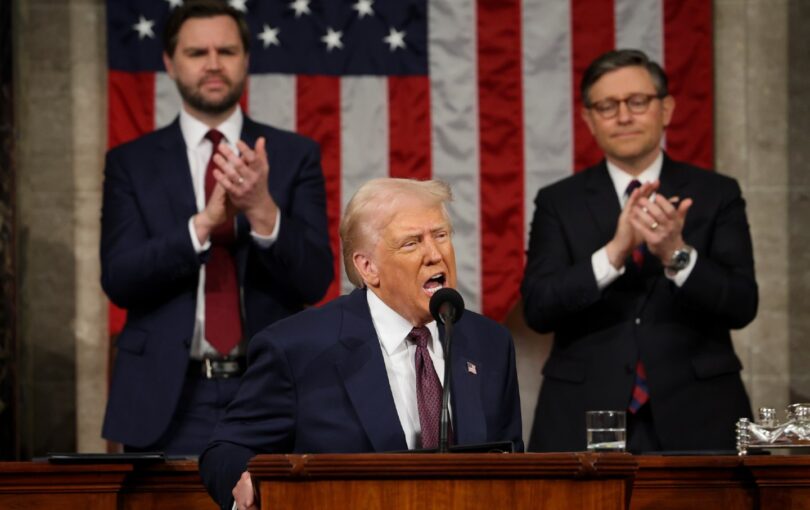
TRUMP ON MID-TERM ELECTION: 'We're going to stop it. We have to stop it.'
Before Trump's State of the Union fades into the oblivion it deserves, we must all read and heed these chilling words from that infamous address...
"The most important line in Trump's State of the Union speech was not about the economy. It came when Trump said, Democrats' policies were 'so bad that the only way they can get elected is to cheat' and added: 'We're going to stop it. We have to stop it.'"
He was signaling that he would use any means necessary to 'prevent the opposition from winning any future election.' It was a 'bald-faced declaration of authoritarian intent,' and a chilling message for the midterms this November."
Zach Beauchamp of Vox quoted in The Week, March 6, 2026

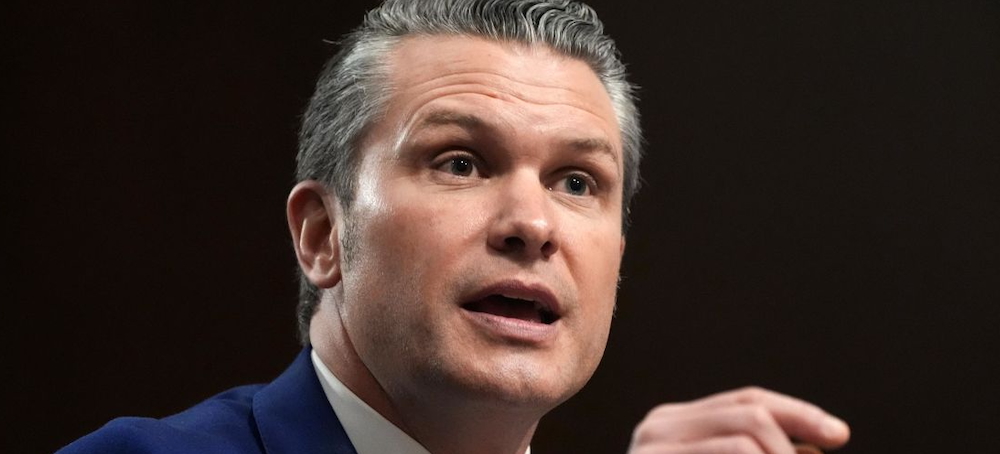 Defense Secretary Pete Hegseth. (photo: Jacquelyn Martin/AP)

Brash and bellicose, he sounded more like a cartoon bully than a sombre statesman. “Death and destruction from the sky all day long,” Pete Hegseth, wearing a red, white and and blue tie and pocket square, bragged to reporters at the Pentagon near Washington. “This was never meant to be a fair fight, and it is not a fair fight. We are punching them while they’re down, which is exactly how it should be.”
Hegseth, 45, a former Fox News TV host who now commands the world’s most powerful military, has this week become the face of Donald Trump’s war in Iran. That has set off alarm bells for critics who warn that the Secretary of Defense – pointedly rebranded “Secretary of War” – has rapidly transformed the Pentagon into the staging ground for an ideological and religious crusade.
With machismo, Christian nationalism and callousness toward the lives of US troops, they say, Hegseth’s puerile displays on TV are aimed at sating Trump’s desire for a warmonger worthy of the manosphere. This was reinforced by a lurid social media video that intersperses clips from Hollywood blockbusters such as Braveheart, Gladiator, Superman and Top Gun with Hegseth and real kill-shot footage of the attacks in Iran.
Janessa Goldbeck, chief executive of Vet Voice Foundation, a nonprofit advocacy organisation, said: “Pete Hegseth is a very dangerous person. He’s a white Christian nationalist and has the arsenal of the United States government at his disposal and a permission slip from President Trump to deploy carnage wherever he wishes against whomever he wishes.”
Hegseth’s rise would have been unthinkable under any other commander-in-chief. Born in Minneapolis, he studied politics at Princeton University and became publisher and editor of the Princeton Tory, a conservative student journal, where he frequently waded into culture-war issues such as feminism and homosexuality.
After leaving Princeton, Hegseth joined the US army national guard as an infantry officer. His service included deployments to Guantánamo Bay in Cuba and tours of Iraq and Afghanistan. He later revealed in a book that he told soldiers under his command in Iraq to ignore legal advice about when they were permitted to kill enemy combatants under their rules of engagement.
Hegseth became chief executive of Concerned Veterans for America, a conservative advocacy group, but departed in 2016 amid allegations of financial mismanagement, sexual impropriety and personal misconduct.
In 2018 Hegseth’s mother, Penelope, sent him an email that said: “You are an abuser of women – that is the ugly truth and I have no respect for any man that belittles, lies, cheats, sleeps around, and uses women for his own power and ego. You are that man (and have been for years) and as your mother, it pains me and embarrasses me to say that, but it is the sad, sad truth.”
Hegseth subsequently became a familiar face on TV as a contributor and co-host of Fox … Friends on Fox News, frequently interviewing Trump and defending his policies. He once wrote that, in the event of a Democratic election win, “the military and police … will be forced to make a choice” and “Yes, there will be some form of civil war”.
But Trump prevailed in 2024 and nominated Hegseth to serve as secretary of defense. At his confirmation hearing, senators raised serious questions about his record: disparaging remarks about women serving in the armed forces; allegations that he drank while on duty; claims of sexual assault and misconduct; his troubled tenure running two small veterans’ nonprofit organisations; and his lack of experience for a post overseeing the world’s most powerful military.
The Senate ultimately split 50–50, forcing the vice-president, JD Vance, to cast the tie-breaking vote. As defense secretary Hegseth has vowed to “unleash overwhelming and punishing violence” on enemies and promised to dispense with “stupid rules of engagement” – rules designed to restrict attacks on civilian populations.
Now, in his first week guiding the nation through a murky new Middle East conflict, Hegseth has largely forgone the solemnity of a traditional defense secretary in favour of the performative antics of a partisan broadcaster revelling in America’s capacity to inflict violence.
For years he had cultivated a hypermasculine “muscleman” aesthetic designed to play to Trump’s sensibilities and the rightwing media ecosystem. Now, faced with a geopolitical crisis that demands nuance and strategic foresight, he appears to many to be out of his depth.
Goldbeck, a Marine Corps veteran who was deployed overseas as a combat engineer officer, commented: “I wish I could say how cavalier, obtuse and hopeless Secretary Hegseth is at leading the Pentagon. I can’t even muster the words to describe his self-adulation, matched only in scope by his apparent moral depravity.”
She added: “Let’s not forget that Pete Hegseth is a former morning-show Fox News TV host, and has this cartoonish persona, speaking what he thinks is tough-guy language, but sounds to me as a veteran and to many of my peers who served in combat like somebody who is completely inept and pretending to have this macho persona.
“Honestly, it’s embarrassing. We know this guy is incompetent. I wouldn’t feel safe leaving Pete Hegseth in charge of putting together a DoorDash order.”
Former White House officials share the concerns. Brett Bruen, president of the public affairs agency Global Situation Room and former global engagement director of the Barack Obama administration, said: “Hegseth is ill-suited for the kind of reassurance and strategy that Americans and our allies need to hear from the Pentagon right now.
“They don’t need a bumper sticker. They don’t need the bravado and the brashness that he brings. They need to know that America’s military is in strong, stable hands and what we have seen in his first couple of war press conferences is an inability to move beyond this Fox personality and into the role of leader of our nation’s military at a time of war.”
During his Pentagon briefing on the war on Wednesday, Hegseth adopted a bombastic tone, saying of Iranian leaders: “They are toast and they know it. Or at least soon enough they will know it. America is winning – decisively, devastatingly and without mercy.”
He bashed “fake news” while addressing the six army reservists killed in an Iranian attack on an operations center in Kuwait. “When a few drones get through or tragic things happen, it’s front-page news. I get it. The press only wants to make the president look bad. But try for once to report the reality. The terms of this war will be set by us at every step.”
The comments provoked uproar for their lack of empathy for America’s fallen. Jeremy Varon, a history professor at the New School for Social Research in New York, said: “That’s outrageous. You have a national effort by all media regardless of partisan bent to memorialise and honour the dead and he sees that simply as a tactic to bring down Trump.”
There was another aspect of Hegseth’s personality barely addressed by the Senate: his sympathy for Christian nationalism. Photos have shown him bearing two tattoos associated with crusader imagery. One depicts the Jerusalem cross – a cluster of five crosses long connected to medieval crusader iconography – on his chest.
Nearby is an image of a sword accompanied by the Latin phrase “Deus vult”, meaning “God wills it”, a slogan historically linked to the crusades and revived in recent years by various far-right groups. It appeared on clothing and flags carried by some participants in the January 6 Capitol attack.
Nor are the references merely symbolic. In his 2020 book, American Crusade, Hegseth wrote that those who benefit from “western civilisation” should “thank a crusader”. The book suggests that democratic politics alone may not suffice to achieve the goals of his political allies, declaring: “Voting is a weapon, but it’s not enough. We don’t want to fight, but, like our fellow Christians one thousand years ago, we must.”
There have been reports of more troubling behaviour. The New Yorker reported that a colleague at Concerned Veterans for America complained that he and another man repeatedly shouted “Kill all Muslims!” during a drunken episode at a bar while travelling for work.
Hegseth has previously endorsed the doctrine of “sphere sovereignty”, a worldview derived from the extremist beliefs of Christian reconstructionism (CR). The philosophy calls for capital punishment for homosexuality and strictly patriarchal families and churches.
The defence secretary attends Pilgrim Hill Reformed Fellowship, a church linked to the Communion of Reformed Evangelical Churches, a denomination co-founded by the pastor Doug Wilson, who has openly advocated a theocratic vision of society in which wives should submit to their husbands and women should be denied the vote. Wilson recently led a worship service at the Pentagon at Hegseth’s invitation.
Robert P Jones, president and founder of Public Religion Research Institute thinktank in Washington, said: “This is not one or two comments. It’s not a kind of one-off behaviour. This is like a longstanding publicly demonstrated orientation that Hegseth has. It’s not just a glorification of violence but a glorification of violence in the name of Christianity and civilisation.”
The Military Religious Freedom Foundation (MRFF) says it has received more than 200 complaints from service members about military commanders invoking extremist Christian rhetoric about biblical “end times” to justify involvement in the Iran war. Such language could also be offensive to Arab allies and provide Iran with the fodder it needs to justify its own holy war against the US.
Jones warned: “It casts this not as anything related to the public – is it about a nuclear programme? Is it about sponsoring terrorism? – which are legitimate political concerns. It takes it out of the realm of politics and casts it as a holy war of a supposedly Christian nation against a Muslim nation.”
Doug Pagitt, a pastor and executive director of the progressive Christian group Vote Common Good, compares Hegseth’s worldview to the historical heresy of Constantine, who allegedly painted a cross on his shield to conquer in the name of God – a theology the broader Christian church has spent centuries trying to distance itself from following the horrors of the Crusades.
Pagitt said: “It seems to me that Pete Hegseth has a worldview, which is contorted toward thinking that this administration has a particular divine calling. He believes – because he said it – that God has uniquely ordained Donald Trump and those that he chooses to accomplish very specific purposes in the world.
“Pete Hegseth’s own version of Christianity is one that’s built around a certain Christian advancement that comes through the domination of the governments of nations. He believes that not only is the military at his disposal to use for his purposes but it’s there to fulfill God’s agenda for the world.”

 A gas station in Baltimore on March 4.

Seven American service members are dead, dozens of Iranian children were murdered by a U.S. missile strike, oil is raining from the skies to poison the air for thousands of people living in Iran following an Israeli missile strike, and oil and gas prices worldwide are surging as the war has led to the blockade of a critical waterway used to transport oil.
But hey, at least we have a new Iranian leader who is in some ways worse than the murderous oppressor whom the United States killed a little over a week ago!
Indeed, Iran announced on Sunday that it replaced Supreme Leader Ayatollah Ali Khamenei with his son Mojtaba Khamenei. The 56-year-old religious cleric lost his mother, wife, and a son, as well as his father, to U.S. strikes.
Given his relative youth, Iran’s new supreme leader could have many years left to rein over the nation with an iron fist. That means we spent billions, lost American lives, and potentially decimated the global economy only to put in someone who may in fact be more extreme than the previous guy who brutally oppressed both dissenters and women.

Axios reported that "Mojtaba is expected to be more hardline than his father, and his ascent means the Iranian regime may get more repressive."
Apparently, regime change in Iran isn't as easy for President Donald Trump as firing people in an episode of "The Apprentice."
Of course, that was obvious if you weren't a half-witted reality TV host who is surrounded by both stupid and evil aides who are egging on your thirst for world domination.
But it was apparently not obvious for Trump, who reportedly thought war with Iran would be easy, consisting of brief strikes to take out the old regime and then an acquiescence from the remaining government figures to choose a new leader more acceptable to Trump—similar to what transpired in Trump's Venezuela invasion.
"Khamenei's son is a lightweight. I have to be involved in the appointment, like with Delcy [Rodriguez] in Venezuela," Trump told Axios on March 5, days before the very “lightweight” Trump spoke of was appointed without Trump’s input.
Ultimately, instead of rolling over as Trump thought Iran would do, it fought back. The country's military launched drone strikes that are dangerous, expensive to thwart, and could expand the war into other Middle Eastern countries. World War III, anyone?
Iran also choked off the Strait of Hormuz—a critical waterway that oil-rich Middle Eastern nations use to transport the commodity around the world. It's led oil prices to surge and in turn caused gas prices to skyrocket, leading Americans to pay much more to fill up their tanks.
“In just a week, consumers have seen gasoline prices surge at one of the fastest rates in years after oil prices spiked following U.S. strikes on Iran and the effective closure of the Strait of Hormuz,” Patrick De Haan, head of petroleum analysis at GasBuddy, wrote in a post on X.
“With additional attacks across the Middle East over the weekend pushing oil above $100 per barrel for the first time in years, fuel markets are now rapidly recalibrating to the risk of prolonged disruption to global supply flows. As a result, gasoline prices in many states could climb another 20 to 50 cents per gallon this week, with price-cycling markets potentially seeing increases as early as today."
This is the opposite of what Americans wanted when they wrongly voted Trump back into office in 2024 under his promise to lower prices and bring peace. So much for that!
It's no wonder that the war—or “short-term experience,” as one House Republican leader ridiculously called it—is so unpopular. Majorities of Americans disapprove of the conflict, with even Trump's own MAGA base angry about their Dear Leader’s decision to launch another Middle East conflict.
The unpopular war threatens to sink the GOP in the November midterms, with voter backlash possibly costing Republicans their majorities in the House and Senate.
Even worse for Republicans—who are spineless cowards refusing to use their power to rein Trump in—is that Trump is dismissing Americans' fears of rising gas prices that will almost certainly lead to another spike in inflation.
"Short term oil prices, which will drop rapidly when the destruction of the Iran nuclear threat is over, is a very small price to pay for U.S.A., and World, Safety and Peace," Trump wrote in a post on Truth Social on Sunday. "ONLY FOOLS WOULD THINK DIFFERENTLY!"
Hear that, voters? Trump says if you think it's bad that you are paying more at the pump you're a fool.
Please use that message in the midterms, Republicans. It’ll go great for you.


