Join us at our brand new blog - Blue Country Gazette - created for those who think "BLUE." Go to www.bluecountrygazette.blogspot.com

YOUR SOURCE FOR TRUTH

Saturday, November 29, 2025

Don't fall for the 'Poor Poor Usha Vance' routine

 Brad Vest/Getty 

VP's wife knew exactly what she was signing up for when she married him

The Week 

Nov. 29, 2025 

Vice President JD Vance might have disrespected his wife's Hindu faith to please conservative Christians, said Renee Graham in The Boston Globe, but don't fall for the "poor poor Usha routine."  

Usha knew she married a "political opportunist and shape-shifter" who hopes to inherit the MAGA movement, and she's going along for the ride. 

People felt sorry for Usha after her husband, a Catholic convert, recently told a cheering crowd at a Turning Point USA event that he hoped that his wife would convert to Christianity.

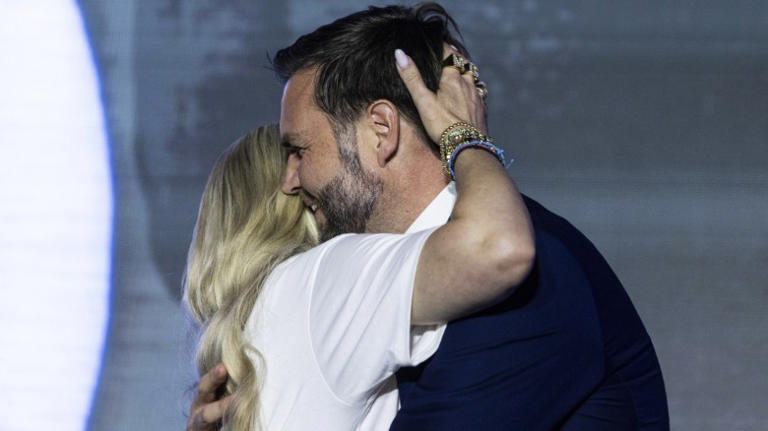
When Vance combined that affront with an "uncomfortably intimate hug" with Charlie Kirk's widow, Erika, the internet exploded with "You in danger, girl" memes.

Usha, however, is no helpless dummy: She's a Yale-trained lawyer who clerked for Supreme Court Chief Justice John Roberts.

As the daughter of Indian immigrants, she has stood by her man through his "disgusting lies" about Haitians eating dogs and cats, and his nativist insistence that only those born in the U.S. are real Americans.  

Perhaps she views her "adjacency to whiteness and power" as protection for herself and her biracial children.  But as the administration wages war on people of color and constitutional rights, "it's America - not Usha Vance - that's in danger."

  Brad Vest/Getty

Wednesday, November 26, 2025

Trump and Hegseth’s Hysterical Reaction to an Ad

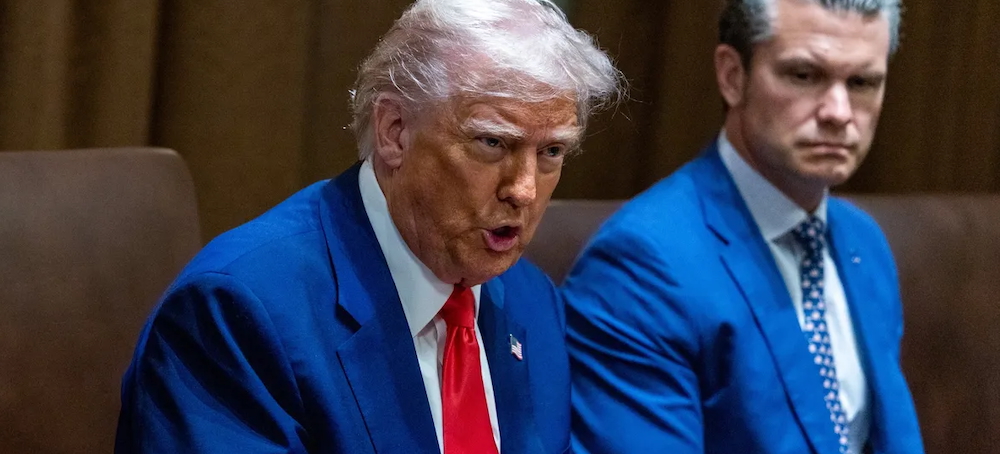
 Trump and Hegseth’s Hysterical Reaction to an Ad Trump and Hegseth during a cabinet meeting at the White House whereat all the cabinet mobsters take turns telling the Godfather what a savior he is.  (photo: Shawn Thew/EPA/Bloomberg)

Are they angry because they intend to use the  military to suppress political dissent?
 
Jonathan Chait / The Atlantic

When a group of Democratic military veterans who serve in Congress released an ad last week urging service members to refuse orders if they are illegal, the Trump administration could have deployed an obvious defense: What are you talking about? We’re not issuing or planning any illegal orders.

Instead, the administration has opted for a rebuttal that is considerably more self-incriminating. President Donald Trump swiftly took to social media to call out these lawmakers for “seditious behavior” that is “punishable by death.” “It is insurrection,” the White House adviser Stephen Miller charged. “It’s a general call for rebellion.”

In light of the administration’s undeclared military campaign in the Caribbean, which has included extralegal strikes against boats that are allegedly smuggling drugs, it might have made sense to let this controversy die down. 

Instead, Pete Hegseth’s self-styled Department of War took to X yesterday to announce that Senator Mark Kelly, a former Navy combat pilot and one of the Democrats who appeared in the ad, will be investigated for a possible court-martial owing to “serious allegations of misconduct.” The post goes on to remind military retirees that they are still subject to the Uniform Code of Military Justice, which prohibits “actions intended to interfere with the loyalty, morale, or good order and discipline of the armed forces.”

It bears noting that the ad does not call for ignoring legal orders. It’s merely a public-service announcement reminding members of the military and the intelligence community of their right to avoid implication in crimes. The ad can be interpreted as a call for rebellion only if the orders coming from above are in fact illegal.

The problem is that the president seems to think that an action is just as long as he calls for it. Trump ran for office in 2016 openly and repeatedly calling for the military to illegally torture prisoners for intelligence purposes. “If I say, ‘Do it,’ they’re going to do it,” he insisted. Though he later conceded that the U.S. is in fact bound by “laws and treaties,” he regularly pardoned service members in his first term who were credibly accused or convicted of war crimes, often against the advice of his own military leadership.

In 2019, Trump reportedly told the head of Customs and Border Protection that he would pardon him for crimes he committed in service of Trump’s immigration-enforcement agenda. He has devoted much of his second term to making good on promises to pardon allies imprisoned for crimes committed in his service. Ed Martin, the U.S. pardon attorney at the Justice Department, publicly articulated this attitude when he claimed, “No MAGA left behind.”

In Hegseth, Trump has found a willing partner. In his book, The War on Warriors, Hegseth argues that the military should enjoy a wide berth to commit war crimes. He came away from his time at Guantánamo Bay firm in the belief that people detained by the military do not deserve due process, and dismisses “the debate about the ‘rights’ of assholes (I mean, ‘detainees’) at Gitmo.” Hegseth goes on to mock the notion that wars should follow rules: “Our enemies should get bullets, not attorneys.”

In sum, the ad’s premise—that the Trump administration’s commitment to the law is less than unshakable—is well-founded.

Why the administration has responded so hysterically to this ad is obvious. Trump and Hegseth do not merely believe that they should be free to give illegal orders and that the rank and file should have to follow them. They are also keen to use the power of the state to suppress political dissent.

In his first term, Trump was rebuffed by top military officials when he suggested the military might shoot peaceful protesters. In his second term, he has placed the Defense Department under Hegseth, whose only qualification is a fanatical partisan loyalty. Hegseth has proceeded to carry out a purge that is driving out suspected non-loyalists, stripping the military of talent and sending a message to remaining officers that the faintest signs of political disloyalty could end their careers.

Trump’s purge of the armed forces and his “l’etat, c’est moi” approach to the law all spring from a single impulse to merge the state with his own interests. An ad instructing members of the military that they serve the United States and its Constitution, and don’t have to act as Donald Trump’s capos, strikes at the heart of his ethos. His demand to punish anybody who merely endorses the Constitution vindicates the charge that he is the document’s greatest enemy.

Take 'em out behind da shed and string 'em up.

Monday, November 24, 2025

'Punishable by DEATH': Deranged Trump calls for Democrats to be killed

  “The President of the United States just called for Democratic members of Congress to be executed. ‘HANG THEM,’ he posted. If you're a person of influence in this country and you haven't picked a side, maybe now would be the time to pick a fucking side,” Sen. Chris Murphy wrote.

"From pardoning MAGA insurrectionists who brought a noose to the Capitol, to urging that members of Congress be hanged, Trump is dangerously spiraling."

President Donald Trump on Thursday accused Democratic lawmakers of sedition and openly called for them to be put to death—employing some of the most vile and incendiary rhetoric he's used to date.

"SEDITIOUS BEHAVIOR, punishable by DEATH!" Trump wrote in a post on Truth Social, referring to a video a group of Democratic lawmakers who served in the military released on Tuesday, in which they urged troops not to follow illegal orders from Trump.

Sens. Elissa Slotkin of Michigan and Mark Kelly of Arizona, along with Reps. Jason Crow of Colorado, Maggie Goodlander of New Hampshire, and Chris Deluzio and Chrissy Houlahan of Pennsylvania said in the video that “No one has to carry out orders that violate the law, or our Constitution.”

“Know that we have your back," the lawmakers said, adding, "don’t give up the ship.”

The video has clearly enraged Trump—who is already feeling cornered after being forced to release the Epstein files. 

He sent out a number of other Truth Social posts slamming the lawmakers, saying in one that the video the Democratic lawmakers released, "is really bad, and Dangerous to our Country."

In yet another Truth Social post, Trump again called the lawmakers' behavior "SEDITIOUS BEHAVIOR AT THE HIGHEST LEVEL," and said that, “Each one of these traitors to our Country should be ARRESTED AND PUT ON TRIAL. Their words cannot be allowed to stand - We won’t have a Country anymore!!! An example MUST BE SET.”

He also reposted an account that called for the lawmakers to be hanged.

Cartoon by Drew Sheneman
“Problem solved” by Drew Sheneman

The Democratic lawmakers did not explicitly say in the video what orders they view as illegal. They are likely referring to the extrajudicial killings Trump is carrying out in the Caribbean Sea, in which he has claimed without evidence that the boats he's having the military blow up are trafficking drugs.

Of course, Trump calling for Democratic lawmakers to be killed is beyond the pale.

But it's especially hypocritical given that he's tried to police speech he views as incendiary, following the death of right-wing podcaster Charlie Kirk.

Democrats slammed Trump's vile behavior.

“The President of the United States just called for Democratic members of Congress to be executed. ‘HANG THEM,’ he posted. If you're a person of influence in this country and you haven't picked a side, maybe now would be the time to pick a fucking side,” Sen. Chris Murphy (D-CT) wrote in a post on X.

“From pardoning MAGA insurrectionists who brought a noose to the Capitol, to urging that members of Congress be hanged, Trump is dangerously spiraling,” Sen. Sheldon Whitehouse (D-RI) wrote in a post on X. “What have Republicans in Congress got to say about this?”

The problem is "Blowin' in the Wind."

Saturday, November 22, 2025

Emails from Prison Show Grisly Ghislaine Maxwell Is Living the Life

 
Thanks to Donald (far left), Ghislaine Maxwell (far right) is serving a 20-year sentence for sex trafficking in a positively posh prison where the warden runs errands for her.  You have to wonder what she really knows.
 
Trump Is Making Sure Epstein Sex Trafficker Is Getting a Lot More Than Extra Toilet Paper in Posh Prison
 
Isaac Stanley-Becker / The Atlantic 
 

The emails that Ghislaine Maxwell has been sending over the past several months from a minimum-security prison near Houston are stamped sensitive but unclassified. Maxwell once cavorted with presidents and royals; now she’s serving a 20-year prison sentence for sex trafficking, convicted of recruiting underage girls for Jeffrey Epstein. Her trajectory is not a happy one.

But the tone of the emails is cheerful. She revels in the privileges she’s been granted since being transferred to a new facility by Donald Trump’s Justice Department, and she expresses optimism about one day freeing herself. 

While telling family of her improved conditions, she remarks that Croatia is one of her favorite vacation destinations. Among the ebullient expressions that appear in the disgraced British socialite’s messages, mostly to her siblings and one of her lawyers: “Yippe skipee” (about her brother’s upcoming visit), “I hear you are a media star!” (in reference to another sibling publicly defending her), and “it gladdens the cockles of my heart” (when she heard from an old friend).

The dozens of emails that I obtained, part of a cache of communications that a nurse at the facility provided to Democrats on the House Judiciary Committee, are notably free of regret, remorse, shame, self-doubt. 

Portions of the emails have been disclosed in recent days, including by NBC News, but the extent of the privileges Maxwell enjoys has not previously been reported. The emails offer a portrait of Maxwell’s relatively comfortable life as the scandal that put her behind bars has gripped Trump in a political vise. 

The problem for the president arises from his administration’s determination to block public access to files about Epstein that he once dangled to the MAGA faithful like some kind of rap sheet for the global elite. This week, he backed down when it became clear that he couldn’t intimidate a sufficient number of Republican lawmakers—grudgingly reversing himself and then claiming credit for legislation compelling the release of the files.

In July, Deputy Attorney General Todd Blanche, who previously served as Trump’s personal defense attorney, took the highly unusual step of visiting Maxwell behind bars. While there, he elicited this exculpatory observation from the Epstein accomplice: “I never witnessed the president in any inappropriate setting in any way.”

Days later, Maxwell was transferred out of a Florida prison, where she had dealt with poor conditions, including “possums falling from the ceiling,” as she would later recount. Her new home was the Federal Prison Camp in Bryan, Texas, a minimum-security facility that Bureau of Prisons guidelines deem inappropriate for sex offenders. 

Since arriving there, she’s benefited from a number of unusual perks, according to the emails as well as people with knowledge of her circumstances who spoke with me on the condition of anonymity.

She is receiving visitors privately, in the prison chapel, instead of in the regular visitation space. Her lawyer has gained authorization from the warden to bring in private electronic equipment, and her legal team has had access to drinks and snacks while working with her. Her privileges extend to more intimate needs. 

Whereas other inmates receive just two rolls of toilet paper a week, and need to either buy more or resort to paper towels when those run out, Maxwell has received a special supply. Her access to communications appears uninterrupted, even when the prison’s main phone lines are down. In August, her brother marveled that they could be in “virtual real time communication.”

Certain benefits may seem more trivial than others, and family members of Maxwell’s fellow inmates told me the scandal is not what she has been allowed, but rather what their loved ones have been denied. 

Local defense attorneys I consulted, including some who have represented inmates at the facility where Maxwell is being held, were most alarmed by the wide-ranging assistance that the warden, Tanisha Hall, appears to be providing Maxwell as she seeks early release. Maxwell has praised the warden in emails to family, saying Hall is “as good as they come.”

What did the warden do to earn Maxwell’s affection? Among other things, the inmate’s emails suggest, Hall provided Maxwell with secretarial services. When a problem with the mail arose in September, as Maxwell worked to find a way out of jail, the warden came up with what the inmate called a “creative solution”—her attorney could scan documents and email them directly to the warden, “and she will scan back my changes!” 

The following month, Maxwell was typing away late one Sunday. She was wading through attachments, and she was “struggling to keep it all together,” she wrote in an email with the subject line “Commutation Application,” suggesting that her team was preparing a direct appeal to Trump. As they worked on their argument, Maxwell told her lawyer that she would transmit relevant records “through the warden.”

Trump, who once socialized with Epstein and Maxwell, hasn’t ruled out a pardon for her. When Maxwell was first arrested, in 2020, Trump told reporters, “I wish her well, whatever it is.” 

Earlier this month, Representative Jamie Raskin, the top Democrat on the House Judiciary Committee, wrote a letter to Trump demanding to know whether his administration had discussed a commutation of Maxwell’s sentence, as well as whether his advisers had arranged for the inmate’s special treatment in prison. “You should not grant any form of clemency to this convicted and unrepentant sex offender,” Raskin wrote. “Your administration should not be providing her with room service, with puppies to play with, with federal law enforcement officials waiting on her every need, or with any special treatment or institutional privilege at all.”

Congressional Democrats have also sought answers from Hall, the warden, who did not respond to my questions. A Bureau of Prisons spokesperson told me in an email that the agency “is committed to maintaining the highest standards of integrity, impartiality, and professionalism in the operation of its facilities,” and that allegations of preferential treatment are “thoroughly investigated.” The most severe repercussions thus far have befallen Noella Turnage, the prison nurse who sent the emails to Raskin’s office and was soon fired. She told me that she was raised in a conservative Republican family and was motivated not by politics but rather by outrage over Maxwell’s own account of her cozy relationship with the warden. In a statement, a Maxwell attorney condemned Raskin for disclosing the correspondence, saying it was the latest example of her client’s “constitutional and human rights being ridden roughshod over.”

Doug Murphy, a prominent Houston-based attorney, likened the warden’s solicitousness with Maxwell to the CEO of a major company dealing directly with a customer’s needs. “It’s way out of the norm,” he told me. He said he could imagine only two possible explanations. The first, which he deemed unlikely, is that the warden has a special relationship with Maxwell. The second is that she was directed by superiors to provide leniency to the convicted sex offender.

“And that would be really concerning,” Murphy said.

When Epstein was arrested on federal sex-trafficking charges, in 2019, not many people outside rarefied social circles knew the name of his former companion. Her father was a British publishing tycoon whose mysterious death in 1991 generated headlines, but that hardly made her a household name. Even when Epstein pleaded guilty to soliciting a minor, in 2008, Maxwell didn’t draw much scrutiny.

That all changed when Epstein was arrested on federal charges and then found dead in his cell at the Metropolitan Correctional Center in Lower Manhattan. Maxwell had withdrawn from public life several years earlier, but she quickly became a stand-in for the legal accountability Epstein had evaded. And, according to prosecutors, she had plenty of culpability in her own right. 

At trial, the government portrayed her as a knowing accomplice to Epstein’s crimes, a predator in her own right who established trust with a ring of girls only to offer them up to Epstein, sometimes participating in the molestation directly. 

Her defense team argued that she was being blamed for things that Epstein did. In 2021, a jury in New York found her guilty of sex trafficking and other charges. The following year, she was sentenced to 20 years in prison.

Maxwell was initially held at a federal detention facility in Brooklyn, but then transferred in the summer of 2022 to a low-security prison in Tallahassee (populated by women convicted of kidnapping and providing material support to terrorism, among other charges). Maxwell complained of poor conditions there, describing the facility as “lawless.” She tried to make do, teaching yoga and Pilates and helping other inmates with legal work.

This past summer, her fortunes began to change as senior members of the Trump administration worked to tamp down a political crisis created when they failed to live up to their own extravagant promises about exposing the monstrous conduct of Epstein and those in his orbit. 

Attorney General Pam Bondi, who had once claimed on cable television to have a client list from Epstein sitting on her desk, said in early July that the government would make no further disclosures from its investigation. Meanwhile, evidence of Trump’s associations with Epstein mounted; The Wall Street Journal reported that Trump had contributed a racy letter to a book compiled by Maxwell for Epstein’s 50th birthday, in 2003.

Amid the fallout, Blanche, the No. 2 at the Justice Department, wrote on social media that he would meet with Maxwell in search of “information about anyone who has committed crimes against victims.” Over the course of a two-day interview in late July, Maxwell said she was unaware of a much-discussed client list and denied knowledge of Epstein’s abuse. 

She also heaped praise on Trump, not only absolving him of improper conduct but also saying, “I admire his extraordinary achievement in becoming the president now. And I like him, and I’ve always liked him.” She said she first met Trump in the early 1990s, through her father, who also “liked him very much.”

FPC Bryan, as Maxwell’s prison is known, houses about 650 women. It’s surrounded by a black fence, not particularly tall or imposing. People locked up inside have been convicted of crimes including embezzlement and fraud. Two of the more well-known inmates are Elizabeth Holmes, the Theranos founder convicted of defrauding investors, and Jen Shah, the former Real Housewives of Salt Lake City star who pleaded guilty to wire fraud.

Maxwell arrived late on the final day of July, receiving her medical check-in outside of normal hours. Other inmates began complaining instantly that she was receiving preferential treatment, including delivery of special meals. 

Hall, the warden, told inmates not to confront or harm her, and threatened to ship them to a harsher facility if they stepped out of line. An inmate who was quoted in the British newspaper The Telegraph saying that she was “absolutely disgusted” by Maxwell’s presence was quickly transferred, the inmate’s attorney, Patrick McLain, told me. 

McLain said it’s “unheard of” for inmates to get the kind of treatment Maxwell is receiving: “Wardens do not get involved with individual prisoners like this.” Maxwell has credited the warden for the conditions at the Texas facility, which she said represents a major improvement over “Tal”—the Tallahassee prison.

“The food is legions better, the place is clean, the staff responsive and polite.” It was safer, too, because “you are not allowed to steal, beat people up and attack them with home made weapons.” She felt she was finally on the right side of “Alice in Wonderlands looking glass,” she wrote to her brother. “I am much much happier.”

Maxwell tried to keep a low profile. She instructed her brother, “You should look like a lawyer visiting me :).” But her attorney at times seemed to delight in the attention she was receiving. She clued Maxwell in on paparazzi outside the prison fence. One of the photographers lying in wait was “one of the best,” she told Maxwell, “if not THE best!”

When she first got to Texas, Maxwell was waiting to find out whether the Supreme Court would hear her case. “I am quietly confident that the Supreme Court case is worthy and valid and has an excellent shot,” she wrote in August. In the meantime, she worked feverishly with her attorney, writing in an email that the warden “would rather that I sent all the updates through her.” In another message, she told her attorney that the warden had records ready for her team to pick up.

She followed other legal proceedings closely. In early October, she remarked on the four-year sentence handed down for the music mogul Sean “Diddy” Combs, who had been convicted on sex-trafficking charges. “Hmm,” she wrote, seeming to suggest that his punishment was lenient compared with hers. Days later, the Supreme Court declined to hear Maxwell’s appeal, making commutation, or some other form of clemency from Trump, her last best hope of relief from her lengthy sentence.

Maxwell wrote cryptically in some of the messages, as if aware that they could one day be disseminated. In one, she expressed concern about a meeting with an unnamed individual, cautioning her attorney, “If something is too good to be true then it isn’t.”

On other matters she was more confident, including her ability to advocate for herself. She seemed to enjoy strategizing with her attorney about her case, like a puzzle that could help her pass the time. She allowed herself optimism about finding a solution. “I have faith,” she wrote.

One day, she imagined, she would not only be released; she might even get her own law license. To that expectation, divulged to her attorney, she appended a playful smiley face.

Trump's hero: She knows where the girls are.

Thursday, November 20, 2025

Despite Congressional Action, Quick and Complete Release of Epstein Files Unlikely

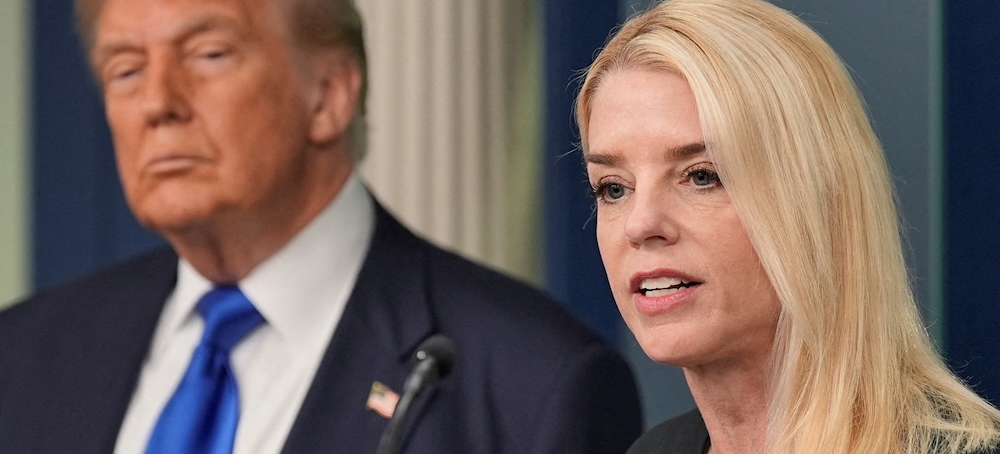
 Despite Congressional Action, Quick Release of Epstein Files Is in DoubtTrump's DOJ lackey Pam Bondi speaks in the White House press briefing room as Donald Trump listens. (photo: Ken Cedeno/Reuters)

 
BRACE YOURSELF: Whatever Is Released Is Sure To Be De-Trumped 
 
Perry Stein, Jeremy Roebuck and Theodoric Meyer / Washington Post


ALSO SEE: House and Senate Both Approve Releasing the Epstein Files by a Near Unanimous Margin

For the past week, official Washington has talked constantly about the Jeffrey Epstein investigation, except for the agency that has custody of the Epstein files.

The Justice Department has been silent.

On Tuesday, the House and Senate agreed to pass a bill calling on Attorney General Pam Bondi to release all unclassified information and files related to the sprawling sex trafficking investigation into the onetime powerful financier.

The Justice Department so far has continued to say nothing about how it would respond to that demand. There are many reasons to doubt that a bulk release of the files is imminent.

If President Donald Trump wanted Bondi to release all of the Epstein files, he could have ordered her to do so at any point in the past six months. He didn’t.

On Sunday, when Trump did an about-face and said House Republicans should vote in favor of releasing the Epstein files, he notably did not say he favored releasing them. Instead, he said in a social media post that the House “can have whatever they are legally entitled to, I DON’T CARE!”

What Congress is “legally entitled to” is a more complicated question than the rhetoric from Capitol Hill might imply.

The legislation that Congress agreed to pass Tuesday gives the Justice Department a few exceptions under which it can refuse to release material. Among them: if release “would jeopardize an active federal investigation or ongoing prosecution.”

On Friday, Trump ordered Bondi to launch a new federal investigation related to Epstein — this one aimed at his ties to several prominent Democrats, including former president Bill Clinton, megadonor Reid Hoffman and former treasury secretary Lawrence H. Summers. Bondi said the top federal prosecutor in New York City would take on the task.

That investigation could become a reason for the Justice Department to block release of many files. Bondi and her deputies have previously said they cannot release information about active investigations.

Other information could be covered by grand jury secrecy rules. The bill Congress agreed to pass does not explicitly waive those.

Bondi has also said many of the files cannot be released because they contain sensitive victim information and pornographic material. The legislation contains another exception allowing the Justice Department to withhold material that “would constitute a clearly unwarranted invasion of personal privacy” or “depicts or contains child sexual abuse.”

There would not be much recourse for Congress if the Justice Department refused to hand over the files since the bill does not have any enforcement teeth.

If the House decided to issue a subpoena demanding the materials, and the Justice Department refused, the chamber’s leaders could refer officials for criminal prosecution. But it would fall to Bondi to decide whether to prosecute herself or her deputies, rendering that threat potentially empty.

On Tuesday, some Republican lawmakers said they were confident that given the legislation, the administration would release the files. Sen. Rand Paul of Kentucky said he hoped the vote in the House was so overwhelming that it would persuade the administration not to block the release of the files.

“I think it’d be a mistake,” Paul said. “If they really try to play games and obscure some of that, I think it’ll really backfire on them.”

Some Democrats were more pessimistic. Sen. Peter Welch of Vermont said he would not be surprised if Bondi refused to release documents because of the investigation she announced last week.

“It would be naive of any of us to think that Trump has really had a conversion,” Welch said, referring to the president’s call for House Republicans to vote for the bill after months of trying to block it. “He does not want the information out.”

Senate Minority Leader Charles E. Schumer of New York said he met with 10 other Senate Democrats on Tuesday evening to discuss ways to press the administration to release the files.

Democrats will do “everything we can to make sure all of it, all of it comes to light and they don’t hide evidence against anyone who might be incriminated by these documents,” Schumer told reporters.

In August, the House subpoenaed the Justice Department demanding the Epstein files. The Justice Department released some files, though that release fueled further public frustration since much of the material had already been made public.

That subpoena, in theory, is still in play, and Congress could attempt to enforce it.

For months, Trump has struggled to contain backlash from within his own party over the Justice Department’s decision this summer not to release the bulk of its investigative file on Epstein. Democrats have accused the president of attempting to hide embarrassing material documenting his years-long friendship with the disgraced financier.

Trump has said that he knew Epstein socially in Palm Beach, Florida, and that they had a falling-out in the mid-2000s. Trump’s name appears several times in previously released documents from Epstein’s estate, but the president has maintained that he had “no idea” about Epstein’s criminal behavior. The documents have produced no evidence of wrongdoing by Trump.

Some within the Republican Party have demanded further disclosures, believing the Justice Department is covering up information that could be damaging to the prominent and powerful friends with whom Epstein surrounded himself. Others have questioned the circumstances of Epstein’s 2019 death while in custody awaiting a federal sex trafficking trial. He was found hanged in his cell, and the death was ruled a suicide.

The questions surrounding Trump’s relationship with Epstein reached a fever pitch last week when the House Oversight Committee released thousands of pages of Epstein’s emails, including several in which he referenced his relationship to Trump.

Epstein, Bondi and Trump go way back to the halcyon days of molesting young girls.  Wonder if Bondi's name comes up in the Epstein files? 

Monday, November 17, 2025

A Grift Bubble May Well Collapse America

https://blogger.googleusercontent.com/img/b/R29vZ2xl/AVvXsEiXc7Th2tEXXM6c_3NX4m_WEf13QOSFyxIMFWjsiGg9oKU3ovWShnotmlyXhT0xxPNJ6imrZeloHFhFUNHtXVWQpVlM4JtvYRbPvKAcjYbSIkoykZn2b-JNMoTnl6DqdpeedmS6Yps0xZIu8xNJm-IFzmlL-ilO4JZac0s_Ygg9tI01kMgOUD8aSYcuw9I/s1000/057047-vance-and-trump-081224.jpg

GRIFTERS: "Trump and Vance do not believe in real things like love, law and patriotism." 
 
Timothy Snyder / Substack

ALSO SEE: Timothy Snyder: Thinking About (Substack)

ALSO SEE: Clark Hoyt | Why Trump Gets Away With It

How does a country burst? To answer this questions, it helps to see matters as do the president and the vice-president: from inside a grift bubble.

As I traveled around the United States these last few weeks -- Columbus, Cincinnati, Los Angeles, Seattle, Portland, DC, Boston, Chicago -- , I tried to explain that I worry more about the disintegration of the United States than about a regime change in which Donald Trump exercises autocratic power from coast to coast.

The effort to create authoritarianism is more likely to lead to a breakup of the state than to a total regime change.

This end of the United States is possible, in part, because our president and vice-president think that it is impossible. Because they are inside a grift bubble, they push for authoritarianism in their own interest, without reckoning with the possibility that their actions can wreck the country. For them, America is a limitless passive resource.

Your perspective is probably different than theirs. To help us understand this risk, it helps to try to see the world from inside a grift bubble.

Imagine that you are a first-rate grifter: the president of the United States, say. Your grift is that you pretend to be a successful businessman, and use that supposed expertise to make your case for the presidency, which office you then use to make money. 

Or imagine instead that you are the vice-president. Your grift is that you claim to understand poor people, whose problems, you say, are the fault of gays, immigrants, and billionaires; and then you rise to power thanks to the money and support of a gay immigrant billionaire.

Given that these are their shticks, and that they have worked, you can see how Trump and Vance might conclude that Americans are gullible and that all things are possible.

The initial claim, the wild lie, is like the air the gets a balloon started: Trump is a rich person; Vance cares about the poor people. The big lies work! And then there is more lying, more hot air, a growing space, a sense of comfort, a safe space for fascist oligarchy.

You grift on and you grift on, and the bubble just gets bigger. It seems like you know everything that you need to know, and that the grift, the graft, and the gruffety-gruff can go on forever. When you have lived for a long time inside a grift bubble, you think you have seen it all, but this is not the case. From inside a grift bubble, you do not see the outside.

You do not grasp that your grift actually depends upon something larger, something better, which it is sapping, weakening, bringing to ruin.

You have fooled the world, and so you think that you understand it. Indeed, as a grifter, you become contemptuous of how other people make their living and live their lives. And yet your knowledge is actually limited. You know things that those outside the grift bubble do not know; but they also know things that you do not know.

You can take away what belongs to people without knowing how they achieved or attained it. The guy who cheats the farmer at the county fair does not know how to farm. The guy who profits from curated crypto scams does not understand the world economy.

Trump and Vance imagine, because it has worked thus far, that they can grift endlessly. They do not understand that their grift depends upon what I will unashamedly call the honest labor and decent convictions of millions of Americans. Were there not Americans who actually worked and cared and tried to live right, there would be nothing and no one to grift.

In an instructive article that he wrote in 1990, the American novelist David Foster Wallace said that cynicism is a form of naïveté. When you dismiss everything, you feel like you can do anything; but then you don’t believe in some things that are real: like love, or law, or patriotism. For you, such things are just tools of the trade, manipulable handles, just the way to enlarge the grift. That they have some other sense, that they are the building blocks of some other reality -- this you do not see. And in that way you are naïve.

Trump and Vance are indeed naïve, in the precise way that corresponds to their cynicism. They think that the United States will continue to exist, for their sake, no matter what they do. From inside the grift bubble, they see only grift, and think they see the whole country. As the bubble grows bigger, they confuse their own profit with the well-being of the whole.

The fact that Trump and Vance do not believe in real things such as love and law and patriotism makes them strong in one way; it makes them weak in another. They cannot foresee the larger consequences, because they do not understand how the world works or how a country is constructed. And as they break things, their naïveté prevents them from seeing what is happening, and indeed forces them to snarl harder -- I suspect that this is why, in some social media thing somewhere, the vice-president lashed out at me on this very point.

And so here we are. The bigger the grift bubble grows, the less healthy material remains beyond it. It sucks away what is productive. As personal connections become the basis of business, the economy slows. It sucks away what is ethical. As corruption comes to seem normal, citizens lose trust in one another. As basic institutions are scorned and destroyed, people cease to believe in the law. The material which builds a nation -- moral, institutional, economic -- starts to give way.

I am worried about the disintegration of the republic for other reasons, of course.

The goal of this administration seems to be to show that government does not work. The appointment of utter incompetents to positions of high authority, the firings of qualified civil servants, and the elimination of crucial agencies -- all this will likely bring epidemics and terror attacks and other disasters. At some point amidst the federal dysfunction the states will have to take on more responsibilities. But why then should their citizens pay taxes to a useless -- but oppressive -- federal government? ICE provoke people who live in cities; that does not mean that cities will concede. The threat to use soldiers against cities will likely create rifts inside the armed forces and the federal government more broadly. We are not so far away, I fear, from some branches of the federal government turning against other branches of the federal government.

Trump also seems to be contemplating a war against Venezuela (or whomever) to distract attention from his activities inside the grift bubble. But any land war, which is what it would take to generate such a distraction, will be difficult and unpredictable. He and Secretary of Defense Pete Hegseth are unfathomably ignorant about modern warfare. Such a move could lead not just to a lot of pointless death but to unpredictable chaos.

All of these factors are connected with the grift bubble. Indeed, they prove its existence. Some of these actions, like the destruction of government agencies, are meant to make grifting easier. Others are designed to generate cover for profiteering and corruption. None of these policies, not one, was made with an eye to something outside the grift bubble. Such actions only make sense to people who are inside the grift and confuse their own position with reality.

The president and vice-president do not know the history of people like themselves, or that of other republics that were needlessly brought down by men of their particular sort. They think that the magic of words will always save them, that there will always be a next grift, that no crisis is so great that it cannot be turned to personal profit. This is true right up until the moment when it is not.

The republic can break, but it need not. Those who work against the grifters, who reinforce the reality beyond the bubble, are doing right. They are not only holding back authoritarianism, but giving the republic a chance. They may be acting from love, or from law, because they know that these things are real. And so they should also know, in acting thus, that they are the patriots.

ONE TRACK MIND: From the mouths of grifters.

Saturday, November 15, 2025

JAMES CARVILLE: “I don’t put anything past him — nothing." Bush and Obama Lawyers Warn Trump Could Challenge 2026 Election Results

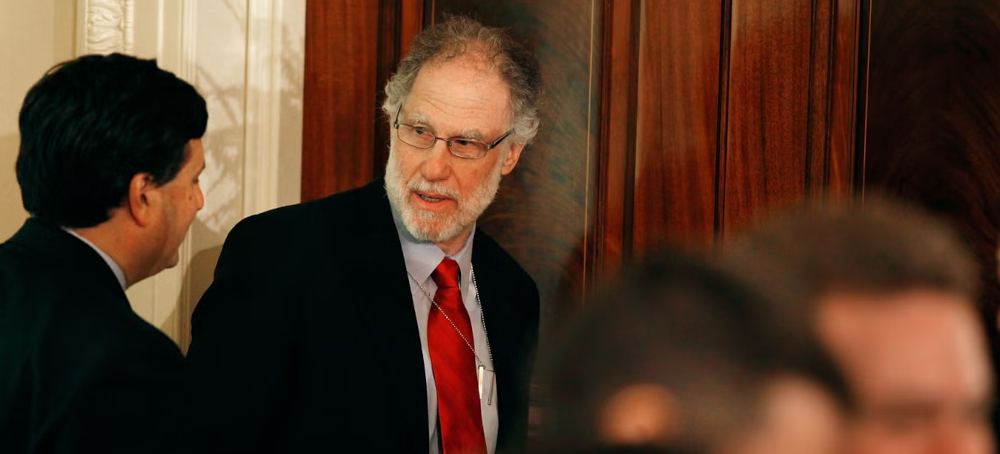
Bush and Obama Lawyers Warn Trump Could Challenge 2026 Election Results if Midterms Don’t Go His Way Bob Bauer (right) served as White House counsel under Democratic President Barack Obama. He joined Jack Goldsmith, who worked for Republican President George W. Bush, in arguing that Trump could dispute the 2026 midterms. (photo: Getty)

‘This prospect must be taken seriously,’ the lawyers for both former Democrat and Republican presidents warn

Brendan Rascius / The Independent 


Government lawyers, who served the Bush and Obama administrations, have warned that President Donald Trump may not take midterm election losses lying down.

Bob Bauer, who served under former President Barack Obama, and Jack Goldsmith, who worked for President George W. Bush, argued that Trump could dispute next year’s election results, which will determine whether or not the Republican party maintains control of Congress.

“His words and actions strongly suggest he may use the formidable powers of the presidency — and possibly even the armed forces — to resist 2026 electoral results he dislikes,” the lawyers wrote in The Economist Wednesday. “This prospect must be taken seriously.”

Bauer and Goldsmith noted that Trump has a history of questioning the legitimacy of election results, pointing to the 2020 win of President Joe Biden, which Trump has frequently described as “stolen” and “rigged.”

And now — less than one year into his second term — Trump seems to be preparing to contest the midterms, which historically have resulted in losses for the president’s party.

As evidence, Bauer and Goldsmith pointed to an August Truth Social post from Trump, in which he promised to “bring HONESTY to the 2026 Midterm Elections” by eliminating mail-in ballots and voting machines.

States, “must do what the Federal Government…tells them, FOR THE GOOD OF OUR COUNTRY…” Trump added.

Trump has also issued an executive order claiming presidential power to impose voting regulations on states, including by mandating proof of citizenship to vote.

This proposed federal takeover of elections “flies in the face of the constitution, which expressly allocates authority over the ‘Times, Places and Manner’ of congressional elections to the states and to Congress,” Bauer and Goldsmith wrote.

So, what could Trump actually do when the midterms roll around? Bauer and Goldsmith argue the president “could order many kinds of federal intervention.”

“As he did in 2020, but with a stronger hand, he could push officials to intervene in states, potentially seizing voting machines,” the lawyers wrote. “He could use federal agencies to demand that states co-operate with his administration’s efforts to detect election fraud. He could intimidate election officials by ordering investigations of claimed irregularities.”

But, the lawyers’ most serious concern is that Trump would invoke the Insurrection Act — which allows the president to suppress unlawful violence — and deploy the military across the country.

“Trump could claim his opponents are obstructing election laws and call in troops to enforce those laws in accordance with his wishes,” they wrote. “Such deployments could occur before, during or after voting begins.

“The integrity of the 2026 election could thus, as in 2020, also depend on the fortitude of state and local officials who administer elections.”

The lawyers did not address the current redistricting effort taking place in a number of states, including Texas and California, which could dramatically alter the balance of power in Congress.

Other commentators have expressed similar concerns about Trump and the midterms, including Democratic strategist James Carville.

“I don’t put anything past him — nothing — to try to call the election off, to do anything he can,” Carville said on a podcast in July.

A White House spokesperson shot back a fiery retort to Fox Digital.

“Trump has taken more action to restore the integrity of our elections on behalf of the American people than any president in modern history,” the spokesperson said. “According to the Democrats, voter fraud doesn’t exist – but clearly they are already searching for copouts preparing to lose big again in the midterms.”


Thursday, November 13, 2025

Epstein bombshells fall ever closer to Donald: "of course he knew about the girls"

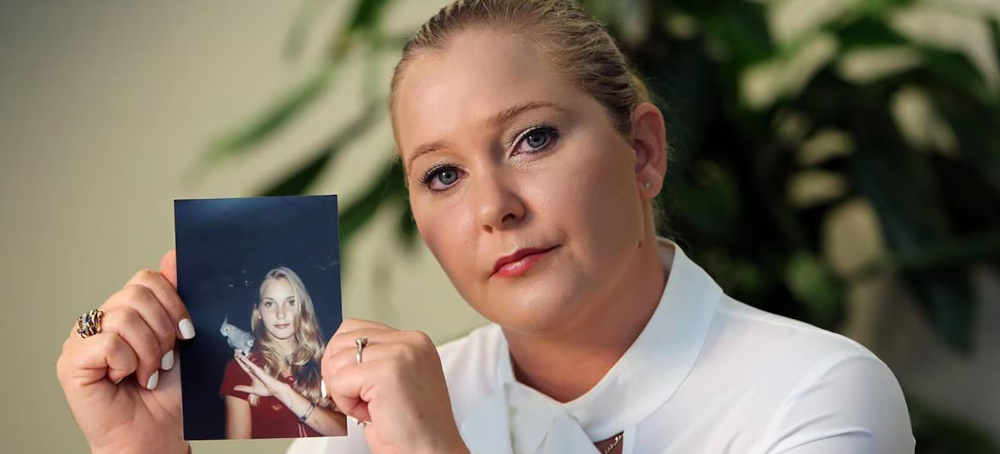
The 'Victim' Trump Spent Hours With at Epstein's House Was Virginia Giuffre  
Donald Trump spent hours with same girl Prince Andrew enjoyed. (photo: Miami Herald)

'Victim' Trump Spent Hours With at Epstein's House Was Virginia Giuffre

Farrah Tomazin / The Daily Beast  

 
Donald Trump spent hours with a sex trafficking victim that Jeffrey Epstein and Ghislaine Maxwell recruited from his Mar-a-Lago club and abused for years.

Moments after explosive new emails suggested the president may have known more about Epstein’s conduct than he has previously acknowledged, MAGA Republicans identified the victim at the heart of the documents as the late Virginia Giuffre, Epstein’s most high-profile survivor.

In one email to Maxwell, which was dated April 2, 2011, Epstein refers to Trump as “the dog that hasn’t barked” and reveals that a certain victim—whose name was redacted in the files—“spent hours at my house with him.”

The emails form part of a cache of documents provided by Epstein’s estate to Democrats on the House Oversight Committee.

However, soon after they were released on Wednesday morning, Republicans on the committee posted on X: “Why did Democrats cover up the name when the Estate didn’t redact it in the redacted documents provided to the committee? It’s because this victim, Virginia Giuffre, publicly said that she never witnessed wrongdoing by President Trump.

“Democrats are trying to create a fake narrative to slander President Trump,” they added. “Shame on them.”

Giuffre, born Virginia Roberts, was one of the earliest and loudest voices calling for criminal charges against Epstein and his enablers.

She lit a fire under the Epstein scandal in 2011, bringing it into the international spotlight when she alleged that she had been sexually assaulted by Prince Andrew as part of Epstein’s sex trafficking operation.

Her astonishing revelations turned the now-ex prince into Britain’s most tarnished royal, and contributed to him losing his royal titles last month.

Before she died by suicide earlier this year, Giuffre had testified that Maxwell hired her as a masseuse for Epstein after meeting her at Trump’s Mar-a-Lago club, where she worked as a 16-year-old locker room attendant at the resort spa.

Maxwell, a British socialite, spotted Giuffre as she was reading a book about massage therapy. She then offered her a job interview to be a private, traveling masseuse, suggesting it would be a potentially life-changing opportunity.

Giuffre attended the interview at Epstein’s Palm Beach home, where she was introduced to Epstein naked and instructed by Maxwell on how to massage him.

The depraved couple soon made her their sex slave, pressuring her into gratifying not only the disgraced financier but also his friends and associates.

As the firestorm surrounding the Epstein files escalated this year, Trump acknowledged in July that he knew Giuffre from Mar-a-Lago and lamented how Epstein “stole her” from him.

“I think she worked at the spa,” he told reporters at the time. “I think that was one of the people. He stole her.”

“Other people would come and complain, this guy is taking people from the spa,” he added.

“I didn’t know that. And then when I heard about it, I told him, I said: ‘Listen, we don’t want you taking our people—whether it was spa or not spa—I don’t want you to take our people. And he was fine, and then not too long after that, he did it again. And I said: out of here!”

But while the president has long described the Epstein files as a “Democratic hoax,” the new emails raise questions about what he knew and when in relation to Epstein’s sexual conduct.

The documents suggest that Epstein mentioned Trump by name multiple times in private correspondence over the last 15 years.

In another email, written to author Michael Wolff on January 31, 2019, Epstein seems to address Trump’s earlier claim that he asked the sex offender to resign his membership at the president’s Mar-a-Lago Club.

“trump said he asked me to resign,” Epstein wrote, adding, “never a member ever. . of course he knew about the girls as he asked to Ghislaine to stop.”

The president did not receive or send any of the messages, nor has he been accused of any criminal wrongdoing in connection with Epstein or Maxwell.

However, the latest revelations are certain to inflame tensions about the administration’s handling of the Epstein files and the decision by Trump’s Department of Justice to renege on a pledge to fully release them.

House Oversight Committee ranking member Robert Garcia said the emails formed part of about 23,000 documents they received from Epstein’s estate in the last few days, and more would be released later today.

Britt Jacovich, spokesperson for progressive group MoveOn Civic Action, said: “It’s no wonder why Trump and Republicans have spent weeks hiding the Epstein emails and files from the public. This is textbook corruption.

“Just as Trump promised on the campaign trail, the American people deserve to know who enabled Jeffrey Epstein’s abuses and his victims deserve justice. Release the Epstein files.”

White House press secretary Karoline Leavitt described the latest Esptein firestorm as a “hoax” designed to distract from the president’s achievements.

“The Democrats selectively leaked emails to the liberal media to create a fake narrative to smear President Trump. The ‘unnamed victim’ referenced in these emails is the late Virginia Giuffre, who repeatedly said President Trump was not involved in any wrongdoing whatsoever and “couldn’t have been friendlier” to her in their limited interactions,” she said.

From the mouths of babes - literally.

Tuesday, November 11, 2025

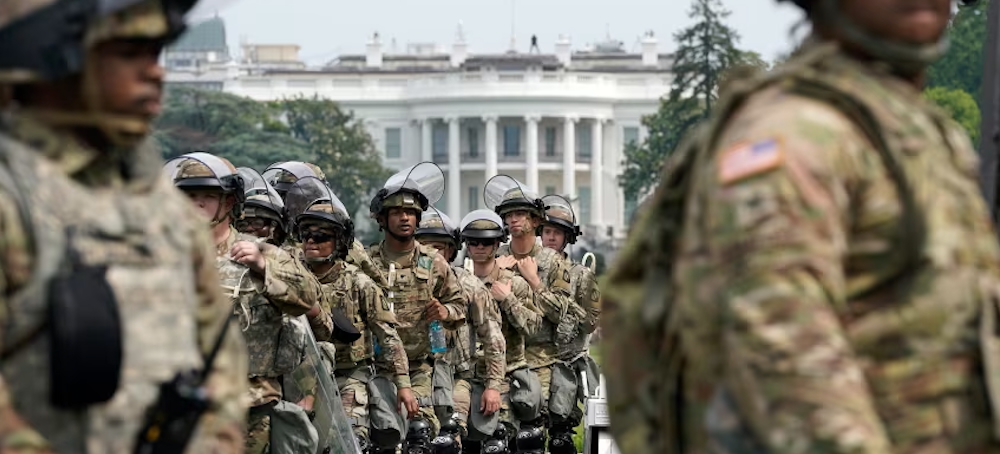
More and More National Guard Members Question Trump Deployments

In an Encrypted Group Chat, National Guard Members Question Trump Deployments 
National Guard members near the White House. (photo: Drew Angerer/Getty Images)
 
'This is just not what any of us signed up for' 
 
'I swore an oath to the Constitution, not a person.' 
 
Kat Lonsdorf / NPR 

As President Trump calls for National Guard deployments across the U.S., a small contingent of Ohio guard members has been quietly expressing concern in an encrypted group chat.

The administration started sending troops into several Democratic-led cities this summer, citing the need to crack down on violent crime and protect federal immigration facilities. 

The Ohio guard members now say they're alarmed at the turn the country is taking. They're even questioning their potential role in it.

"I really went to a dark place when they sent the troops to [Los Angeles], and then eventually [Washington, D.C.], and now, Chicago. This is just not what any of us signed up for, and it's so out of the scope of normal operations," says J, a member of the Ohio National Guard who spoke to NPR on condition of anonymity.

In the summer, Trump sent troops into Los Angeles as anti-ICE protests escalated. He then deployed guard troops into D.C., where around 2,300 still regularly patrol streets. Then a torrent of plans for deployments came — Chicago, Portland, Memphis, cities in Louisiana and Missouri. Many of them remain embroiled in legal limbo.

In Ohio, J and several other members have taken to that group chat to discuss the deployments and the accompanying anxiety they've felt. J, as well as members C and A — all part of the same unit — agreed to talk to NPR on the condition that they are only identified by their first initials, because they are not authorized to talk to the press and fear retribution for expressing their opinions.

"I have been on two humanitarian-esque missions with the guard, which were awesome, doing the things you see on the commercial, helping these communities," says J. "And then you want me to go pick up trash and dissuade homeless people in D.C. at gunpoint. Like, no dude. It's so disheartening every time I see another city — and I just wonder, 'who's going to stand up to this?'"

It's a sentiment that's building with guard members elsewhere.

In recent weeks, more than 100 active military members have reached out to About Face, a nonpartisan nonprofit made up of current service members and post-9/11 veterans to be a resource for those who might be questioning their deployments, according to the organization.

"In the military culture, it's really easy to feel like if you have questions or dissent, you're the only person who thinks that," says director Brittany Ramos DeBarros, a combat veteran who served in Afghanistan.

The group has started an information campaign, specifically targeting members of the National Guard around the country — using flyers, posters, even billboards — encouraging them to reach out if they're having doubts.

"We take very seriously making sure that people do understand what they could be facing if they follow their conscience," says DeBarros. "But the thing we also help people think through is, what is the cost of not following your conscience? Because as Iraq and Afghanistan vets in particular, many of us are living with that cost every day."

NPR reached out to both the White House and the Pentagon for this story.

"Our great National Guardsmen signed up to defend the nation and serve the American people," wrote Pentagon Press Secretary Kingsley Wilson in a statement. "We are proud of the work they have accomplished this year, and we are confident in their collective ability to carry out any and all orders by President Trump, the Department of War, and state leaders."

White House spokesperson Abigail Jackson defended the deployments, saying Trump was using his "lawful authority to protect federal assets and personnel." Jackson lashed out at Democratic leaders, saying they'd failed to stop violent attacks on law enforcement.

The group chat

The group chat with the Ohio National Guard members — set up on the encrypted messaging app Signal — began amid the flurry of executive orders President Trump signed as he took office. Some of them affected the military. The members say they needed a space to process it.

"It's not even necessarily expressing opinions or anything. It's just expressing questions about things that come out," says A.

They say the chat is active every day, with members sharing information and news articles they come across. In recent months, that chat has grown to a dozen members of their unit, and it's become largely focused on Trump's rhetoric around the National Guard and his deployments of troops to several cities.

Ohio's Republican Gov. Mike DeWine has agreed to send troops to support the administration's efforts; there are about 150 in DC right now.

That voluntary directive has come to this unit. None of the three took it. They say the orders themselves were uncharacteristically vague.

"What exactly are we going to be doing? Are we going to have leave? And those answers aren't very clear — but in the past, it's always been very clear," says A. "Anywhere that we go, there's crucial information that we get about the why behind it. And whenever we don't get that, especially for these city moves, members ask questions."

Growing anti-guard sentiment

A joined the guard to pay for college. J was looking for direction in life. And C felt the pull of the benefits that the guard offers and to serve her country. All three have served for years, even decades.

The three say they are grappling with whether to leave the guard, and end their military careers.

"The only reason I want to finish my current contract is just because I feel like there's weight to what I do and say right now, and I just want to use that to do some good," says J.

C says she has been proud of her military career and how she has served — noting that she's served on missions that she didn't necessarily agree with before. But she worries these deployments could change that. She says she's spent a lot of time thinking about what line she won't cross.

"I've been in therapy. Lots of therapy has taken me to the point where at least I can be okay if I have to say goodbye. That sucks. Is this tarnishing my service? Is it undoing everything I thought I was fighting for?" she says.

The three say they've felt anti-guard sentiment from some of their community and in their civilian lives.

"Everything that has been happening is so counter to doctrine, and so counter to what we've been taught," C says.

Their thoughts

The Trump administration has publicly talked about using the National Guard to help with mass deportations and immigration enforcement — something broadly illegal under US law. That bothers the three guard members.

"There is no way I would participate in that," says J. "I just think when everything is said and done, people are going to have to answer for what we're seeing now, and I don't want to be any part of it."

A also says he's been wrestling with what he'd do if made to participate.

"I think, like, establishing those boundaries with yourself: What am I willing to do? What am I willing to give up? And where do I draw those lines?" he says.

The idea of troops patrolling U.S. streets — even if they're only picking up trash — is also problematic for the Ohio guard members.

"It's kind of like fearmongering. People who don't see people in uniform every day, you send 50 of them out to walk their street, it's going to send a message," J says.

DeBarros, the director of About Face, says she knows the tactic well.

"In Afghanistan, we used to regularly carry out what are called presence patrols, where there was no purpose or mission other than to be present in the space and normalizing that we were there," she said. "Letting people know, oh, if you act up, we are here, and we're watching."

C has been thinking a lot about what she's willing to give up and the potential consequences.

"I swore an oath to the Constitution, not a person," she says. "I just really, really implore my peers and everybody outside looking in, to just think about that. Really think about that, and think about what that means. And if there are questions, ask them. Keep talking."