Assassin does not erase what Trump has done, or what he's promised to do.
The man who shot then–Alabama Governor George Wallace wanted to be famous,
and he thought becoming an assassin was the best way to do it.
Dissuaded from reaching then-President Richard Nixon by tight security,
the would-be assassin instead shot the segregationist Democrat several
times during a Maryland campaign stop in 1972. One bullet left Wallace
paralyzed from the waist down for the rest of his life.
The attempted assassination of Wallace, like the attempted
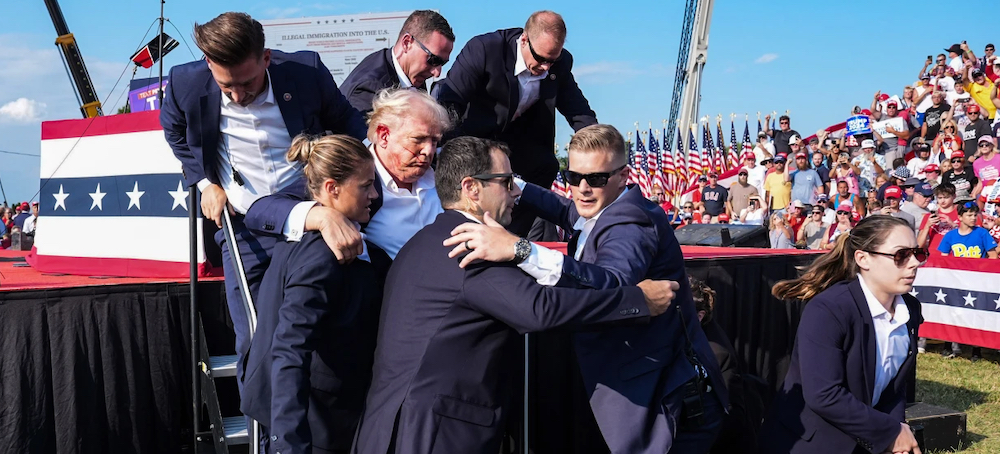
assassination of former President Donald Trump this past weekend, was a
crime against American democracy. It does not matter whether you find
these men admirable or detestable; these are heinous acts all the same,
acts whose consequences reach far beyond their targets.
Democracy can
survive conflict, it can survive vicious disagreement and extreme
rhetoric, it can survive boisterous protest and gratuitous insult. But
there are at least three types of political violence that are
potentially fatal for democracy: violence against voters and organizers,
ethnic violence, and violence against elected officials.
Democracy
simply cannot long endure in a climate where such political violence is
commonplace. To threaten or engage in these acts in a democracy is to
set a fire in a dry field of summer grass—the conflagration can be
contained, or it can rage out of control.
Attempted assassinations, however, do not beatify their targets or
those target's beliefs. The man who tried to kill Wallace did not, by
his evil act, render segregation tolerable or just. This was still the
same George Wallace who sent police to beat civil-rights protesters on the Edmund Pettus Bridge and who said that those who opposed the Vietnam War should be imprisoned for treason.
He was still the George Wallace who cried “Segregation now, segregation
forever!” Wallace’s wounds did not unspeak Wallace’s own public endorsements of political violence against his targets.
The same is true of Trump. In the aftermath of the assassination attempt,
many Republicans and some Democrats have placed the blame for the
shooting on those who oppose Trump as a danger to American democracy,
and have called for that criticism to cease. “When the message goes out
constantly that the election of Donald Trump would be a threat to
democracy and that the republic would end, it heats up the environment,”
Republican House Speaker Mike Johnson said yesterday.
“It’s simply not true. Everyone needs to turn the rhetoric down.”
Democratic Representative Jared Golden of Maine echoed Johnson’s
admonition, saying, “We can start by dropping hyperbolic threats about
the stakes of this election. It should not be misleadingly portrayed as a
struggle between democracy or authoritarianism, or a battle against
fascists or socialists bent on destroying America. These are dangerous
lies.” The cable-news channel MSNBC pulled down its flagship morning
show, CNN reported, over fears that someone on air might criticize a man running for the most powerful office in the world.
The attempted assassination of Trump is a wicked act against the
self-determination of the American people.
It does not erase all the
crimes that Trump himself has committed against that right of
self-determination.
It does not change the fact that Trump was impeached for attempting
to use U.S.-government aid to coerce an ally into falsely implicating a
political rival.
It does not change the fact that the president was impeached a second time
for sending a mob to sack the Capitol in an effort to overturn an
election.
It does not change the fact that Trump fabricated lies about
that election having been stolen, whipping his listeners into a rage
that then propelled them to attempt to overturn the election by force.
It does not change the fact that Trump himself, like Wallace, is a
consistent advocate of political violence whose own supporters have acted on his admonitions in the past, and who has vowed to pardon those who tried to overthrow an election on his behalf. A mob, goaded on by Trump, called for his vice president, Mike Pence, to be lynched for not using authority he didn’t have to overturn an election they lost.
Trump has called for military and civilian prosecutions of his political opponents. He is still planning to assemble a massive armed force aimed at deporting “20 million people,” a number about twice the size of the actual undocumented population, which he sees as “poisoning the blood of the country.”
This will require an immense application of state violence that will
not be limited to undocumented immigrants, but directed at anyone the
state might suspect of being one.
He has already repeatedly shown his
willingness to use state force against protesters, including in at least
one instance against the wishes of local officials. He and those around him are still planning to eviscerate anti-discrimination protections for women, ethnic minorities, and LGBTQ people. He is still the person most directly responsible
for the draconian restrictions on women’s bodily autonomy that force
some mothers to leave their home state just to receive lifesaving
abortions, and he is still planning to empower people who would restrict that autonomy further. He is still planning to purge the federal government of anyone whose loyalty is to the Constitution rather than Trump himself, or who even perceives a distinction between the two.
The crimes of a would-be assassin do not obligate us to ignore what
Trump would do with the power he is demanding. There is no moral
principle that requires people to forget that Trump loyalists, before
accusing Trump critics of maliciously framing Trump as a threat to
democracy, had preemptively proclaimed that they would not accept losing the 2024 presidential election.
Republicans can insist that the attempt on Trump’s life demands a swift
coronation of the aspiring despot who leads their party, but you are
not compelled to obey.
This is a country where gun ownership is a matter of personal
identity for millions, and where the firearm industry has so captured
the political system that virtually any restriction on the sale of guns
that would affect the industry’s bottom line is regarded as
unconstitutional. Under such circumstances, the risk of extremists
engaging in political violence is always high. Although the gunman’s
motivations are not yet known, no political ideology has a monopoly on
extremists who are willing to commit violence in the name of their
beliefs.
On the level of rhetoric, however, there is one political party in
America whose elected officials consistently condemn political violence,
and one party whose leadership has tacitly or explicitly advocated for
it. Yesterday, President Joe Biden gave a speech saying,
“Disagreement is inevitable in American democracy. It’s part of human
nature,” but “politics must never be a literal battlefield, and, God
forbid, a killing field.”
Before this weekend, before Republicans were demanding that criticism
of Trump’s actions and agenda be silenced, and before at least one
media outlet began to comply, Republicans were openly contemplating such
violence. “Some folks need killing! It’s time for somebody to say it.
It’s not a matter of vengeance. It’s not a matter of being mean or
spiteful. It’s a matter of necessity!” the Republican Lieutenant
Governor of North Carolina (and a current gubernatorial candidate) said in early July.
Kevin Roberts, the head of the Heritage Foundation and one of the architects behind Project 2025, declared,
“We are in the process of the second American Revolution, which will
remain bloodless if the left allows it to be.” After Nancy Pelosi’s
husband, Paul, was bludgeoned by a man with a hammer, Trump himself mocked the injured Paul Pelosi, saying, “We’ll stand up to crazy Nancy Pelosi, who ruined San Francisco—how’s her husband doing, anybody know?”
As the writer Parker Molloy notes,
“The same voices who are so quick to decry Democratic rhetoric as
dangerous were often silent—or even supportive—when Trump made
statements that seemed to encourage violence.” Trump’s own rhetoric
about becoming a dictator
has contained the lightly veiled threat of political violence against
his enemies. “Revenge does take time, I will say that,” Trump told the talk-show host Phil McGraw
in response to a softball question intended to offer Trump a chance to
disavow vengeance. “And sometimes revenge can be justified, Phil. I have
to be honest. Sometimes it can.”
Attempting to murder someone running for office is a vicious crime,
not only against the person targeted, but against a political system
that relies on the peaceful transition of power from one faction to
another. This crime does not erase what Trump has done, or what he has
promised to do, any more than the attempted assassination of Wallace
obligated America to reinstate Jim Crow segregation. The fundamental
rights of the American people to choose their leaders and shape their
own fate are not forfeit to the wrongs of one man, whether an assassin
or a president.
That Trump is a victim does not obligate anyone to
forget the millions of people he would make victims if given the
opportunity.


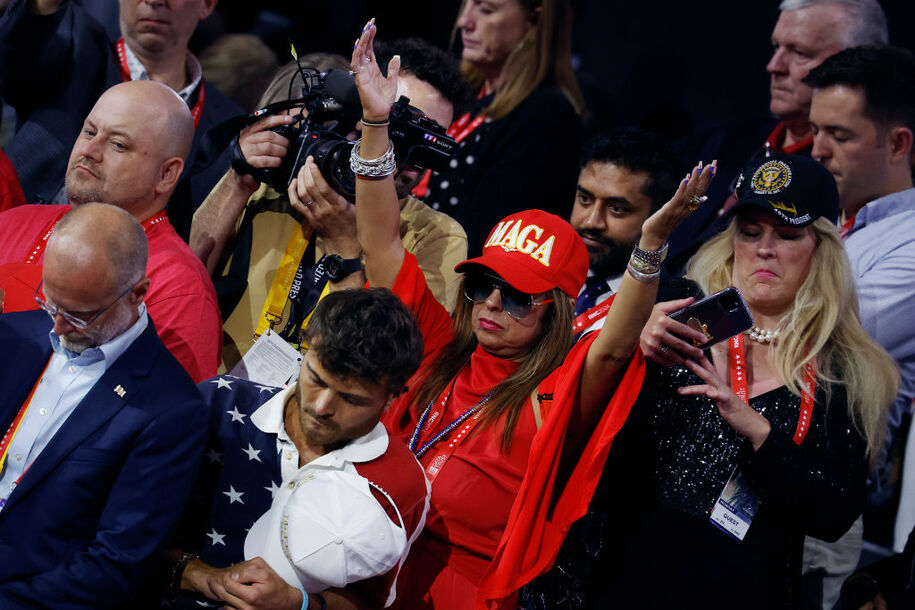 Attendees pray at the close of the first day of the 2024 Republican National Convention in Milwaukee, Wisconsin.





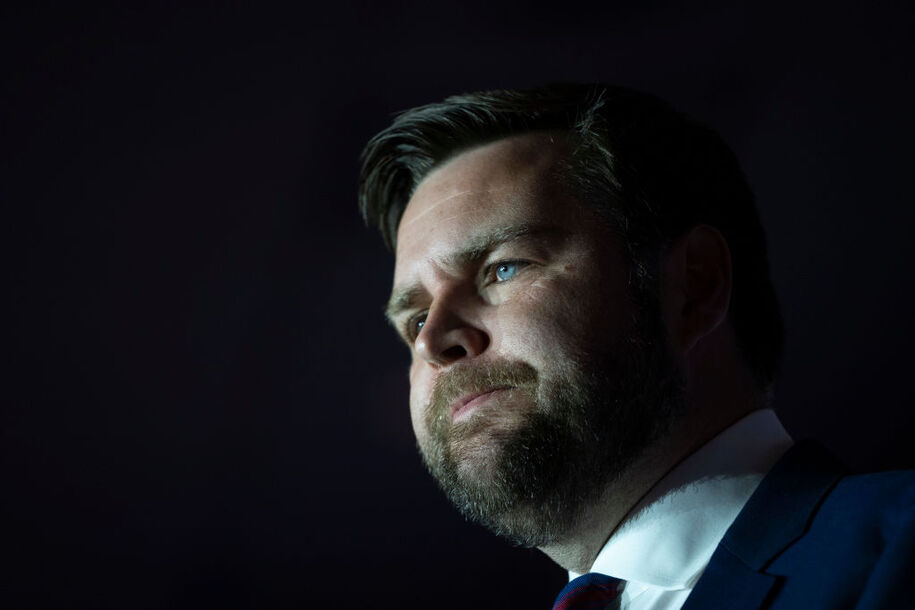



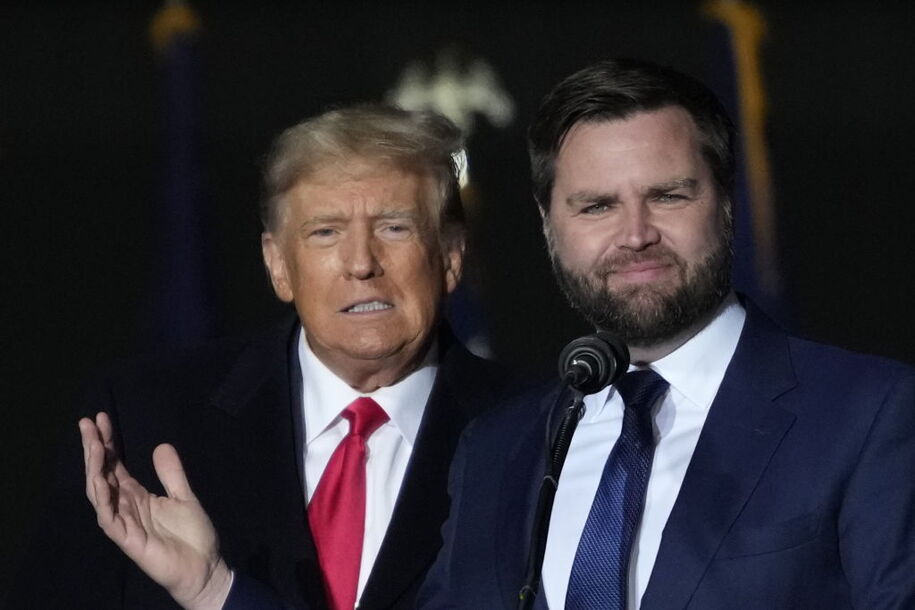 Donald "America's Hitler" Trump and Ohio Sen. J.D. "Bootlicker" Vance


