Join us at our brand new blog - Blue Country Gazette - created for those who think "BLUE." Go to www.bluecountrygazette.blogspot.com

YOUR SOURCE FOR TRUTH

Friday, July 4, 2014

Pitchforks are coming for us Plutocrats

Nick Hanauer in front of a Mc'Donalds. (photo: Robbie McClaran/Redux Pictures)
By Nick Hanauer, Politico
03 July 14

ou probably don’t know me, but like you I am one of those .01%ers, a proud and unapologetic capitalist. I have founded, co-founded and funded more than 30 companies across a range of industries—from itsy-bitsy ones like the night club I started in my 20s to giant ones like Amazon.com, for which I was the first nonfamily investor. Then I founded aQuantive, an Internet advertising company that was sold to Microsoft in 2007 for $6.4 billion. In cash. My friends and I own a bank. I tell you all this to demonstrate that in many ways I’m no different from you. Like you, I have a broad perspective on business and capitalism. And also like you, I have been rewarded obscenely for my success, with a life that the other 99.99 percent of Americans can’t even imagine. Multiple homes, my own plane, etc., etc. You know what I’m talking about. In 1992, I was selling pillows made by my family’s business, Pacific Coast Feather Co., to retail stores across the country, and the Internet was a clunky novelty to which one hooked up with a loud squawk at 300 baud. But I saw pretty quickly, even back then, that many of my customers, the big department store chains, were already doomed. I knew that as soon as the Internet became fast and trustworthy enough—and that time wasn’t far off—people were going to shop online like crazy. Goodbye, Caldor. And Filene’s. And Borders. And on and on.

Realizing that, seeing over the horizon a little faster than the next guy, was the strategic part of my success. The lucky part was that I had two friends, both immensely talented, who also saw a lot of potential in the web. One was a guy you’ve probably never heard of named Jeff Tauber, and the other was a fellow named Jeff Bezos. I was so excited by the potential of the web that I told both Jeffs that I wanted to invest in whatever they launched, big time. It just happened that the second Jeff—Bezos—called me back first to take up my investment offer. So I helped underwrite his tiny start-up bookseller. The other Jeff started a web department store called Cybershop, but at a time when trust in Internet sales was still low, it was too early for his high-end online idea; people just weren’t yet ready to buy expensive goods without personally checking them out (unlike a basic commodity like books, which don’t vary in quality—Bezos’ great insight). Cybershop didn’t make it, just another dot-com bust. Amazon did somewhat better. Now I own a very large yacht.

But let’s speak frankly to each other. I’m not the smartest guy you’ve ever met, or the hardest-working. I was a mediocre student. I’m not technical at all—I can’t write a word of code. What sets me apart, I think, is a tolerance for risk and an intuition about what will happen in the future. Seeing where things are headed is the essence of entrepreneurship. And what do I see in our future now?

I see pitchforks.

At the same time that people like you and me are thriving beyond the dreams of any plutocrats in history, the rest of the country—the 99.99 percent—is lagging far behind. The divide between the haves and have-nots is getting worse really, really fast. In 1980, the top 1 percent controlled about 8 percent of U.S. national income. The bottom 50 percent shared about 18 percent. Today the top 1 percent share about 20 percent; the bottom 50 percent, just 12 percent.

But the problem isn’t that we have inequality. Some inequality is intrinsic to any high-functioning capitalist economy. The problem is that inequality is at historically high levels and getting worse every day. Our country is rapidly becoming less a capitalist society and more a feudal society. Unless our policies change dramatically, the middle class will disappear, and we will be back to late 18th-century France. Before the revolution.

And so I have a message for my fellow filthy rich, for all of us who live in our gated bubble worlds: Wake up, people. It won’t last.

If we don’t do something to fix the glaring inequities in this economy, the pitchforks are going to come for us. No society can sustain this kind of rising inequality. In fact, there is no example in human history where wealth accumulated like this and the pitchforks didn’t eventually come out. You show me a highly unequal society, and I will show you a police state. Or an uprising. There are no counterexamples. None. It’s not if, it’s when.

Many of us think we’re special because “this is America.” We think we’re immune to the same forces that started the Arab Spring—or the French and Russian revolutions, for that matter. I know you fellow .01%ers tend to dismiss this kind of argument; I’ve had many of you tell me to my face I’m completely bonkers. And yes, I know there are many of you who are convinced that because you saw a poor kid with an iPhone that one time, inequality is a fiction.

Here’s what I say to you: You’re living in a dream world. What everyone wants to believe is that when things reach a tipping point and go from being merely crappy for the masses to dangerous and socially destabilizing, that we’re somehow going to know about that shift ahead of time. Any student of history knows that’s not the way it happens. Revolutions, like bankruptcies, come gradually, and then suddenly. One day, somebody sets himself on fire, then thousands of people are in the streets, and before you know it, the country is burning. And then there’s no time for us to get to the airport and jump on our Gulfstream Vs and fly to New Zealand. That’s the way it always happens. If inequality keeps rising as it has been, eventually it will happen. We will not be able to predict when, and it will be terrible—for everybody. But especially for us. 

The most ironic thing about rising inequality is how completely unnecessary and self-defeating it is. If we do something about it, if we adjust our policies in the way that, say, Franklin D. Roosevelt did during the Great Depression—so that we help the 99 percent and preempt the revolutionaries and crazies, the ones with the pitchforks—that will be the best thing possible for us rich folks, too. It’s not just that we’ll escape with our lives; it’s that we’ll most certainly get even richer. 

The model for us rich guys here should be Henry Ford, who realized that all his autoworkers in Michigan weren’t only cheap labor to be exploited; they were consumers, too. Ford figured that if he raised their wages, to a then-exorbitant $5 a day, they’d be able to afford his Model Ts.

What a great idea. My suggestion to you is: Let’s do it all over again. We’ve got to try something. These idiotic trickle-down policies are destroying my customer base. And yours too.

It’s when I realized this that I decided I had to leave my insulated world of the super-rich and get involved in politics. Not directly, by running for office or becoming one of the big-money billionaires who back candidates in an election. Instead, I wanted to try to change the conversation with ideas—by advancing what my co-author, Eric Liu, and I call “middle-out” economics. It’s the long-overdue rebuttal to the trickle-down economics worldview that has become economic orthodoxy across party lines—and has so screwed the American middle class and our economy generally. Middle-out economics rejects the old misconception that an economy is a perfectly efficient, mechanistic system and embraces the much more accurate idea of an economy as a complex ecosystem made up of real people who are dependent on one another.

Which is why the fundamental law of capitalism must be: If workers have more money, businesses have more customers. Which makes middle-class consumers, not rich businesspeople like us, the true job creators. Which means a thriving middle class is the source of American prosperity, not a consequence of it. The middle class creates us rich people, not the other way around.

On June 19, 2013, Bloomberg published an article I wrote called “The Capitalist’s Case for a $15 Minimum Wage.” Forbes labeled it “Nick Hanauer’s near insane” proposal. And yet, just weeks after it was published, my friend David Rolf, a Service Employees International Union organizer, roused fast-food workers to go on strike around the country for a $15 living wage. Nearly a year later, the city of Seattle passed a $15 minimum wage. And just 350 days after my article was published, Seattle Mayor Ed Murray signed that ordinance into law. How could this happen, you ask?

It happened because we reminded the masses that they are the source of growth and prosperity, not us rich guys. We reminded them that when workers have more money, businesses have more customers—and need more employees. We reminded them that if businesses paid workers a living wage rather than poverty wages, taxpayers wouldn’t have to make up the difference. And when we got done, 74 percent of likely Seattle voters in a recent poll agreed that a $15 minimum wage was a swell idea.

The standard response in the minimum-wage debate, made by Republicans and their business backers and plenty of Democrats as well, is that raising the minimum wage costs jobs. Businesses will have to lay off workers. This argument reflects the orthodox economics that most people had in college. If you took Econ 101, then you literally were taught that if wages go up, employment must go down. The law of supply and demand and all that. That’s why you’ve got John Boehner and other Republicans in Congress insisting that if you price employment higher, you get less of it. Really?

Because here’s an odd thing. During the past three decades, compensation for CEOs grew 127 times faster than it did for workers. Since 1950, the CEO-to-worker pay ratio has increased 1,000 percent, and that is not a typo. CEOs used to earn 30 times the median wage; now they rake in 500 times. Yet no company I know of has eliminated its senior managers, or outsourced them to China or automated their jobs. Instead, we now have more CEOs and senior executives than ever before. So, too, for financial services workers and technology workers. These folks earn multiples of the median wage, yet we somehow have more and more of them.

The thing about us businesspeople is that we love our customers rich and our employees poor. So for as long as there has been capitalism, capitalists have said the same thing about any effort to raise wages. We’ve had 75 years of complaints from big business—when the minimum wage was instituted, when women had to be paid equitable amounts, when child labor laws were created. Every time the capitalists said exactly the same thing in the same way: We’re all going to go bankrupt. I’ll have to close. I’ll have to lay everyone off. It hasn’t happened. In fact, the data show that when workers are better treated, business gets better. The naysayers are just wrong.

Most of you probably think that the $15 minimum wage in Seattle is an insane departure from rational policy that puts our economy at great risk. But in Seattle, our current minimum wage of $9.32 is already nearly 30 percent higher than the federal minimum wage. And has it ruined our economy yet? Well, trickle-downers, look at the data here: The two cities in the nation with the highest rate of job growth by small businesses are San Francisco and Seattle. Guess which cities have the highest minimum wage? San Francisco and Seattle. The fastest-growing big city in America? Seattle. Fifteen dollars isn’t a risky untried policy for us. It’s doubling down on the strategy that’s already allowing our city to kick your city’s ass.

It makes perfect sense if you think about it: If a worker earns $7.25 an hour, which is now the national minimum wage, what proportion of that person’s income do you think ends up in the cash registers of local small businesses? Hardly any. That person is paying rent, ideally going out to get subsistence groceries at Safeway, and, if really lucky, has a bus pass. But she’s not going out to eat at restaurants. Not browsing for new clothes. Not buying flowers on Mother’s Day.

Is this issue more complicated than I’m making out? Of course. Are there many factors at play determining the dynamics of employment? Yup. But please, please stop insisting that if we pay low-wage workers more, unemployment will skyrocket and it will destroy the economy. It’s utter nonsense. The most insidious thing about trickle-down economics isn’t believing that if the rich get richer, it’s good for the economy. It’s believing that if the poor get richer, it’s bad for the economy.

I know that virtually all of you feel that compelling our businesses to pay workers more is somehow unfair, or is too much government interference. Most of you think that we should just let good examples like Costco or Gap lead the way. Or let the market set the price. But here’s the thing. When those who set bad examples, like the owners of Wal-Mart or McDonald’s, pay their workers close to the minimum wage, what they’re really saying is that they’d pay even less if it weren’t illegal. (Thankfully both companies have recently said they would not oppose a hike in the minimum wage.) In any large group, some people absolutely will not do the right thing. That’s why our economy can only be safe and effective if it is governed by the same kinds of rules as, say, the transportation system, with its speed limits and stop signs.

Wal-Mart is our nation’s largest employer with some 1.4 million employees in the United States and more than $25 billion in pre-tax profit. So why are Wal-Mart employees the largest group of Medicaid recipients in many states? Wal-Mart could, say, pay each of its 1 million lowest-paid workers an extra $10,000 per year, raise them all out of poverty and enable them to, of all things, afford to shop at Wal-Mart. Not only would this also save us all the expense of the food stamps, Medicaid and rent assistance that they currently require, but Wal-Mart would still earn more than $15 billion pre-tax per year. Wal-Mart won’t (and shouldn’t) volunteer to pay its workers more than their competitors. In order for us to have an economy that works for everyone, we should compel all retailers to pay living wages—not just ask politely.

We rich people have been falsely persuaded by our schooling and the affirmation of society, and have convinced ourselves, that we are the main job creators. It’s simply not true. There can never be enough super-rich Americans to power a great economy. I earn about 1,000 times the median American annually, but I don’t buy thousands of times more stuff. My family purchased three cars over the past few years, not 3,000. I buy a few pairs of pants and a few shirts a year, just like most American men. I bought two pairs of the fancy wool pants I am wearing as I write, what my partner Mike calls my “manager pants.” I guess I could have bought 1,000 pairs. But why would I? Instead, I sock my extra money away in savings, where it doesn’t do the country much good.

So forget all that rhetoric about how America is great because of people like you and me and Steve Jobs. You know the truth even if you won’t admit it: If any of us had been born in Somalia or the Congo, all we’d be is some guy standing barefoot next to a dirt road selling fruit. It’s not that Somalia and Congo don’t have good entrepreneurs. It’s just that the best ones are selling their wares off crates by the side of the road because that’s all their customers can afford.

So why not talk about a different kind of New Deal for the American people, one that could appeal to the right as well as left—to libertarians as well as liberals? First, I’d ask my Republican friends to get real about reducing the size of government. Yes, yes and yes, you guys are all correct: The federal government is too big in some ways. But no way can you cut government substantially, not the way things are now. Ronald Reagan and George W. Bush each had eight years to do it, and they failed miserably.

Republicans and Democrats in Congress can’t shrink government with wishful thinking. The only way to slash government for real is to go back to basic economic principles: You have to reduce the demand for government. If people are getting $15 an hour or more, they don’t need food stamps. They don’t need rent assistance. They don’t need you and me to pay for their medical care. If the consumer middle class is back, buying and shopping, then it stands to reason you won’t need as large a welfare state. And at the same time, revenues from payroll and sales taxes would rise, reducing the deficit.

This is, in other words, an economic approach that can unite left and right. Perhaps that’s one reason the right is beginning, inexorably, to wake up to this reality as well. Even Republicans as diverse as Mitt Romney and Rick Santorum recently came out in favor of raising the minimum wage, in defiance of the Republicans in Congress. 

One thing we can agree on—I’m sure of this—is that the change isn’t going to start in Washington. Thinking is stale, arguments even more so. On both sides. 

But the way I see it, that’s all right. Most major social movements have seen their earliest victories at the state and municipal levels. The fight over the eight-hour workday, which ended in Washington, D.C., in 1938, began in places like Illinois and Massachusetts in the late 1800s. The movement for social security began in California in the 1930s. Even the Affordable Health Care Act—Obamacare—would have been hard to imagine without Mitt Romney’s model in Massachusetts to lead the way.

Sadly, no Republicans and few Democrats get this. President Obama doesn’t seem to either, though his heart is in the right place. In his State of the Union speech this year, he mentioned the need for a higher minimum wage but failed to make the case that less inequality and a renewed middle class would promote faster economic growth. Instead, the arguments we hear from most Democrats are the same old social-justice claims. The only reason to help workers is because we feel sorry for them. These fairness arguments feed right into every stereotype of Obama and the Democrats as bleeding hearts. Republicans say growth. Democrats say fairness—and lose every time.

But just because the two parties in Washington haven’t figured it out yet doesn’t mean we rich folks can just keep going. The conversation is already changing, even if the billionaires aren’t onto it. I know what you think: You think that Occupy Wall Street and all the other capitalism-is-the-problem protesters disappeared without a trace. But that’s not true. Of course, it’s hard to get people to sleep in a park in the cause of social justice. But the protests we had in the wake of the 2008 financial crisis really did help to change the debate in this country from death panels and debt ceilings to inequality.

It’s just that so many of you plutocrats didn’t get the message.

Dear 1%ers, many of our fellow citizens are starting to believe that capitalism itself is the problem. I disagree, and I’m sure you do too. Capitalism, when well managed, is the greatest social technology ever invented to create prosperity in human societies. But capitalism left unchecked tends toward concentration and collapse. It can be managed either to benefit the few in the near term or the many in the long term. The work of democracies is to bend it to the latter. That is why investments in the middle class work. And tax breaks for rich people like us don’t. Balancing the power of workers and billionaires by raising the minimum wage isn’t bad for capitalism. It’s an indispensable tool smart capitalists use to make capitalism stable and sustainable. And no one has a bigger stake in that than zillionaires like us.

The oldest and most important conflict in human societies is the battle over the concentration of wealth and power. The folks like us at the top have always told those at the bottom that our respective positions are righteous and good for all. Historically, we called that divine right. Today we have trickle-down economics.

What nonsense this is. Am I really such a superior person? Do I belong at the center of the moral as well as economic universe? Do you?

My family, the Hanauers, started in Germany selling feathers and pillows. They got chased out of Germany by Hitler and ended up in Seattle owning another pillow company. Three generations later, I benefited from that. Then I got as lucky as a person could possibly get in the Internet age by having a buddy in Seattle named Bezos. I look at the average Joe on the street, and I say, “There but for the grace of Jeff go I.” Even the best of us, in the worst of circumstances, are barefoot, standing by a dirt road, selling fruit. We should never forget that, or forget that the United States of America and its middle class made us, rather than the other way around.

Or we could sit back, do nothing, enjoy our yachts. And wait for the pitchforks.

Thursday, July 3, 2014

Even San Carlos beats Payson to ASU

ASU, San Carlos Apache Tribe enter historic agreement to establish new tribal college

But the Roundup still believes in Kenny

Posted: June 12, 2014
two men signing papers on table with people watching on
Terry Rambler (right), chairman of the San Carlos Apache Tribe, and Eduardo Pagan, ASU vice provost of academic excellence and inclusion, sign an agreement to bring a college to the tribal nation as members of the San Carlos Apache Tribal Council watch.
Julie Newberg, julie.newberg@asu.edu 
Media Relations

Arizona State University has entered into a historic agreement with the San Carlos Apache Tribe in southeastern Arizona that will bring a college to the tribal nation, as well as programs that benefit youth and emphasize healthy lifestyles.

“ASU has one of the largest populations of Native American students of any college or university in the country, and we are enriched by the presence of our Native students, faculty and staff,” said ASU President Michael M. Crow. “The Apache tribal college will prepare students for the rigors of university studies and encourage more of them to pursue a four-year degree at ASU and other institutions. We look forward to working with the San Carlos Apache Tribe to help more Native students realize their dream of obtaining a college education.”

“A tribal college operated by and for Apaches will help secure the future of the tribe, not just as a means for sustainable economic development, but as a critical institution to preserve our language, our culture and our history. Our partnership with ASU will greatly assist the tribe with making a tribal college a reality,” said Terry Rambler, chairman of the San Carlos Apache Tribe.

ASU administrators will work to advise the tribe in establishing the college’s operating guidelines, articles of incorporation and accreditation standards, as well as support for credit transfer partnerships, said John Tippeconnic, ASU American Indian Studies director. Maria Hesse, ASU vice provost for academic partnerships, will work on ensuring seamless transfers for students.

“We anticipate that students who begin at the Apache tribal college will be able to easily transfer into majors at ASU, and we will build curricular pathways that ensure they have the right preparation for university success,” Hesse said.

A tribal college will also help youth continue their studies after completing high school.

“Aiding in the design of a tribal college will enable San Carlos tribal youth and adults to bridge the gap between high school and the four-year university. This effort will provide a pipeline for students to earn college credit during their first two years and then transfer to ASU,” Tippeconnic said.

Tippeconnic has first-hand knowledge of the process since he was instrumental in building Comanche Nation College in Oklahoma. Diane Humetewa, former special adviser to the president for American Indian Affairs, was instrumental in bringing the agreement to fruition.

ASU will consult with the tribe in facility design and curriculum. Students from the ASU Del E. Webb School of Construction will benefit from the planning, design and construction processes as the new tribal college is shared as a best practice that will be showcased at ASU-sponsored events.

Through the agreement, a Native American Achievement Program that is administered through ASU American Indian Student Support Services will provide academic counseling and personal support.

“This will help incoming first-year freshmen and transfer student recipients of San Carlos Apache tribal grants and scholarships to succeed academically and socially at ASU,” said Michael Begaye, American Indian Student Support Services director.

The memorandum of understanding also supports the tribe’s Sports Camp and Healthy Lifestyles Initiatives by advising the tribe on nutrition and fitness best practices, as well as identifying university fitness, sports and nutrition awareness activities that may benefit the tribe.

San Carlos Apache Youth leadership initiatives will involve ASU support in endeavors such as advisement on best practices to engage youth in academic and community leadership, hosting youth from the tribe for leadership through public speaking and writing skills support when available, as well as jointly researching grants and funding for youth participation in summer bridge programs that support incoming ASU students.

Conservatives vision of freedom is warped

Economist, professor, author and political commentator Robert Reich. (photo: Richard Morgenstein)


By Robert Reich, Robert Reich's Blog
03 July 14
n Monday the Supreme Court struck down a key part of the Affordable Care Act, ruling that privately-owned corporations don’t have to offer their employees contraceptive coverage that conflicts with the corporate owners’ religious beliefs.
The owners of Hobby Lobby, the plaintiffs in the case, were always free to practice their religion. The Court bestowed religious freedom on their corporation as well – a leap of logic as absurd as giving corporations freedom of speech. Corporations aren’t people.

The deeper problem is the Court’s obliviousness to the growing imbalance of economic power between corporations and real people. By giving companies the right not offer employees contraceptive services otherwise mandated by law, the Court ignored the rights of employees to receive those services.

(Justice Alito’s suggestion that those services could be provided directly by the federal government is as politically likely as is a single-payer federal health-insurance plan – which presumably would be necessary to supply such contraceptives or any other Obamacare service corporations refuse to offer on religious grounds.)

The same imbalance of power rendered the Court’s decision in “Citizens United,” granting corporations freedom of speech, so perverse. In reality, corporate free speech drowns out the free speech of ordinary people who can’t flood the halls of Congress with campaign contributions.

Freedom is the one value conservatives place above all others, yet time and again their ideal of freedom ignores the growing imbalance of power in our society that’s eroding the freedoms of most people.

This isn’t new. In the early 1930s, the Court trumped New Deal legislation with “freedom of contract” – the presumed right of people to make whatever deals they want unencumbered by federal regulations. Eventually (perhaps influenced by FDR’s threat to expand the Court and pack it with his own appointees) the Court relented.

But the conservative mind has never incorporated economic power into its understanding of freedom. Conservatives still champion “free enterprise” and equate the so-called “free market” with liberty. To them, government “intrusions” on the market threaten freedom.

Yet the “free market” doesn’t exist in nature. There, only the fittest and strongest survive. The “free market” is the product of laws and rules continuously emanating from legislatures, executive departments, and courts. Government doesn’t “intrude” on the free market. It defines and organizes (and often reorganizes) it.

Here’s where the reality of power comes in. It’s one thing if these laws and rules are shaped democratically, reflecting the values and preferences of most people.

But anyone with half a brain can see the growing concentration of income and wealth at the top of America has concentrated political power there as well — generating laws and rules that tilt the playing field ever further in the direction of corporations and the wealthy.

Antitrust laws designed to constrain monopolies have been eviscerated. Competition among Internet service providers, for example, is rapidly disappearing – resulting in higher prices than in any other rich country. Companies are being allowed to prolong patents and trademarks, keeping drug prices higher here than in Canada or Europe.

Tax laws favor capital over labor, giving capital gains a lower rate than ordinary income. The rich get humongous mortgage interest deductions while renters get no deduction at all.

The value of real property (the major asset of the middle class) is taxed annually, but not the value of stocks and bonds (where the rich park most of their wealth).

Bankruptcy laws allow companies to smoothly reorganize, but not college graduates burdened by student loans.

The minimum wage is steadily losing value, while CEO pay is in the stratosphere. Under U.S. law, shareholders have only an “advisory” role in determining what CEOs rake in.

Public goods paid for with tax revenues (public schools, affordable public universities, parks, roads, bridges) are deteriorating, while private goods paid for individually (private schools and colleges, health clubs, security guards, gated community amenities) are burgeoning.

I could go on, but you get the point. The so-called “free market” is not expanding options and opportunities for most people. It’s extending them for the few who are wealthy enough to influence how the market is organized.

Most of us remain “free” in limited sense of not being coerced into purchasing, say, the medications or Internet services that are unnecessarily expensive, or contraceptives they can no longer get under their employer’s insurance plan. We can just go without.

We’re likewise free not to be burdened with years of student debt payments; no one is required to attend college. And we’re free not to rent a place in a neighborhood with lousy schools and pot-holed roads; if we can’t afford better, we’re free to work harder so we can.

But this is a very parched view of freedom.

Conservatives who claim to be on the side of freedom while ignoring the growing imbalance of economic and political power in America are not in fact on the side of freedom. They are on the side of those with the power.

Wednesday, July 2, 2014

Aging AZ population brings new challenges

Advocates say a growing number of retirement-age residents can bring a need for new services, but also brings the demand for new businesses and can infuse money into local economies. (Photo by Dru Bloomfield via flickr/Creative Commons)

By MATTHEW SEEMAN Cronkite News Service 

WASHINGTON – Arizona’s population is growing older, bringing new opportunities – and new challenges – to the state in coming years, advocates say. 

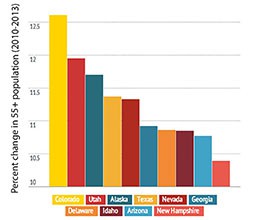
Those age 55 and older made up about 1.8 million people in Arizona in 2013, according to recent Census Bureau estimates, an increase of nearly 11 percent from the bureau’s 2010 estimates. That was the ninth-fastest growth rate among states in that period.

The state’s retirement-age population also grew from about 25 percent of residents in 2010 to 27 percent of the overall population in 2013, the Census said.

Included in that number is a net gain of about 25,000 people age 55 and over who moved to the state between 2010 and 2012. There are several reasons those people might move to Arizona, including a favorable climate and lower taxes, said Richard Fiesta, executive director of the Alliance for Retired Americans.

“It is a tax-friendly state for retirees,” Fiesta said, citing the state’s relatively low income tax rate and its lack of taxes on Social Security income, among others.

The growth in Arizona’s older population reflects nationwide aging, as baby boomers continue to get older, said state demographer Jim Chang.

“In the past several years, it has been growing faster than before, that’s for sure,” Chang said.

As older people make up a larger portion of the overall population, advocates said businesses will begin to adapt – and profit.

“What I tell people is every retiree that moves to the state brings a job with them, because they bring their pension checks and Social Security checks to spend,” said Doug Hart, president of the Arizona chapter of the Alliance for Retired Americans. That includes creating significant demand for the health-care industry in Arizona, he said.

But health care is just one of the many sectors that could grow as Arizona sees more retirees. Sandy Markwood, CEO of the National Association of Area Agencies on Aging, said the purchasing power of people 55 and over will attract the attention of businesses, pointing to an increase in advertising directed toward seniors for health care and travel.

“Older adults hold a lot of the economic power in any community,” Markwood said. “So if you’re looking at 20, 25 percent of your population being over any age, that’s an economic driver.”

Housing is another business that could benefit from more retirement-age people, she said, as they downsize from family homes to housing with less space. Downtowns and urban areas become more attractive, Markwood said, because they are central hubs full of activity.

But with these opportunities come new demands and the need for both public- and private-sector adaptation.

Markwood said new housing demands will require new zoning policies to allow mixed-use developments so people can live and shop without travelling far, while Hart said Arizona will need new schools and centers to train people for health care careers.

Public transit is another area that could need upgrades, Hart said. Transit is lacking in Arizona’s sprawling cities, he said, and retirees could benefit from improvements.

“You need public transportation, in many cases, for people that simply cannot drive or are not able to,” Hart said.

Markwood agreed, saying that other businesses, such as ride-shares that allow people to rent cars by the hour, could benefit as well. Communities should plan their infrastructure with a focus on creating lifetime members, she said, rather than solely on young families.

“You can have the best services in the world,”  she said. “You can have home-delivered meals or adult day-care centers. But the bottom line is, if somebody comes home to their house that doesn’t meet their needs or doesn’t have transportation to get to the senior center, the quality of the life of that person is compromised.”


 GROWING OLDER 
 
Arizona saw the ninth-fastest growth in the nation in its 55-and-older population between 2010 and 2013, according to the most recent estimates from the Census Bureau. (Cronkite News Service graphic by Matthew Seeman)
Arizona’s retirement-age population grew by nearly 11 percent from 2010 to 2013, according to Census Bureau estimates, placing it in the top 10 for states with fast-growing senior populations. The number of residents age 55 or above (in parentheses) in 2013 and the increase from 2010:

Colorado: 12.6 percent (1,303,457)
Utah: 11.9 percent (553,186)
Alaska: 11.7 percent (158,867)
Texas: 11.4 percent (5,840,578)
Nevada: 11.3 percent (718,034)
Georgia: 10.9 percent (2,350,959)
Delaware: 10.9 percent (268,290)
Idaho: 10.9 percent (419,141)
Arizona: 10.8 percent (1,795,663)
New Hampshire: 10.4 percent (396,519)

How our Constitution views women as sluts

Fifty years ago, many brave souls traveled to Mississippi to register African Americans to vote. They paid dearly for it. (photo: PBS)


You Have No Excuse for Not Voting. Not Anymore.


By Charles Pierce, Esquire

02 July 14

We get the government we deserve, and we are on track for one that is heedless of concern for women's health, and poised to eliminate unions.

ereabouts, we've long been amused by the deep thoughts of Utah's Senator Mike Lee, who is to the Constitution what Paul Ryan is to actual economics. Which is to say, he is recognized as a konztitooshinul skolar because he keeps telling people that he is — just as the Zombie Eyed Granny Starver has become known as a "budget wonk" because enough people have called him that — despite the fact that the full implications of the Ninth, 13th, 14th and 15th amendments seem to have eluded his notice. Anyway, Mike Lee put his very big brain to work yesterday regarding the Supreme Court's Humanae Vitae decision in favor of the Hobby Lobby and Conestoga Wood folks. Mike Lee's very big brain labored very hard and came up with a constitutional basis for why women are basically sluts.

During an appearance on Sirius XM's The Wilkow Majority, host Andrew Wilkow argued that the real question in Burwell v. Hobby Lobby Stores Inc., was about "whether or not a person who runs a business should be forced to provide something that is largely for recreational behavior, if it goes against their religious beliefs." Lee, responded by saying "Yea, that's right, that's right," before claiming that "this administration is using the often coercive power of the federal government to force people into their way of being and their way of existing, their way of believing and thinking and acting."

So there really isn't any excuse any more.

Over the weekend, I watched the PBS documentary on Freedom Summer, the effort 50 years ago to register African Americans to vote in the state of Mississippi, the effort that cost so many people so dearly, especially the families of Andrew Goodman, James Chaney, and Mickey Schwerner, who were beaten and shot to death, and buried in a dam, because the state of Mississippi had local police forces shot through with the Ku Klux Klan. Now, five decades later, with a Republican House far gone into nihilistic vandalism, and with the Senate hanging in the balance, and a Supreme Court one septuagenarian's heartbeat away from a return to the golden days of the last Gilded Age, and a Democratic president in the White House on whom those responsible for the previous three phenomena have painted a bullseye, we keep hearing about how hard it is going to be for the Democratic party to turn out its voters this fall to take advantage of the opportunities for which Goodman, Chaney, and Schwerner gave their lives, and did so in my lifetime, not in a distant antebellum episode in some backwater.

So there really isn't any excuse any more.

Quite simply, if the Republican party gains control of the United States Senate, and if it maintains that majority in 2016, neither Barack Obama, nor Hillary Clinton, if she were to succeed him in office, will be allowed to appoint a Supreme Court justice. It will not happen. There will be nobody whose views and judicial philosophy will be satisfactory to the majority Republicans unless whoever the president is happens to nominate Antonin (Short Time) Scalia's left nut. Yesterday, the bare 5-4 majority of Federalist Society Papists demonstrated that it is heedless of concern for women's health, and poised to eliminate the ability of public employees -- and, later, any employees -- from organizing themselves.


(For an interesting historical view, I can highly recommend the redoubtable Thers at Whiskey Fire, who draws on his academic experience to explain how, in regard to human sexuality, the United States Of America is turning into the Irish Free State, circa 1935.)

So there really isn't any excuse any more.

And it's not like the raw material isn't there. In a number of states in which the Democratic candidate was thought to be in desperate trouble, those candidates remain stubbornly—and narrowly—ahead. In the newly insane state of North Carolina, Kay Hagan has opened a little daylight over Thom Tillis. It should be significant that Hagan and Tillis are on opposite sides of the Hobby Lobby ruling. In Arkansas, Tea Party heartthrob Tom Cotton is giving a master class in how a promising candidate can fail to launch, and Mark Pryor has been the beneficiary.(Hint: the farmers you represent will not be pleased if you vote against a farm bill, even if it's because freedom.) Mary Landrieu is still Mary Landrieu, but she's still in a virtual tie. Reproductive rights—as defined yesterday by Samuel Alito—could be enough to save Mark Udall in Colorado, who is running a bit ahead of onetime Personhood champion Cory Gardner. (Gardner already has tried to walk that back, stepping on another rake as he did so.) And, in Michigan, Terri Lynn Land put out a commercial in which she ridiculed the idea of a "war on women." She's now running behind Democratic candidate Gary Peters among the women of Michigan.

So there really isn't any excuse any more.


I occasionally get chaffed by folks for giving out civics lessons but, seriously, we get the government we deserve. The Founders, and those brave people who came later, a group that certainly includes the three Mississippi martyrs and thousands more whose names we don't know, made sacrifices that leave us no alibis. If you live in a state that has restricted the franchise, and that has erected hoops through which you have to jump, then learn how to jump through the hoops and break down those barriers by flooding the polls. If you don't live in a state where it has been made more difficult to vote, then get off your sorry ass.

One of the most striking parts of the PBS documentary was the testimony of Rita Schwerner who, while her husband was still missing, flew to Mississippi to give witness and to make sure her husband's murder would not fade, as so many others did. (She also memorably got in the face of President Lyndon B. Johnson. I've defended LBJ on a lot of issues, but his response to Freedom Summer and, ultimately, to the Mississippi Freedom Democratic Party at the 1964 Democratic convention, was not his finest hour.) In a recent interview, she explained why she went to the place where her husband already had disappeared.

RITA SCHWERNER BENDER: Yes, but that was after the three of them were missing, and there was enormous attention. And the enormous attention was because two of the three men were white. Nobody had paid very much attention, either on a national level or locally, with the murders of black men and often children who had been - Mississippi had the highest rate of lynchings in the entire country. I think there was something over 500 that were documented. And there were probably many more that never made any kind of recognition.
There really isn't any excuse any more.

Tuesday, July 1, 2014

Even Supremes beholden to corporations

Senator John McCain, R-Ariz., talks Tuesday with Senator Dick Durbin, D-Ill. (photo: Chip Somodevilla/Getty Images)

A $300 Billion Example of How Corporations Control Our Government

By Carl Gibson, Reader Supported News

n a real democracy, like the constitutional republic in which we supposedly live, the people choose representatives through the election process to vote for their interests in government. In an oligarchy, like the one in which we actually live, corporations buy representatives through the election process to secure benefits for themselves and rig the game further in their favor. Here’s one $300 billion example. This infographic by Luke Keohane of Move to Amend lays it all out in detail: 

Senator John McCain (R-AZ) sits on the Senate committees on foreign relations, armed services, and homeland security. Senator Dick Durbin (D-IL) sits on the Senate subcommittee for defense appropriations. Collectively, these four committees are responsible for funding arms sales and foreign aid, the continued maintenance and development of the military, oversight for government contracts, and the allocation of the budget for the defense department. Through these four committees, $300 billion in taxpayer dollars, which is roughly $2000 per taxpayer, went to private military contractors in 2013.

These defense contractors were able to secure lavish contracts only through their extensive lobbying efforts, like hiring expensive lawyers with existing connections in government. The Hogan Lovell law firm, where Chief Justice John Roberts previously worked before joining the Supreme Court, explicitly boasts on its website about its expertise in helping corporate clients worm their way through the regulatory system.

Our interdisciplinary practice brings together lawyers with the corporate, commercial and regulatory experience to assist our clients in capitalizing on opportunities and avoiding pitfalls.… we know how to guide you through procurement and regulatory minefields as well as how to protect your interests effectively in disputes and government investigations.… Our clients include some of the largest and most established aerospace, defense, and government services companies in the U.S., Europe and the Middle East.

Justice Antonin Scalia also came from a law firm that lobbies for some of the biggest military contractors. Jones Day law firm’s client list includes war profiteers like Bechtel, General Electric, and Verizon. Scalia worked in Jones Day’s Cleveland office before Ronald Reagan appointed him to the Supreme Court. So what happens when veterans of law firms specializing in corporate lobbying make it all the way to the Supreme Court?

In 2010, both Scalia and Roberts voted to establish money as speech in the Citizens United vs. FEC decision, which allowed for corporations to spend unlimited amounts of money influencing elections. And just recently, both justices voted that aggregate limits on individual campaign donations are unconstitutional in the McCutcheon vs. FEC decision. So not only can large military contractors use their influence in Congress to secure lucrative contracts, they also have influence in the courts to overturn laws that previously limited their ability to buy politicians outright.

Last Summer, when the Senate held a vote to authorize the use of military force in Syria, both John McCain and Dick Durbin voted YES. As Maplight shows, Senators McCain and Durbin received more than $300,000 in campaign contributions from defense contractors between the two of them. Moreover, members of the Senate who voted YES for military intervention in Syria received 83 percent more in campaign donations from military contractors than those who voted NO. It’s expected that through the continued support of military contractors in their re-election campaigns, McCain and Durbin will continue to use their positions in the senate to give those same military contractors more government contracts.

It isn’t hard to see that our current system of unlimited money in politics, made possible through corporate “personhood” and money as political speech, is the reason both parties in Congress are so nakedly corrupt. Until we get a constitutional amendment establishing that corporations aren’t people and money is not speech, we can expect more of the same quid-pro-quo bribery in our politics.

Carl Gibson, 26, is co-founder of US Uncut, a nationwide creative direct-action movement that mobilized tens of thousands of activists against corporate tax avoidance and budget cuts in the months leading up to the Occupy Wall Street movement. Carl and other US Uncut activists are featured in the documentary "We're Not Broke," which premiered at the 2012 Sundance Film Festival. He currently lives in Madison, Wisconsin. You can contact him at carl@rsnorg.org, and follow him on twitter at @uncutCG.

Iraq to have unity government before U.S.

The Borowitz Report

June 24, 2014


kerry-iraq.jpg BAGHDAD (The Borowitz Report)—In a meeting with Iraqi Prime Minister Nuri al-Maliki on Monday, Secretary of State John Kerry stressed the importance of forming a unity government in Iraq but refused to commit to a timetable for creating one in the United States.
 
The sensitive topic of a unity government for the United States came at the end of a thirty-minute meeting, during which Secretary Kerry lectured the Iraqi Prime Minister about the value of a government “where people of different parties put aside their differences, make meaningful compromises, and work together for the good of the nation.” 
 
Taking this in, al-Maliki agreed that it was an excellent idea and politely asked Secretary Kerry if the United States had ever considered forming such a government.
According to observers, Kerry appeared to be caught off guard by this question and blurted out,”You first.”

Despite that awkward moment, after the meeting Kerry said that he had not “totally slammed the door” on the idea of a unity government in the United States.

“Let’s just get one formed in Iraq,” he said. “If it works out for them, maybe someday we’ll give it a try.”

Brendan Smialowski/Pool/Getty.