Join us at our brand new blog - Blue Country Gazette - created for those who think "BLUE." Go to www.bluecountrygazette.blogspot.com

YOUR SOURCE FOR TRUTH

Tuesday, February 4, 2014

Survey: GOP in denial on wealth inequality

By Richard Eskow
The Populist Moment
The classic definition of an 'economic populist' is a person who feels that wealth is unfairly distributed in this country. Unsurprisingly, most Republicans don’t feel that way.

According to surveys collected by PollingReport.com, only a third of them agree that our economy’s distribution of wealth is unfair. That compares to an overwhelming 80 percent of Democrats and 62 percent – nearly two-thirds – of "independents."

That means that a Democratic candidate who pushes populism has a chance of attracting two-thirds of independents and more than one-third of the opposition party’s voters. This enthusiasm translates into a desire for more government action, and the poll numbers become stronger as the questions get more specific.

The signs increasingly indicate that, however much the folkways of Washington may resist, this nation has entered a Populist Moment. If you live and work inside the Beltway, you ignore it at your own peril.

Coke controversy: other languages exist

The Borowitz Report

February 3, 2014

cola-580.jpg
ATLANTA (The Borowitz Report)—The Coca-Cola Company ignited a firestorm of controversy on Sunday with a Super Bowl ad that appeared to make the inflammatory claim that other languages besides English exist.

From coast to coast, viewers reacted with outrage and horror to what many were calling the most incendiary Super Bowl ad in history.

“I was enjoying the Super Bowl with my family, and suddenly, out of nowhere, comes this ad suggesting that there are other languages that aren’t English,” said Carol Foyler, a mother of three from Akron, Ohio. “I grabbed the remote and turned it off. My kids shouldn’t be exposed to garbage that’s just going to confuse them.”

The Alliance for Responsible Advertising, a conservative watchdog group that monitors advertising it considers offensive and unfit for family viewing, issued a statement demanding that Coke apologize for the controversial ad and promise never to air it again.

“Last night, Coke assaulted millions of Americans with its misguided and inappropriate view that other languages exist,” the statement said. “In the future, we strongly hope that Coke will keep its crazy theories to itself.”

N. Gila Co. part of hazardous weather forecast


HAZARDOUS WEATHER OUTLOOK
NATIONAL WEATHER SERVICE FLAGSTAFF AZ
446 AM MST MON FEB 3 2014


THIS HAZARDOUS WEATHER OUTLOOK IS FOR APACHE...COCONINO...NORTHERN GILA...NAVAJO...AND YAVAPAI COUNTIES IN NORTHERN ARIZONA.


.DAY ONE...TODAY AND TONIGHT

A WEAK DISTURBANCE WILL BRING LIGHT SNOW SHOWERS TO NORTHERN ARIZONA. SNOW LEVELS WILL RANGE FROM 3500 TO AROUND 4500 FEET ELEVATION.


.DAYS TWO THROUGH SEVEN...TUESDAY THROUGH SUNDAY

ON TUESDAY...LIGHT SNOW SHOWERS WILL CONTINUE ACROSS NORTHERN ARIZONA. SNOW LEVEL RANGES WILL HOVER BETWEEN 3000 TO 4000 FEET WITH AN INCH OR TWO OF 24 HOUR STORM TOTAL SNOW ACCUMULATION OVER THE MOUNTAIN AREAS.


THURSDAY AND FRIDAY...A STRONGER STORM SYSTEM AND COLD FRONT WILL MOVE ACROSS ARIZONA LATE THURSDAY INTO FRIDAY. EXPECT A DROP IN HIGH TEMPERATURES ALONG WITH INCREASING SNOW SHOWER COVERAGE...WITH MODERATE SNOW ACCUMULATIONS POSSIBLE OVER THE HIGH TERRAIN ON FRIDAY.

Monday, February 3, 2014

AZ among worst for residents’ financial security

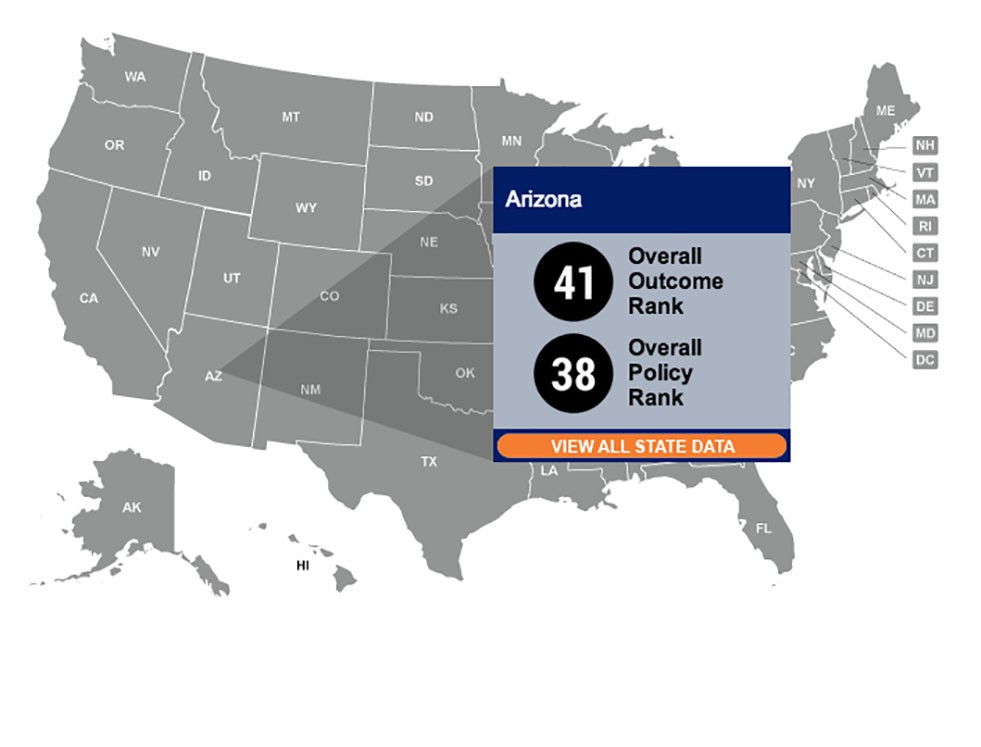
    Arizona again ranked among the worst states when it came to the financial security of residents, according to an annual report by the Corporation for Enterprise Development, which rated states on policies aimed at helping struggling families and on residents’ liquid assets. (Graphic courtesy the Corporation for Enterprise Development)

    By WHITNEY OGDEN
    Cronkite News Service

    WASHINGTON – More than 40 percent of Arizona households are on the brink of “financial devastation,” according to a national report that again ranked the state among the worst in terms of its residents’ financial security. 

    The Assets and Opportunity Scorecard released Thursday graded states based on residents’ liquid assets and on policies aimed at helping struggling families, among other measures. The 2014 report by the Corporation for Enterprise Development ranked Arizona 41st overall. 

    The report said 45.7 percent of Arizona households are in a “persistent state of financial insecurity,” essentially unchanged from last year’s 45.2 percent.

    “In a general sense, we aren’t doing very well,” said Cynthia Zwick, executive director of Arizona Community Action Association. “We were hit pretty hard by the recession, which we’re still climbing out of.”

    Zwick said because of the recession, Arizona cut many services and resources. That left families hit by the economic downturn “literally living paycheck to paycheck” with no help from the state. She said Arizona now has the fifth-highest rate of poverty in the country, with 19 percent of its residents living below the poverty line.

    “They’re working one to two jobs and still not able to … make ends meet,” Zwick said.

    CFED President Andrea Levere said the financially insecure residents highlighted in the report are “liquid-asset poor,” meaning they do not have savings to cover “basic expenses” at the poverty level for three months if hit by a financial emergency, such as a health expense or a car problem.

    “In the U.S., 44 percent couldn’t even live at the poverty level,” for those three months, Levere said. “And in Arizona it’s even worse, it’s at 46 percent.”

    The report also scored states on 67 different policy measures that it said could address the financial challenges of residents. Arizona ranked 38th in this category.

    Sapna Gupta, senior policy analyst at Arizona State University’s Morrison Institute for Public Policy, said the report’s findings were not surprising. But she thinks there is hope for Arizona in at least one category: Health-care policy, where Arizona is currently ranked 34th.

    “That number for health care can change,” said Gupta, who thinks the number might improve since state residents can now enroll for health care under Affordable Care Act.

    “The number of uninsured will go down,” she said. “Once more Arizonans start enrolling … that (ranking) is going to change.”

    Levere said one way Arizona could improve its overall ranking is by eliminating the asset limits that currently bar families from receiving Temporary Assistance for Needy Families if their savings exceed a certain amount. She called the limit “completely counterproductive.”

    “You want to encourage people to build up even the smallest savings … so if something happens to the car, they can fix it so then they can get to their job so they don’t lose it,” Levere said.

    Zwick said another way Arizona could improve is by boosting the average weekly unemployment benefit to at least 50 percent of the state’s average weekly wage.

    “We have one of the lowest payments to an unemployed person of any state,” she said. “The maximum weekly unemployment benefit is $240 … that’s fairly low.”

    However Arizona goes about it, Levere said policymakers need to act.

    “There are lots of opportunities for the state of Arizona to help families,” she said.


     Arizona Rankings 

    The Assets and Opportunity Scorecard ranked states for their policies and their actual situations, or “outcomes,” in five categories, and then gave an overall score. 

    For Arizona:

    Overall outcomes rank: 41st
    - Financial assets and income: 41st
    - Business and jobs: 43rd
    - Housing and homeownership: 19th
    - Health care: 48th
    - Education: 42nd

    Overall policies rank: 38th
    - Financial assets and income: 26th
    - Business and jobs: 38th
    - Housing and homeownership: 33rd
    - Health care: 34th
    - Education: 34th

    20 richest Americans are takers, not makers


    Paul Buchheit
    Published: Monday 27 January 2014
    nationofchange.org
    The richest Americans keep making money. And they’re taking the rest of us for all they can get.

    The top individuals on the 2013 Forbes 400 list are generally believed to be makers of great companies or concepts. They are the role models of Paul Ryan, who laments, "We're going to a majority of takers versus makers in America." They are defended by Cato Institute CEO John A. Allison IV, who once protested: "Instead of an attack on the 1 percent, let's call it an attack on the very productive."

    But many of the richest Americans are takers. The top twenty, with a total net worth of almost two-thirds of a trillion dollars, have all taken from the public or from employees, or through taxes or untaxed inheritances.

    Bill Gates
    Bill Gates may be a knowledgeable and hard-working man, but he was also lucky and opportunistic. He was a taker. In 1975, at the age of 20, he founded Microsoft with high school buddy Paul Allen. This was the era of the first desktop computers, and numerous small companies were trying to program them, most notably Digital Research, headed by brilliant software designer Gary Kildall. His CP/M operating system (OS) was the industry standard. Even Gates' company used it.

    But Kildall was an innovator, not a businessman, and when IBM came calling for an OS for the new IBM PC, his delays drove the big mainframe company to Gates. Even though the newly established Microsoft company couldn't fill IBM's needs, Gates and Allen saw an opportunity, and so they hurriedly bought the rights to another local company's OS -- which was based on Kildall's CP/M system. Kildall wanted to sue, but intellectual property law for software had not yet been established. Kildall was a maker who got taken.

    David Lefer, a collaborator for the book They Made America, summarized: "Gates didn't invent the PC operating system, and any history that says he did is wrong."

    Warren Buffett
    At first glance, Warren Buffett seems to be a different breed of multi-billionaire, advocating for higher taxes on the rich and a reasonable estate tax. But his company, Berkshire Hathaway, hasn't been paying its taxes. According to the New York Post, "the company openly admits that it owes back taxes since as long ago as 2002."

    A review of Berkshire Hathaway's annual report confirms that despite profits of over $22 billion in 2012, a $255 million refund was claimed, while $44 billion in federal taxes remain deferred on the company's balance sheet.

    Berkshire Hathaway has another little surprise hidden in the small print of its income statement. It shows an income tax expense of almost $7 billion, all of it hypothetical.

    Larry Ellison
    Ellison was #1 on Sam Pizzigati's Greediest of 2013 list. A well-deserved ranking. Since 2008 the Oracle CEO has awarded himself tens of millions of dollars in stock options and performance pay, most of it either tax-deferred or tax deductible. The money taken from the taxpayers served as a nice down-payment on Ellison's purchase of the sixth-largest Hawaiian island.

    Koch Brothers
    This is an easy one, sad to say. Koch Industries is taking away our clean air and water, taking its waste to Detroit and Chicago, trying to take away the minimum wage, seeking to take down renewable energy initiatives and taking away jobs And trying to take us for fools, with statements like this from Charles Koch: "I want my legacy to be...a better way of life for...all Americans."

    The Walmart Family
    Where to begin? Walmart takes from employees, takes from the taxpayers, takes from competitors and suppliers, takes from foreign workers, takes from the environment.
    Walmart sales associates make about $9.00 per hour, which comes to $18,000 per year for a full-time worker, well below the poverty threshold for a family of four (and even below the threshold for a family of three).

    Walmart makes more than that from profits and subsidies. In the U.S., the company makes over $18,000 per employee, including $13,000 in pre-tax profits (after paying salaries) and a taxpayer subsidy of $5,815 per worker.

    On top of all the business profits, the four members of the Walmart family made a combined $28.9 billion from their investments last year. Less than a third of that would have given every U.S. Walmart worker a $3.00 raise, enough to end the public subsidy.
    Article image
    Michael Bloomberg
    Bloomberg has taken from workers, vetoing the Prevailing Wage Bill while likening the higher wage campaign to communism. He has taken from children through cutbacks to child care and after-school programs. He has taken funding from the homeless and he has taken away the dignity and civil rights of minorities through his "stop and frisk" policy. A long-term pattern of taking from the poor and redistributing to the rich has caused New York City to become the most unequal city in the U.S.

    Sheldon Adelson
    Casino magnate Adelson is a taker. He had his Sands Corporation in Las Vegas declare a special dividend that will pay him $1.2 billion, at the capital gains tax rate. Meanwhile, The Sands took bribe money, admitting that it likely violated the U.S. Foreign Corrupt Practices Act in its dealings with China.

    Jeff Bezos
    The Bezos way of taking is by using the extraordinary advantage of tax-free sales on Amazon to offer discounts while undercutting competitors. While this might seem like a failure of government rather than an appropriation by business, it's a little of both, since Bezos, according to Slate, has "spent millions of dollars per year on lobbyists, deployed an army of lawyers, and cultivated political allies with large campaign contributions."

    The Amazon CEO also takes from his employees, who are considered underpaid and overworked, making less for warehouse work than Walmart workers, fearful about joining unions, and at risk for physical breakdowns on the hottest working days.

    Larry Page and Sergey Brin
    Google's business, like that of Facebook, is based on the Internet, which started as ARPANET, the Defense Department's Advanced Research Projects Agency computer network from the 1960s. The National Science Foundation funded the Digital Library Initiative research at Stanford University that was adopted as the Google model. (The late Steve Jobs spoke for the industry: "We have always been shameless about stealing great ideas.")

    Google has gained recognition as one of the world's biggest tax avoiders, a master at the "Double Irish" revenue shift to Bermuda tax havens, and employing tax loopholes to bring money back to the U.S. without paying taxes on it.

    The Mars Family
    Jacqueline, John, and Forrest, Jr. are trying, along with the Kochs and the Waltons, to take more money out of their inherited and untaxed estates by conducting a coordinated campaign to repeal the estate tax. For all three families, the “makers” were their parents or grandparents.

    Lobbying for lower taxes by ill-informed or self-centered estate tax opponents is understandable. But according to a report by Public Citizen and United for a Fair Economy, "The families also have helped finance outside groups that have spent millions on fear-mongering ad campaigns intended to sway public opinion against the estate tax."

    Carl Icahn
    Icahn is involved in an indirect but lucrative form of taking, asking Apple CEO Tim Cook to buy back $150 billion of its own stock. Stock buybacks are a means by which major corporations seek to put upward pressure on the market prices of their own shares. Icahn owns $2.5 billion of Apple stock.

    George Soros
    Soros went overseas to do his taking, betting heavily against the British Pound after the fall of the Berlin Wall, to the point that overwhelming pressure was exerted on the Bank of England, leading to a collapse of the national currency.
    In effect, Soros contributed to the destabilization of a major country's financial position by manipulating the markets and choosing, as he put it, to "go for the jugular."

    Mark Zuckerberg
    To a large extent Mark Zuckerberg took his Facebook idea from others, in both a long-term and immediate sense. As Gar Alperovitz noted, "Between the mid-1980s and the mid-1990s the National Science Foundation spent $200 million to build and operate a network of regional supercomputing hubs called the NSFNET. Connected to the ARPANET, this network established Internet access for nearly all U.S. universities, making it a civilian network in all but name."

    Zuckerberg developed his version of social networking while he was at Harvard. Before he made his contribution, Columbia University students Adam Goldberg and Wayne Ting built a system called Campus Network, which was much more sophisticated than the early versions of Facebook. But Zuckerberg eventually prevailed for at least three reasons: the Harvard name; better financial support; and the simplicity of Facebook, which ironically boosted the system's popularity among students engaging in social networking for the first time. A possible fourth reason: it was alleged that Zuckerberg hacked into competitors' computers to compromise user data.

    One More Take...
    Bloomberg and Ellison and Zuckerberg and Page & Brin have one more cunning strategy for remaining on the take: $1 a year salaries.

    It sounds noble, and generates a lot of good will. But as MSN Money puts it, "Dollar pay is typically a myth, since the CEOs getting $1 in salary often get huge stock-and-option grants." Stock options, dividends, and performance pay are all either tax-deferred or untaxed, or taxed at the capital gains rate. If cash is needed, CEOs like Zuckerberg can borrow against their billions in stock holdings and real estate, at an interest rate much smaller than the income tax rate.

    The richest Americans keep making money. And they're taking the rest of us for all they can get.

    Author pic
    ABOUT Paul Buchheit
    Paul Buchheit is a college teacher with formal training in language development and cognitive science. He is the founder and developer of social justice and educational websites (UsAgainstGreed.org, RappingHistory.org, PayUpNow.org), and the editor and main author of "American Wars: Illusions and Realities" (Clarity Press). He can be reached at paul@UsAgainstGreed.org.

    Sunday, February 2, 2014

    Let this Dem suggest some cuts

     LETTER TO THE EDITOR 
     
    Editor:

    Regarding "What are Dems willing to cut?" (Letters, Thursday).

    Democrats are willing to cut.  How about cutting oil company subsidies and tax breaks for extremely profitable corporations that don't pay taxes or that ship jobs overseas or that expect their low-wage employees to rely on government largesse to maintain a minimal standard of living?

    How about bargaining for medical and drug costs, raising the Social Security cap on incomes over $100,000 per year, implementing a transaction tax on all stock trades, removing the ability to shelter income offshore, reducing defense spending to, oh, say less than only the next six or seven highest-spending countries combined, and letting the military go back to taking care of itself instead of spending three times as much by using civilian contractors?

    How about going where the money is instead of trying to put the squeeze on people least able to afford it?

    Getting out of this slump would be relatively easy if some politicians weren't conservative in name only.

    Deborah Deminie
    Scottsdale

    (From today's Feb. 2 Arizona Republic, the Rim Country's best newspaper value.  For home delivery seven days a week call 1-800-332-6733.)

    At least it's not snowing!

      OUT TO PASTOR  
    By Dr. James L. Snyder
    Gazette Contributor 

    If somebody gave out an award for grouchiness and downright cantankerousness, I am sure I would take top honors. Of course, according to the Gracious Mistress of the Parsonage, there is no honor in being grouchy or cantankerous, nor is there room for it in our humble abode.
    For the past week I have been grouchy and cantankerous and any other adjective you might want to throw into that pot of naughtiness. By the time the week ended that pot was boiling hot and about to explode.
     

    It is always beneficial to look back over an incident and figure out where you made your mistake. I often don't do it, but in this case, the mistake I made was so obvious it could not be overlooked. 

    Most faults can be remedied if you know what to do about it. Then, there are those mistakes that no matter what you do, still end up being mistakes. My mistake was I exhibited my downright grouchiness and cantankerous spirit in front of my wife. 

    I know the marriage manual says there should be no secrets between husband and wife. Down through the years I have tried to maintain that part of the marital relationship, and I have done a good job thus far. What the manual does not say is, there are special times when a husband should not speak his mind in front of his wife. My wife constantly reminds me that God gave men two ears and one mouth for a particular purpose - open our ears and shut our mouth. 

    I do not think I got that far in the instructions, but I will take my wife's word on that one, you can be sure. 

    In my defense, however, this past week I was colder than I have ever been in all my life, at least that I can remember. Now, it is one thing to be cold, but quite a different thing to tell somebody, especially your wife, that you are cold. 

    I made that mistake once and told my wife I was cold. She felt my forehead, got out my bathrobe, fussed over me all evening and made me hot tea with honey to drink. I wanted to tell her that I was cold; I did not have a cold. 

    It was so cold the little gray cells were shivering so much they were not functioning 100%. According to some people's opinion, it is a rare occasion when they do function 100%. 

    As I remember it, I was looking out our back patio window, watching it drizzle and shivering in the cold. If I need any defense on my side, I did not realize that in the same room was the Gracious Mistress of the Parsonage. 

    Enveloped in this aroma of sheer ignorance, I said out loud something to the effect, "I hate this cold weather!" Following that pointed observation, as I now reflect, I also growled most viciously.

     It was then I heard a noise explode behind me. 

    "Well, at least it is not snowing! You should be grateful for that." 

    I swung around as quickly as possible, and there standing in all her glory with both hands firmly planted on her hips was my wife staring in my direction. The tone of her voice and her demeanor revealed I was in for one of her infamous lectures. 

    All week long, we had been noticing some of our family up north experiencing some very severe snow conditions. Some even missed school for several days because of the snow drifting. One family member way up north was without electricity for nearly a week. In some of these areas, the temperature has been in the minus degrees for at least a week. 

    "Don't you know how lucky you are to live in a place where it doesn't snow and the temperature doesn't get below zero? Instead of complaining, you should be grateful for what you really have. Think of members of our family up north suffering in that freezing weather! Would you like to change places with them right now?"

     I have often said this and I am sure I will continue saying it until the day I die, when my wife is right she is right. No argument from me here. 

    Then she made a statement I am still mulling over. "Be thankful for what you don't have." 

    I must say she had a great point there. Sometimes it is quite hard to be thankful for what you do not have when you are so caught up in the problems right in front of you.

    Thinking about that, my grouchiness and cantankerousness began evaporating. I suppose they have their place, and I am ashamed to admit they are in my place more often than I should allow them. 

    In many ways, it is easy to be thankful for what you have in your hand at the time. The apostle Paul pointed this out in one of his letters. "And let the peace of God rule in your hearts, to the which also ye are called in one body; and be ye thankful" (Colossians 3:15). 

    For most of us, being thankful does not come natural. It is something we have to work at on a daily basis. It has to go a step further. 

    Be thankful for what you do not have and you will be all that more thankful for what you do have. 

    Rev. James L. Snyder is pastor of the Family of God Fellowship, PO Box 831313, Ocala, FL 34483. He lives with his wife, Martha, in Silver Springs Shores. Call him at 1-866-552-2543 or e-mail jamessnyder2@att.net. His web site is www.jamessnyderministries.com.