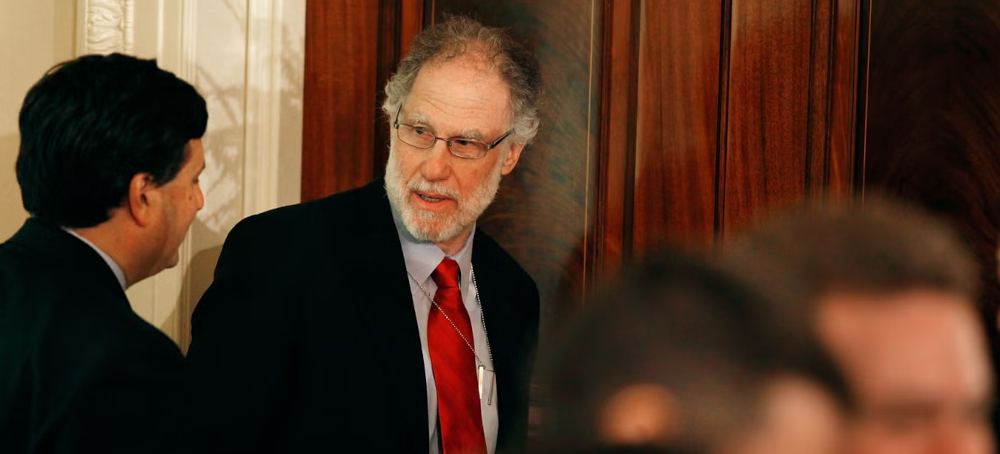
Bob Bauer (right) served as White House counsel
under Democratic President Barack Obama. He joined Jack Goldsmith, who
worked for Republican President George W. Bush, in arguing that Trump
could dispute the 2026 midterms. (photo: Getty)
‘This prospect must be taken seriously,’ the lawyers for both former Democrat and Republican presidents warn
Brendan Rascius/The Independent
14 November 25
Government lawyers, who served the Bush and Obama
administrations, have warned that President Donald Trump may not take
midterm election losses lying down.
Bob Bauer, who served under former President Barack Obama, and Jack
Goldsmith, who worked for President George W. Bush, argued that Trump
could dispute next year’s election results, which will determine whether
or not the Republican party maintains control of Congress.
“His words and actions strongly suggest he may use the formidable powers of the presidency — and possibly even the armed forces — to resist 2026 electoral results he dislikes,” the lawyers wrote in The Economist Wednesday. “This prospect must be taken seriously.”
Bauer and Goldsmith noted that Trump has a history of questioning the
legitimacy of election results, pointing to the 2020 win of President
Joe Biden, which Trump has frequently described as “stolen” and
“rigged.”
And now — less than one year into his second term — Trump seems to be
preparing to contest the midterms, which historically have resulted in
losses for the president’s party.
As evidence, Bauer and Goldsmith pointed to an August Truth Social post
from Trump, in which he promised to “bring HONESTY to the 2026 Midterm
Elections” by eliminating mail-in ballots and voting machines.
States, “must do what the Federal Government…tells them, FOR THE GOOD OF OUR COUNTRY…” Trump added.
Trump has also issued an executive order claiming presidential power
to impose voting regulations on states, including by mandating proof of
citizenship to vote.
This proposed federal takeover of elections “flies in the face of the
constitution, which expressly allocates authority over the ‘Times,
Places and Manner’ of congressional elections to the states and to
Congress,” Bauer and Goldsmith wrote.
So, what could Trump actually do when the midterms roll around? Bauer
and Goldsmith argue the president “could order many kinds of federal
intervention.”
“As he did in 2020, but with a stronger hand, he could push officials
to intervene in states, potentially seizing voting machines,” the
lawyers wrote. “He could use federal agencies to demand that states
co-operate with his administration’s efforts to detect election fraud.
He could intimidate election officials by ordering investigations of
claimed irregularities.”
But, the lawyers’ most serious concern is that Trump would invoke the
Insurrection Act — which allows the president to suppress unlawful
violence — and deploy the military across the country.
“Trump could claim his opponents are obstructing election laws and
call in troops to enforce those laws in accordance with his wishes,”
they wrote. “Such deployments could occur before, during or after voting
begins.
“The integrity of the 2026 election could thus, as in 2020, also
depend on the fortitude of state and local officials who administer
elections.”
The lawyers did not address the current redistricting effort
taking place in a number of states, including Texas and California,
which could dramatically alter the balance of power in Congress.
Other commentators have expressed similar concerns about Trump and the midterms, including Democratic strategist James Carville.
“I don’t put anything past him — nothing — to try to call the
election off, to do anything he can,” Carville said on a podcast in
July.
A White House spokesperson shot back a fiery retort to Fox Digital.
“Trump has taken more action to restore the integrity
of our elections on behalf of the American people than any president in
modern history,” the spokesperson said. “According to the Democrats,
voter fraud doesn’t exist – but clearly they are already searching for
copouts preparing to lose big again in the midterms.”
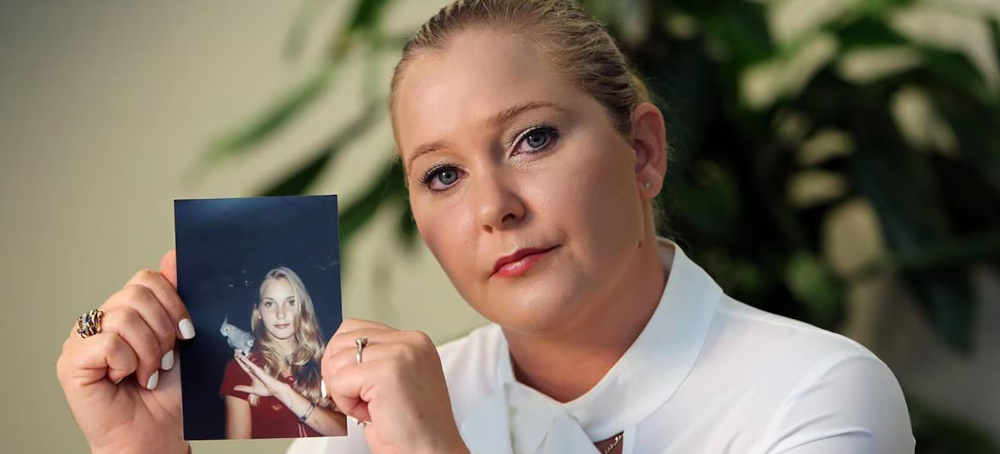
Donald Trump spent hours with same girl Prince Andrew enjoyed. (photo: Miami Herald)
'Victim' Trump Spent Hours With at Epstein's House Was Virginia Giuffre
Farrah Tomazin/The Daily Beast
13 November 25
Donald
Trump spent hours with a sex trafficking victim that Jeffrey Epstein
and Ghislaine Maxwell recruited from his Mar-a-Lago club and abused for
years.
Moments after explosive new emails suggested the president
may have known more about Epstein’s conduct than he has previously
acknowledged, MAGA Republicans identified the victim at the heart of the
documents as the late Virginia Giuffre, Epstein’s most high-profile
survivor.
In one email to Maxwell, which was dated April 2, 2011,
Epstein refers to Trump as “the dog that hasn’t barked” and reveals
that a certain victim—whose name was redacted in the files—“spent hours
at my house with him.”
The emails form part of a cache of documents provided by Epstein’s estate to Democrats on the House Oversight Committee.
However,
soon after they were released on Wednesday morning, Republicans on the
committee posted on X: “Why did Democrats cover up the name when the
Estate didn’t redact it in the redacted documents provided to the
committee? It’s because this victim, Virginia Giuffre, publicly said
that she never witnessed wrongdoing by President Trump.
“Democrats are trying to create a fake narrative to slander President Trump,” they added. “Shame on them.”
Giuffre,
born Virginia Roberts, was one of the earliest and loudest voices
calling for criminal charges against Epstein and his enablers.
She
lit a fire under the Epstein scandal in 2011, bringing it into the
international spotlight when she alleged that she had been sexually
assaulted by Prince Andrew as part of Epstein’s sex trafficking
operation.
Her astonishing revelations turned the now-ex prince
into Britain’s most tarnished royal, and contributed to him losing his
royal titles last month.
Before she died by suicide earlier this
year, Giuffre had testified that Maxwell hired her as a masseuse for
Epstein after meeting her at Trump’s Mar-a-Lago club, where she worked
as a 16-year-old locker room attendant at the resort spa.
Maxwell,
a British socialite, spotted Giuffre as she was reading a book about
massage therapy. She then offered her a job interview to be a private,
traveling masseuse, suggesting it would be a potentially life-changing
opportunity.
Giuffre attended the interview at Epstein’s Palm
Beach home, where she was introduced to Epstein naked and instructed by
Maxwell on how to massage him.
The depraved couple soon made her
their sex slave, pressuring her into gratifying not only the disgraced
financier but also his friends and associates.
As the firestorm
surrounding the Epstein files escalated this year, Trump acknowledged in
July that he knew Giuffre from Mar-a-Lago and lamented how Epstein
“stole her” from him.
“I think she worked at the spa,” he told reporters at the time. “I think that was one of the people. He stole her.”
“Other people would come and complain, this guy is taking people from the spa,” he added.
“I
didn’t know that. And then when I heard about it, I told him, I said:
‘Listen, we don’t want you taking our people—whether it was spa or not
spa—I don’t want you to take our people. And he was fine, and then not
too long after that, he did it again. And I said: out of here!”
But
while the president has long described the Epstein files as a
“Democratic hoax,” the new emails raise questions about what he knew and
when in relation to Epstein’s sexual conduct.
The documents suggest that Epstein mentioned Trump by name multiple times in private correspondence over the last 15 years.
In
another email, written to author Michael Wolff on January 31, 2019,
Epstein seems to address Trump’s earlier claim that he asked the sex
offender to resign his membership at the president’s Mar-a-Lago Club.
“trump
said he asked me to resign,” Epstein wrote, adding, “never a member
ever. . of course he knew about the girls as he asked to Ghislaine to
stop.”
The president did not receive or send any of the messages,
nor has he been accused of any criminal wrongdoing in connection with
Epstein or Maxwell.
However, the latest revelations are certain
to inflame tensions about the administration’s handling of the Epstein
files and the decision by Trump’s Department of Justice to renege on a
pledge to fully release them.
House Oversight Committee ranking
member Robert Garcia said the emails formed part of about 23,000
documents they received from Epstein’s estate in the last few days, and
more would be released later today.
Britt Jacovich, spokesperson
for progressive group MoveOn Civic Action, said: “It’s no wonder why
Trump and Republicans have spent weeks hiding the Epstein emails and
files from the public. This is textbook corruption.
“Just as
Trump promised on the campaign trail, the American people deserve to
know who enabled Jeffrey Epstein’s abuses and his victims deserve
justice. Release the Epstein files.”
White House press secretary
Karoline Leavitt described the latest Esptein firestorm as a “hoax”
designed to distract from the president’s achievements.
“The
Democrats selectively leaked emails to the liberal media to create a
fake narrative to smear President Trump. The ‘unnamed victim’ referenced
in these emails is the late Virginia Giuffre, who repeatedly said
President Trump was not involved in any wrongdoing whatsoever and
“couldn’t have been friendlier” to her in their limited interactions,”
she said.
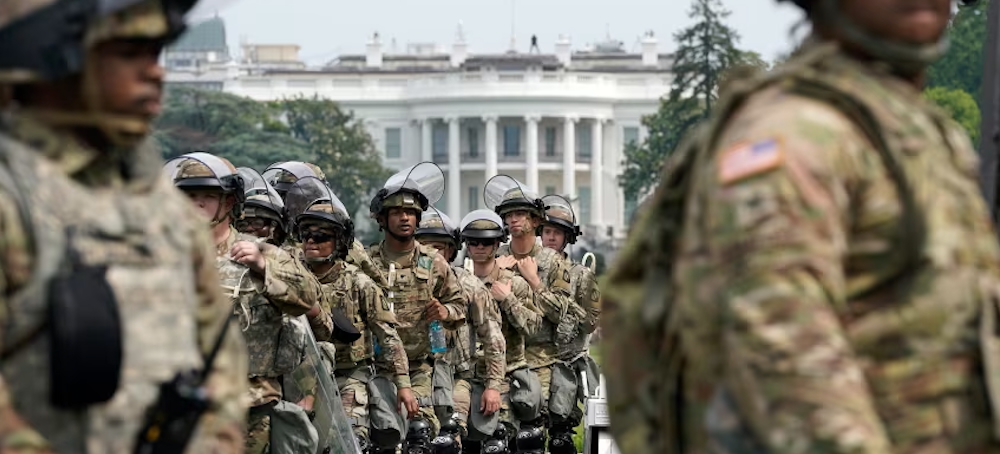
National Guard members near the White House. (photo: Drew Angerer/Getty Images)
'This
is just not what any of us signed up for'
'I swore an oath to the Constitution, not a person.'
Kat Lonsdorf/NPR
10 November 25
As President Trump calls for National Guard deployments across the U.S., a small contingent of Ohio guard members has been quietly expressing concern in an encrypted group chat.
The administration started sending troops into several Democratic-led
cities this summer, citing the need to crack down on violent crime and
protect federal immigration facilities.
The Ohio guard members now say
they're alarmed at the turn the country is taking. They're even
questioning their potential role in it.
"I really went to a dark place when they sent the troops to [Los
Angeles], and then eventually [Washington, D.C.], and now, Chicago. This
is just not what any of us signed up for, and it's so out of the scope
of normal operations," says J, a member of the Ohio National Guard who
spoke to NPR on condition of anonymity.
In the summer, Trump sent troops
into Los Angeles as anti-ICE protests escalated. He then deployed guard
troops into D.C., where around 2,300 still regularly patrol streets.
Then a torrent of plans for deployments came — Chicago, Portland, Memphis, cities in Louisiana and Missouri. Many of them remain embroiled in legal limbo.
In Ohio, J and several other members have taken to that group chat to
discuss the deployments and the accompanying anxiety they've felt. J,
as well as members C and A — all part of the same unit — agreed to talk
to NPR on the condition that they are only identified by their first
initials, because they are not authorized to talk to the press and fear
retribution for expressing their opinions.
"I have been on two humanitarian-esque missions with the guard, which
were awesome, doing the things you see on the commercial, helping these
communities," says J. "And then you want me to go pick up trash and
dissuade homeless people in D.C. at gunpoint. Like, no dude. It's so
disheartening every time I see another city — and I just wonder, 'who's
going to stand up to this?'"
It's a sentiment that's building with guard members elsewhere.
In recent weeks, more than 100 active military members have reached out to About Face,
a nonpartisan nonprofit made up of current service members and
post-9/11 veterans to be a resource for those who might be questioning
their deployments, according to the organization.
"In the military culture, it's really easy to feel like if you have
questions or dissent, you're the only person who thinks that," says
director Brittany Ramos DeBarros, a combat veteran who served in
Afghanistan.
The group has started an information campaign, specifically targeting
members of the National Guard around the country — using flyers,
posters, even billboards — encouraging them to reach out if they're
having doubts.
"We take very seriously making sure that people do understand what
they could be facing if they follow their conscience," says DeBarros.
"But the thing we also help people think through is, what is the cost of
not following your conscience? Because as Iraq and Afghanistan vets in
particular, many of us are living with that cost every day."
NPR reached out to both the White House and the Pentagon for this story.
"Our great National Guardsmen signed up to defend the nation and
serve the American people," wrote Pentagon Press Secretary Kingsley
Wilson in a statement. "We are proud of the work they have accomplished
this year, and we are confident in their collective ability to carry out
any and all orders by President Trump, the Department of War, and state
leaders."
White House spokesperson Abigail Jackson defended the deployments,
saying Trump was using his "lawful authority to protect federal assets
and personnel." Jackson lashed out at Democratic leaders, saying they'd
failed to stop violent attacks on law enforcement.
The group chat
The group chat with the Ohio National Guard members — set up on the encrypted messaging app Signal — began amid the flurry of executive orders
President Trump signed as he took office. Some of them affected the
military. The members say they needed a space to process it.
"It's not even necessarily expressing opinions or anything. It's just expressing questions about things that come out," says A.
They say the chat is active every day, with members sharing
information and news articles they come across. In recent months, that
chat has grown to a dozen members of their unit, and it's become largely
focused on Trump's rhetoric around the National Guard and his
deployments of troops to several cities.
Ohio's Republican Gov. Mike DeWine has agreed to send troops to
support the administration's efforts; there are about 150 in DC right
now.
That voluntary directive has come to this unit. None of the three
took it. They say the orders themselves were uncharacteristically vague.
"What exactly are we going to be doing? Are we going to have leave?
And those answers aren't very clear — but in the past, it's always been
very clear," says A. "Anywhere that we go, there's crucial information
that we get about the why behind it. And whenever we don't get that,
especially for these city moves, members ask questions."
Growing anti-guard sentiment
A joined the guard to pay for college. J was looking for direction in
life. And C felt the pull of the benefits that the guard offers and to
serve her country. All three have served for years, even decades.
The three say they are grappling with whether to leave the guard, and end their military careers.
"The only reason I want to finish my current contract is just because
I feel like there's weight to what I do and say right now, and I just
want to use that to do some good," says J.
C says she has been proud of her military career and how she has
served — noting that she's served on missions that she didn't
necessarily agree with before. But she worries these deployments could
change that. She says she's spent a lot of time thinking about what line
she won't cross.
"I've been in therapy. Lots of therapy has taken me to the point
where at least I can be okay if I have to say goodbye. That sucks. Is
this tarnishing my service? Is it undoing everything I thought I was
fighting for?" she says.
The three say they've felt anti-guard sentiment from some of their community and in their civilian lives.
"Everything that has been happening is so counter to doctrine, and so counter to what we've been taught," C says.
"There is no way I would participate in that," says J. "I just think
when everything is said and done, people are going to have to answer for
what we're seeing now, and I don't want to be any part of it."
A also says he's been wrestling with what he'd do if made to participate.
"I think, like, establishing those boundaries with yourself: What am I
willing to do? What am I willing to give up? And where do I draw those
lines?" he says.
The idea of troops patrolling U.S. streets — even if they're only
picking up trash — is also problematic for the Ohio guard members.
"It's kind of like fearmongering. People who don't see people in
uniform every day, you send 50 of them out to walk their street, it's
going to send a message," J says.
DeBarros, the director of About Face, says she knows the tactic well.
"In Afghanistan, we used to regularly carry out what are called
presence patrols, where there was no purpose or mission other than to be
present in the space and normalizing that we were there," she said.
"Letting people know, oh, if you act up, we are here, and we're
watching."
C has been thinking a lot about what she's willing to give up and the potential consequences.
"I swore an oath to the Constitution, not a person," she says. "I
just really, really implore my peers and everybody outside looking in,
to just think about that. Really think about that, and think about what
that means. And if there are questions, ask them. Keep talking."
California Gov. Gavin Newsom positions the Alliance as protection against “political
interference” and a counter to “extremists [who] try to weaponize the
CDC and spread misinformation.”
Alliance responds to wacky Trump/RFK Jr. health
policies
Fifteen governors announced the
Governors Public Health Alliance, a coalition designed to coordinate
public health policy across states. The Alliance positions itself as a
response to what its members call a lack of science-based leadership
from Washington under the second Trump administration.
All
founding members are Democrats. They say the group is nonpartisan
because it follows scientific guidance. Critics call it a partisan
operation that will fragment the nation’s public health system.
What the Alliance Does
The
GPHA describes itself as a “nonpartisan coordinating hub for governors
and their public health leaders.” The organization connects member
states on health surveillance, emergency response, and policy
coordination.
Core Functions
Health threat detection: The Alliance creates channels for states to share data on emerging health threats.
Emergency preparedness: Member states pool resources and best practices for crisis response.
Public health guidance: The group aims to align policies on issues like vaccine recommendations across state lines.
Global
health liaison: The GPHA plans to engage directly with international
health organizations, a role typically held by the federal government.
The
Alliance connects with existing regional groups like the West Coast
Health Alliance and the Northeast Public Health Collaborative, creating a
national platform for their work.
Member States and Leadership
The
coalition includes 14 states and Guam, representing roughly one-third
of the U.S. population. All founding governors are Democrats.
State/Territory
Founding Governor
California
Gavin Newsom
Colorado
Jared Polis
Connecticut
Ned Lamont
Delaware
Matt Meyer
Guam
Lou Leon Guerrero
Hawaii
Josh Green
Illinois
JB Pritzker
Maryland
Wes Moore
Massachusetts
Maura Healey
New Jersey
Phil Murphy
New York
Kathy Hochul
North Carolina
Josh Stein
Oregon
Tina Kotek
Rhode Island
Dan McKee
Washington
Bob Ferguson
GovAct and Advisory Structure
The
nonprofit GovAct (Governors Action Alliance), founded by Julia Spiegel,
incubated the GPHA. GovAct describes itself as a “centralized platform
for collaboration across governors’ offices” to help them “champion
fundamental freedoms and improve people’s lives.”
The Alliance uses two advisory groups to claim bipartisan legitimacy:
GovAct’s Bipartisan Advisory Board
includes former Republican governors Arne Carlson (Minnesota), Marc
Racicot (Montana), and Bill Weld (Massachusetts), along with Democrats
Jim Doyle (Wisconsin), Deval Patrick (Massachusetts), and Kathleen
Sebelius (Kansas). Former federal officials Sally Yates and Larry
Thompson also serve.
Public Health Expert Advisors
include Dr. Mandy Cohen (former CDC Director), Dr. Anne Zink (former
Alaska Chief Medical Officer), and Dr. Raj Panjabi (former White House
Senior Director for Global Health Security and Biodefense). Dr. Zink has
said she joined only because the initiative is nonpartisan.
This
structure separates the Democratic governors who run the Alliance from
the bipartisan and expert advisors who guide it, creating a defense
against partisanship accusations.
Why the Alliance Was Formed
The
GPHA launched as a direct response to Trump administration health
policies, particularly those of Health and Human Services Secretary
Robert F. Kennedy Jr.
Illinois Governor JB Pritzker accused the federal government of “abandoning science for conspiracy theories.”
New
York Governor Kathy Hochul said the administration was “wreaking havoc
on public health” by undermining vaccine access, attacking abortion
rights, and slashing Medicaid funding.
Maryland Governor Wes Moore
stated that when the federal government tells states “you’re on your
own,” governors must work together.
California Governor Gavin
Newsom positioned the Alliance as protection against “political
interference” and a counter to “extremists [who] try to weaponize the
CDC and spread misinformation.”
These governors believe federal
health agencies, particularly the CDC, have been compromised through
leadership changes, reduced transparency, and the sidelining of
scientific advisory bodies.
The Science vs. Politics Frame
The
Alliance pledges to ensure public health decisions are “driven by data,
facts, and the health of the American people” rather than political
ideology. This positions member states as defenders of evidence-based
policy against what they see as federal hostility to scientific
consensus, especially on vaccines.
Lessons from COVID-19
Several
governors, including Connecticut’s Ned Lamont, have compared the GPHA
to regional pacts formed during the COVID-19 pandemic. When federal
guidance seemed inconsistent, states collaborated on messaging, travel
restrictions, and medical supply procurement. The GPHA formalizes this
state-led approach.
The Alliance’s creation opens a fight over who
controls the public health narrative in America. GPHA governors argue
the administration politicized federal agencies like the CDC, requiring a
new source of authority. The administration counters that these
governors destroyed public trust during COVID-19 with mask mandates and
school closures.
This
reflects competing definitions of public health. For GPHA states, it’s a
collective good protected by expert-guided government action. For the
administration, it’s about individual liberty and freedom from
government overreach.
How the Alliance Operates
The GPHA moved quickly to demonstrate its operational capacity beyond political statements.
Initial Actions
Coordinated executive action:
Member states share strategies for preserving COVID-19 vaccine access,
including standing orders to counteract federal guidance changes.
Expert briefings:
Governors and their public health teams receive regular updates from
Alliance advisors, providing scientific information independent of
federal channels.
Policy toolkits:
The GPHA develops resources for responding to major events like
sporting competitions or political conventions, and for managing
emerging health threats with coordinated cross-state communication.
The
Alliance serves as a national umbrella connecting regional groups. It
links the West Coast Health Alliance and Northeast Public Health
Collaborative, amplifying their work on issues like bulk vaccine
procurement and supply chain resilience.
The GPHA mirrors core CDC
and HHS functions: expert briefings, policy guidance, and national
strategy coordination on vaccine distribution and pandemic response. For
member states, it operates as a parallel CDC providing services and
scientific validation they no longer trust federal agencies to deliver.
This
raises questions about resource duplication and whether a
nonprofit-backed state coalition can replicate the scale, funding, and
research capacity of federal public health agencies.
The Nonpartisan Claim
The gap between the GPHA’s “nonpartisan” branding and its all-Democratic membership generates the sharpest criticism.
Supporters
argue the Alliance’s nonpartisanship comes from its mission to follow
science, not from member party affiliation. They point to the bipartisan
advisory board with Republican former governors and the independent
health experts. Dr. Mandy Cohen notes that staff from Republican-led
states have attended GPHA briefings.
Critics
say an organization of only Democratic governors is partisan by
definition. Several founding governors—Gavin Newsom, JB Pritzker, and
Wes Moore—are potential 2028 presidential candidates, suggesting
political positioning may drive their participation. GovAct has also
coordinated Democratic-led alliances on abortion access, reinforcing
perceptions that it advances partisan policy rather than nonpartisan
governance.
The Federal Response
The
Trump administration rejects the GPHA’s premise. HHS spokesman Andrew
Nixon argues that GPHA governors “destroyed public trust” during
COVID-19 through “unscientific school closures, toddler mask mandates,
and vaccine passports.” He calls these the “failed politics of the
pandemic.”
The administration claims it’s working to “rebuild that
trust by grounding every policy in rigorous evidence and Gold Standard
Science.” This rhetoric mirrors the Alliance’s language about science
and evidence, framing the GPHA as a continuation of failed policies by
discredited actors.
Risk of a Fragmented System
Policy
experts warn the GPHA could create a “two-track system of public health
protection.” GPHA states would follow one set of guidelines while
non-member states follow different federal guidance or their own
policies.
Stanford law and health policy professor Michelle M.
Mello says this could create dramatic variations in public health
protection by zip code. Because infectious diseases cross state borders,
this fragmentation could undermine national pandemic response.
Politically
defined health blocs operating with different facts and recommendations
could increase public confusion and erode trust in all public health
institutions.
The GPHA shifts American federalism. The traditional
model features federal agencies setting national standards that states
implement and adapt. The Alliance creates parallel guidance competing
with the federal government for legitimacy, resources, and public trust.
States
are no longer just “laboratories of democracy” testing policies.
They’re building rival power centers on national security issues like
pandemic preparedness. This competitive federalism could make the public
increasingly cynical about all official health advice, regardless of
source. Creating an alternative system to “rebuild trust” may further
erode the concept of a single, reliable source of scientific truth.
How the GPHA Differs from Existing Groups
The GPHA’s structure and mission contrast sharply with traditional interstate collaboration.
The National Governors Association
Founded
in 1908, the National Governors Association represents all 55 states,
territories, and commonwealths. It provides a forum for sharing best
practices, developing bipartisan policy solutions, and speaking with
unified voice on national policy.
The NGA maintains substantial
public health infrastructure. Its Center for Best Practices and Public
Health and Emergency Management Task Force support governors on health
issues. The NGA provides policy analysis, technical assistance, and
learning networks on Medicaid, the opioid crisis, chronic disease
prevention, and epidemic preparedness. Task forces are typically
co-chaired by one Democrat and one Republican.
Key differences:
Partisanship:
The NGA is structurally bipartisan. The GPHA, despite its bipartisan
advisory board, operates through an exclusively Democratic membership.
Federal relationship:
The NGA collaborates with and influences the administration and
Congress on behalf of all states. The GPHA was created to counter the
federal government.
Scope and speed:
The NGA is comprehensive and consensus-driven. The GPHA is focused and
designed for quick action on specific public health threats.
The
GPHA’s existence suggests its founding members believe traditional
bipartisan mechanisms like the NGA can’t address their concerns in a
hyper-partisan environment. If the NGA’s consensus model could resolve
disputes between GPHA states and the Trump administration over science
and public health, the Alliance likely wouldn’t exist.
The NGA
seeks common ground. The GPHA defends what its members consider a
non-negotiable position: the integrity of science-based policy.
The
GPHA’s formation criticizes the NGA’s effectiveness when common ground
on fundamental issues has vanished. When one side views the other as
operating outside accepted bounds of facts and reason, polite bipartisan
negotiation breaks down.
If governors feel they must create
partisan alliances because traditional bipartisan forums are inadequate,
it signals decay in collaborative structures managing state-federal
relations. The GPHA isn’t just a new organization. It’s a symptom of
declining influence among the old ones.
Colorado Gov. Jared Polis (holding dog) and family: two very special reasons to believe in vaccines.
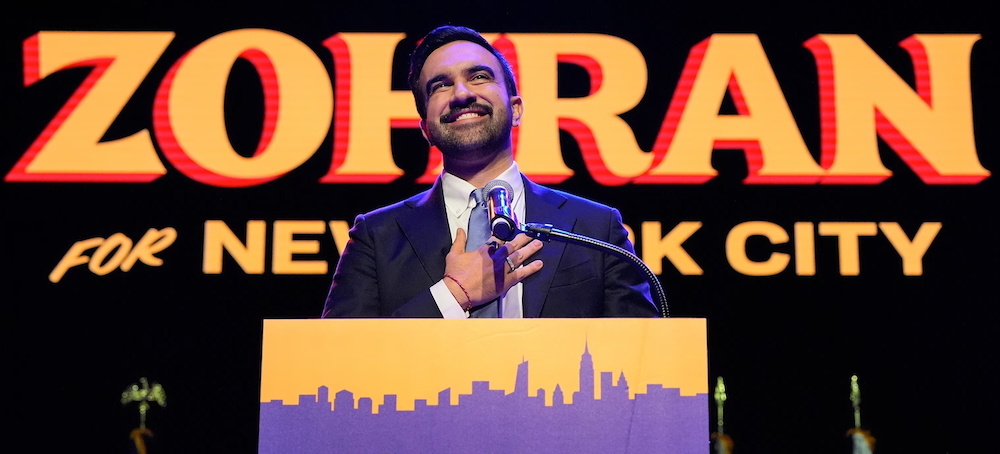
Democrat Zohran Mamdani delivers his winning remarks after a projected win of the New York City mayoral election. (photo: ABC)
Voters reject candidates and causes aligned with Trump's Republican
Party
Steve Peoples and Will Weissert/AP05 November 25
Democrats dominated the first major Election Day since President Donald Trump returned to the White House.
And while a debate about the future of the Democratic Party may have
only just begun, there are signs that the economy — specifically,
Trump’s inability to deliver the economic turnaround he promised last
fall — may be a real problem for Trump’s GOP heading into next year’s
higher-stakes midterm elections.
Democrats on Tuesday won governor’s races in Virginia and New Jersey,
the only states electing new chief executives this year. They also
swept a trio of state Supreme Court contests in swing-state Pennsylvania
and ballots measures from Colorado to Maine.
Trump was largely absent from the campaign trail, but GOP candidates
closely aligned themselves with the president, betting that his big win
last year could provide a path to victory this time. They were wrong.
Democrats are hoping the off-year romp offers a new winning playbook,
but some caution may be warranted. Tuesday’s elections were limited to a
handful of states, most of which lean blue, and the party that holds
the White House typically struggles in off-year elections.
Meanwhile, Republicans in Washington may be more excited than
Democrats that a self-described democratic socialist will become New
York City’s next mayor.
Here’s some top takeaways:
A new Democratic playbook emerges
Former Rep. Abigail Spanberger will become Virginia’s next governor —
and its first female chief executive — while Rep. Mikie Sherrill won
the New Jersey governor’s office by running campaigns focused largely on
the economy, public safety and health care.
Early results showed Democrats outperforming their margins from four
years ago in fast-growing suburbs, rural areas and even places with high
concentrations of military voters.
The Democrats won by actively distancing themselves from some of the
Democratic Party’s far-left policies and emphasized what Spanberger
described in her victory speech as “pragmatism over partisanship.”
A growing collection of Democratic leaders believe the moderate
approach holds the key to the party’s revival after the GOP won the
White House and both congressional chambers last year.
Above all, the Democrats in both states focused on rising costs such
as groceries, energy and health care, which Trump has struggled to
control.
In addition to tacking to the middle on economic issues, Spanberger
and Sherrill downplayed their support for progressive priorities,
including LGBTQ rights and resistance against Trump’s attack on American
institutions. Spanberger rarely even mentioned Trump’s name on the campaign trail.
Both also have resumes that appealed to the middle.
Spanberger is a former CIA case officer who spent years abroad
working undercover, while Sherrill spent a decade as an active-duty
helicopter pilot for the Navy before entering Congress. Both played up
their public safety backgrounds as a direct response to the GOP’s attack
that Democrats are soft on crime.
It’s (still) the economy, stupid
Trump and his Republican allies have been especially focused on immigration, crime and conservative cultural issues.
But voters who decided Tuesday’s top elections were more concerned
about the economy, jobs and costs of living. That’s according to the AP
Voter Poll, an expansive survey of more than 17,000 voters in New
Jersey, Virginia, California and New York City suggesting that many
voters felt they can’t get ahead financially in today’s economy.
Ironically, the same economic anxieties helped propel Trump to the
White House just one year ago. Now, the economic concerns appear to be
undermining his party’s political goals in 2025 — and could be more
problematic for the GOP in next year’s midterm elections, which will
decide the balance of power for Trump’s final two years in office.
That’s even as Trump regularly brags about stock prices booming and
boasted about leading a new renaissance of American manufacturing.
About half of Virginia voters said the economy was the most important
issue facing their state while most New Jersey voters said either taxes
or the economy were the top issue in their state. Just over half of New
York City voters said cost of living was their top concern.
It was unclear whether kitchen table concerns weighing so heavily on
voters might help break the impasse that has prompted the government
shutdown, which has spanned more than a month.
A referendum on Trump
This was the first election since Trump’s return to the presidency
and voters rejected candidates and causes aligned with his Republican
Party from Virginia and Pennsylvania to Maine and New Jersey. It was, in
fact, difficult to point to any significant victory for Trump’s party.
They also expressed strong feelings about the direction of the country under his leadership.
About 6 in 10 voters in Virginia and New Jersey said they are “angry”
or “dissatisfied” with the way things are going in the country today,
according to the AP Voter Poll. Just one-third said they are
“enthusiastic” or “satisfied.”
In a sign of the extent of the GOP’s struggles, Republicans lost the
Virginia attorney general’s race to Democrat Jay Jones, who was forced to apologize after text messages surfaced weeks before Election Day in which he depicted the murder of political opponents.
Fearing a bad night, Trump tried to distance himself from the election results.
The president endorsed Ciattarelli in New Jersey but held only a pair of tele-town halls on his behalf, including one Monday night.
Trump also did a Monday night tele-town hall for Virginia Republican
candidates, but he focused mostly in favor of the GOP candidate for
attorney general, who also lost.
Despite Trump’s distance, his policies — including his “big,
beautiful” budget bill and his massive cuts to the federal workforce —
played a central role in Virginia, New Jersey and even New York City’s
mayoral contest. And the Republicans in each refused to distance
themselves from the president or his agenda.
The results left the president ducking blame.
“TRUMP WASN’T ON THE BALLOT, AND SHUTDOWN, WERE THE TWO REASONS THAT
REPUBLICANS LOST ELECTIONS TONIGHT,” according to pollsters, he posted
on his social media account.
Trump planned to have breakfast Wednesday at the White House with
Senate Republicans who have so far opposed his calls to end the shutdown
by abandoning the legislative filibuster, the 60-vote minimum needed to
pass most major legislation though the Senate.
A new star for Democrats (and Republicans) in New York City
Moderates won in Virginia and New Jersey. But it was a self-described
democratic socialist who cruised to victory in New York City.
Zohran Mamdani, a 34-year-old state legislator who backs radical
changes to address economic inequality, will serve as the next mayor of
the nation’s largest city.
His bold agenda and inspirational approach helped generate the
largest turnout in a New York City mayoral race in at least three
decades. It also spooked some business leaders and voices in the Jewish
community, who otherwise support Democrats but oppose some of Mamdani’s
past statements about personal wealth accumulation and Israel.
Trump, who actually endorsed Mamdani’s independent opponent, former
Democratic Gov. Andrew Cuomo, falsely called Mamdani a communist on the
eve of the election.
Some Republicans in Washington were quietly rooting for a Mamdani
victory. Even before his win was final, Republican campaign committees
launched attack ads against more than a dozen vulnerable House Democrats
in New York and New Jersey linking them to Mamdani and his far-left
politics.
The ad campaign is expected to extend to Democrats across the country ahead of next year’s midterms.
More Democratic wins
The Democratic successes extended beyond Virginia, New Jersey and New York.
In Pennsylvania, Democrats swept all three elections for state
supreme court justices. The wins could have implications for key cases
involving redistricting and balloting for midterm elections — and the
2028 presidential race — in the nation’s most populous swing state.
Conservative causes struggled on ballot questions in other states as well.
Maine voters defeated a measure that would have mandated showing an
ID at the polls while approving a “red flag” rule meant to make it
easier for family members to petition a court to restrict a potentially
dangerous person’s access to guns.
Colorado approved raising taxes on people earning more than $300,000
to fund school meal programs and food assistance for low-income state
residents.
And in California, Gov. Gavin Newsom, frequently mentioned as a 2028 presidential hopeful, led a triumphant charge to redraw congressional maps to give Democrats as many as five more House seats in upcoming elections.
The push is the centerpiece of a Democratic effort to counter new
Republican maps in Texas and elsewhere that were drawn to boost the
GOP’s chances in next year’s fight to control Congress. For the new maps
to count in 2026, however, Californians had to vote on a yes-or-no
ballot question known as Proposition 50. It was easily approved.
Federal agents wait to detain people in an immigration courtroom in New York on Oct. 23.Conservative
Supremes have, without explanation, given ICE the OK to racially
profile and they are going for it with terrifying new tools and great
gusto
The Trump administration has given Immigration and Customs Enforcement an absolutely staggering amount of money to hurt immigrants, and they’re not letting it go to waste.
Fortunately for ICE—but unfortunately for everyone else—tech
companies are happily playing their part in building a truly dystopian
society, one where you are always under the administration’s gaze.
According to 404 Media,
ICE is using a facial recognition app to identify people, including
citizens. Videos show ICE agents stopping random kids on bikes and
people in cars and, if they don’t have or refuse to provide
identification, they point their little cellphones at them to scan their
faces.
ICE agents detain a protester in Chicago on Oct. 23.
The outlet wasn’t able to confirm which app ICE is using, but in the past they’ve used
Mobile Fortify, which contains 200 million images as well as data from
the State Department, Customs and Border Patrol, the FBI, and state
records. A scan of someone’s face returns detailed information,
including name, date of birth, nationality, and immigration status.
This sounds a lot like ICE now has the power to stop anyone
they want for no particular reason and demand they submit to biometric
screening to prove they’re a citizen. And if they aren’t, they’re
presumably arrested.
You’ll note in this grand plan that there’s nothing about the
probable cause ICE has to stop people with this high-tech version of
“papers, please.” Indeed, it looks a lot like ICE simply profiles people
and then subjects them to a search. Because that’s exactly what
scanning your face after detaining you is: a search.
Because we have the Fourth Amendment,
searches are supposed to be based on a reasonable, particularized
suspicion. In other words, law enforcement officers are supposed to have
a specific, reasonable concern about a specific person or persons
before stopping them. Otherwise, officers could just stop anyone at any
time for any reason.
Okay, well, we did have a Fourth Amendment. In September, the conservatives on the Supreme Court decided it’s A-OK
to racially profile Hispanic people, considering things like the
language they speak, their accent, where they're located, and what type
of work they do.
The majority didn’t bother to explain their reasoning, but we can all thank Justice Brett Kavanaugh for his smug concurrence describing how this would work in practice.
A cartoon by Mike Luckovich.
“If the officers learn that the individual they stopped is a U.
S. citizen or otherwise lawfully in the United States, they promptly
let the individual go,” he wrote.
Do they, Brett? Do they?
What about the more than 170 citizens who have been detained by ICE? What about Maria Greeley, a U.S. citizen born in Illinois, who was stopped by federal agents
and told that she didn’t look like she should have the last name
Greeley, presumably because she’s Latina and a service worker? Those
agents grabbed her, zip-tied her hands, and detained her based on their
racist ideas about what kinds of last names immigrants should have.
And
this is undoubtedly going to get worse as the Trump administration
leverages its cozy relationships with big tech companies helmed by
morally deficient billionaires.
ICE has partnered with Peter Thiel’s Palantir—to the tune of $30 million of your tax dollars— which is building “ImmigrationOS,” a cutesy little name for another tool of the surveillance state.
The justification for giving Palantir all of that money? It
will streamline the identification of immigrants and make their removal
more efficient. Also, without ImmigrationOS, ICE won’t be able to target
MS-13 and Tren de Aragua gang members … because we’re still pretending
this is about gang members.
The government also just gave
a different facial recognition company, Clearview, a cool $10 million
for access to its giant database to identify people who assault
immigration agents. Given how much the Department of Homeland Security lies about these so-called assaults, this looks much more like it will be a tool for identifying, targeting, and arresting protesters.
Palantir co-founder Peter Thiel
While DHS wants to know everything about you, they’re not very
interested in you knowing anything about them. Thanks again to the
complete moral collapse of big tech billionaires, any attempts to report the location of ICE agents or even to simply host videos of ICE’s past misdeeds have been obligingly deleted from app stores.
And don’t sleep on how handy it is for ICE to get unfettered
access to government databases. One of the big projects of the so-called
Department of Government Efficiency was to break down the firewalls
between government databases so the administration could better target
and torment immigrants. DHS demanded that the Internal Revenue Service
provide data for 7.3 million taxpayers in violation of privacy laws. And
when the acting general counsel refused to do this, the administration shoved him out.
The
government is pouring so much money into surveilling immigrants, but
it’s really doing double duty. Trump is in the process of creating an
ever-watchful government that has no guardrails.
And really, who is going to stop him?
"We can all thank [Kangaroo Court] Justice Brett Kavanaugh for his smug concurrence."
Just $25, and best of all, $17 from the sale of each plate will fund spay and neuter services for dogs and cats across Arizona. Click ad to order now at www.azpetplates.org ~~~~~~~~~~~~~~~~~~~~~~~~~~~~~
~~~~~~~~~~~~~~~~~~~~~~~~~
TO ADVERTISE ON OUR BLOG
The above are paid ads. To place yours for just $25/month, call Jim Keyworth at (928) 517-1103 or e-mail peoplesgazette@gmail.com. Banner ads are also available across the bottom and top of the blog.
(The Rim Country Gazette Blog is currently averaging over 5,000 visits per month. Our readership survey shows Gazette readers are better educated and more affluent than the average newspaper reader. Gazette Blog ads reach the people most likely to vote and to use your services and products.)


 Bob Bauer (right) served as White House counsel
under Democratic President Barack Obama. He joined Jack Goldsmith, who
worked for Republican President George W. Bush, in arguing that Trump
could dispute the 2026 midterms. (photo: Getty)
Bob Bauer (right) served as White House counsel
under Democratic President Barack Obama. He joined Jack Goldsmith, who
worked for Republican President George W. Bush, in arguing that Trump
could dispute the 2026 midterms. (photo: Getty)