Join us at our brand new blog - Blue Country Gazette - created for those who think "BLUE." Go to www.bluecountrygazette.blogspot.com

YOUR SOURCE FOR TRUTH

Tuesday, June 24, 2025

Trump's Juneteenth message: Americans get too many days off

no image description available
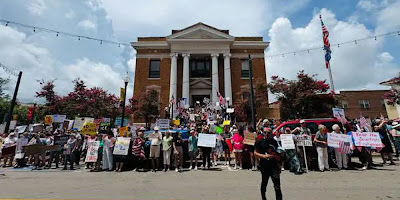
Many people celebrated Juneteenth, like this gathering in Oakland, California, but not Trump.

President Donald Trump bemoaned the Juneteenth holiday on Thursday, saying Americans get too many days off and that it is hurting businesses.

"Too many non-working holidays in America,” Trump wrote in a Truth Social post Thursday night. “It is costing our Country $BILLIONS OF DOLLARS to keep all of these businesses closed. 

The workers don’t want it either! Soon we’ll end up having a holiday for every once [sic] working day of the year. It must change if we are going to, MAKE AMERICA GREAT AGAIN!" 

There’s so much to break down from this ridiculous social media post it’s hard to know where to start.

First, it’s incredibly rich for Trump—who has spent many of the 151 days he’s been in office on the golf course rather than working—to say that American workers are given too much time off. 

Trump is also notorious for not working hard himself, beginning his days late with scheduled "executive time"—where he sits like a vegetable in front of cable news raging about how it's not covering him favorably enough.

What's more, companies aren't forced to close on federal holidays, as there is no law requiring that workers be given days off. That’s in stark contrast to other countries, where the government mandates that workers get vacation days. For example, in the United Kingdom workers must be given 28 days of paid vacation annually. And in France and Spain, workers receive five weeks of mandated paid leave. 

We’re sure that plenty of workers were toiling away on Thursday—I’m sure some readers here will let us know in the comments that their offices and workplaces were up and running.

Also, find us a worker who thinks, as Trump asserted, that they get too much vacation. We'll wait. 

What’s even more hypocritical is that Trump honored Juneteenth every year during his first term as president, even before it was a federal holiday. According to the Associated Press, he claimed once to have made the holiday “very famous.”

Ultimately, Trump was likely mad about Thursday’s federal holiday not because workers got the day off, but because of what the holiday represents—the day commemorating the emancipation of enslaved Black Americans. Juneteenth was, for many years, mostly celebrated by the Black community before former President Joe Biden signed a bill into law that made the day an official federal holiday. 

For Trump and his administration, they’d rather celebrate the traitorous Confederates, whose names they are now putting back on military bases across the country, than give workers the day off to celebrate the end of slavery. Gross.

You could call him a pig, but that would be insulting to all of pigdom.

Sunday, June 22, 2025

Trump Bombs Iran, Ignoring Congress and the Constitution

Donald Trump Bombs Iran, and America Waits  
President Trump speaks after US military bombed Iran's nuclear facilities. (photo: Carlos Barria/Getty)

"Donnie transforms from self-proclaimed peacemaker to warmonger.”
 
David Remnick / New Yorker

ALSO SEE: U.S. Enters War Against Iran

The United States joined Israel in its war against the Islamic Republic of Iran on Saturday night as President Donald Trump ordered American bombers to destroy three key nuclear sites. Just before 8 p.m., Trump went on Truth Social to deliver the news:

"We have completed our very successful attack on the three Nuclear sites in Iran, including Fordow, Natanz, and Esfahan. All planes are now outside of Iran air space. A full payload of BOMBS was dropped on the primary site, Fordow. All planes are safely on their way home."

In a brief television address at 10 p.m., Trump declared the operation a “spectacular military success” and said the three sites had been “completely and totally obliterated.”

In recent days, polls have shown that a majority of the American people, including a majority of the President’s supporters, opposed going to war with Iran. By ordering these strikes, Trump acted without congressional approval and in contradiction to his campaign promise to avoid the kind of disasters experienced in Iraq, Libya, and Afghanistan. 

I recently wrote a piece reviewing many of the dangers and possibilities that could follow an American bombing in Iran. After hearing the news, I immediately called one of the country’s most knowledgeable experts on Iran, Karim Sadjadpour. He is a scholar at the Carnegie Endowment for International Peace and worked as an analyst with the International Crisis Group in Tehran, from 2003 to 2005.

“I’m in shock,” Sadjadpour told me, about ten minutes after Trump’s announcement. “I’m sitting here watching this on CNN and trying to see the reaction on Persian-language Twitter.”

“This is unprecedented, dropping a thirty-thousand-pound bomb,” he continued. 

“Anyone who has observed the last two decades of history in the Middle East would think hard about unleashing such an attack. You would want to think several steps ahead, and there is no evidence that the President has done that. His tweet and his public comments have given the impression that this is the end of war and the commencement of peace, but I suspect the Iranians think differently. They have a program on which they have spent hundreds of billions of dollars. The regime—perhaps not the people, but the regime—takes pride in that and now it is destroyed. No dictatorship wants to look emasculated and humiliated in the eyes of its own people.”

The question now is how Iran will respond. “If the Ayatollah [Ali Khamenei] responds weakly, he loses face,” Sadjadpour said. “If he responds too strongly, he could lose his head.”

“A lot of the options that they have for retaliation are the strategic equivalent of a suicide bombing,” he went on. “They can do enormous damage to our embassies. They might mine the Strait of Hormuz. They can continue missile barrages against Israel. They can attempt to do real damage to the world economy, though the regime might not survive the blowback.”

In the past couple of weeks, Israeli intelligence and bomber pilots have wiped out much of the upper echelons of the Iranian security establishment, along with the country’s top nuclear scientists. The Islamic Revolutionary Guard Corps is still in place, however, and, according to numerous analyses, they are likely to fill any power vacuum, at least in the short term. But the truth is, Sadjadpour said, the events of the coming days and months will be hard to predict.

Will the Israelis or Americans ever come forward with hard, convincing evidence about the Iranian nuclear threat and its timing? Not for the first time, Benjamin Netanyahu asserted that the threat was imminent and acted on it, and yet he did not provide the public with clear evidence of Iran being close to obtaining a nuclear weapon. Nor did Trump. Israel and the United States have now set back Iran’s nuclear program as never before. And yet, if this regime survives, it could well make a secret effort in the future to produce or obtain an atomic weapon as deterrence against a repeat of the strikes that have just taken place.

“Will we look back and say this prevented an Iranian bomb or insured one?” Sadjadpour said. “Similarly, have we hastened the demise of the regime, or have we entrenched it? The modern history of the Middle East does not give favorable answers to these questions. Iran is in a unique situation. It’s plausible that the Revolutionary Guard commanders will look at the Supreme Leader, Khamenei, and say, ‘You have led us to ruin. We have been the most sanctioned and isolated country in the world, and now your nuclear program is destroyed and we are humiliated. It is time to move aside.’ ”

Khamenei is eighty-six, and has been in power since 1989. “He’s one of the longest-serving dictators in the world—you don’t get to be that by being a gambler,” Sadjadpour said. “He has instincts for survival but also instincts of defiance. Right now, his survival instincts and his defiance instincts are in tension. Imagine it: You are eighty-six with the physical and, perhaps, cognitive limits that come with that. You have limited bandwidth, but now you are meant to lead a war against the U.S., the world’s biggest superpower, and Israel, the region’s biggest military power, and you are doing it from a bunker. It is hard to see how the outcome can be positive for him.

“But, as we have learned too often in history, military success doesn’t always translate to political success. In my opinion—and maybe history will view it differently—so much that we do now as a nation is not a reflection of national deliberation or national interest. It is the impulse of one man. Trump came to office believing his mere presence would resolve world conflicts in twenty-four hours: Russia-Ukraine, Israel-Palestine. When Trump saw that he wasn’t successful, he had a great sense of urgency to come to a resolution in Iran. The combination of Netanyahu’s persistence and Khamenei’s defiance transformed Trump from a self-proclaimed peacemaker to a warmonger.”

In Saudi Arabia last month, Trump delivered an extraordinary speech that was highly critical of military interventions and nation-building adventures in the Middle East. “In the end, the so-called nation builders wrecked far more nations than they built,” Trump said. “And the interventionalists were intervening in complex societies that they did not even understand.”

During his speech, Trump seemed to draw a sharp distinction between himself and Republican predecessors such as George W. Bush, saying, “In recent years, far too many American Presidents have been afflicted with the notion that it’s our job to look into the souls of foreign leaders and use U.S. policy to dispense justice for their sins.” It is this kind of rhetoric that has won the approval of the isolationist strain of the maga movement and the Republican Party, including Steve Bannon and Tucker Carlson. Trump’s action in Iran Saturday night will inevitably alienate that faction as it earns praise from the likes of Fox News commentators such as Mark Levin and Sean Hannity, as well as Senators Ted Cruz and Lindsey Graham.

“Trump came to the Presidency with a Nixon-goes-to-China idea where Iran is concerned,” Sadjadpour said. “He wanted to build hotels there. And now he has dropped a thirty-thousand-pound bomb. He was frustrated that he hadn’t solved Gaza or Ukraine. The nuclear deal that Obama worked out with Iran and the rest, the J.C.P.O.A., was a two-year-long negotiation. He had no patience for that. And when Khamenei wasn’t agreeing to his terms very quickly, and when he encountered Netanyahu’s persistence and Khamenei’s resistance, he changed. The morning after the Israeli invasion, Trump wanted to associate himself with that success. He didn’t want Netanyahu alone to have a Churchill moment. He wants to be remembered for destroying nuclear facilities. But it means the next President will be faced with the same challenge.”

Although it is true that many Iranians despise the ruling theocracy, and though it is true that the Iranian people are among the most pro-American in the region, there is no reason to be confident that even the most restive will welcome foreign intervention. And it is unlikely, at least in the short term, that what will follow this regime, if it falls, will be a secular liberal democracy with civil rights for women and religious minorities. Regime change is rarely, if ever, regarded as a gift. The C.I.A. and British oil companies helped the Army topple Mohammad Mosaddegh, a popular Iranian Prime Minister, in 1953, and that coup is still part of the political conversation in Iran, Sadjadpour said.

“From World War Two to 2010, more than half of authoritarian regimes that fell were followed by other authoritarian regimes, and Iran, in 1979, is just one of many,” he said. “Only a quarter of them led to democracy. And that number was lower if it was triggered by violence or foreign military invasion. We should be very wary of the idea that what happened tonight will somehow automatically lead to a democratic Persian Spring.”

Friday, June 20, 2025

Does America Have Secret Police Now?

 Does America Have Secret Police Now? 

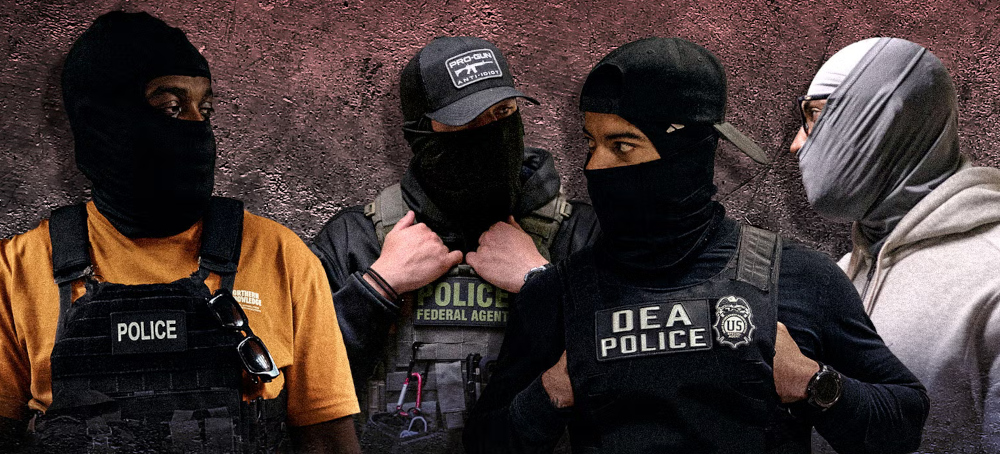
"Of all the things this Trump term, the rapid normalization of masked law enforcement disturbs me the most."  Whose country is this, anyway? (photo: Slate)

 
Masked MAGA Thugs Grabbing People Off the Streets Much More Frightening Than Civilian Protests
 
Sam Adams / Slate  

In It Was Just an Accident, the first movie from Iranian dissident Jafar Panahi after his 2022 arrest for making anti-state propaganda, a small-town mechanic suspects that the stranger who stops by his garage late one night is the same man who tortured him while he was in prison. The mechanic vows to take revenge, but there’s a problem: He never saw the man’s face, and all he has to go on is the telltale squeak of his tormenter’s prosthetic leg. 

Unable to stifle the nagging feeling that he might have the wrong man, the mechanic tracks down more and more victims, each of whom tries to identify their torturer in their own way, by the scars on his thigh or his familiar smell. After a while, what started out as an anguished vigilante mission starts to feel more like a lopsided farce. Without the ability to identify the person who wronged them, the very idea of justice becomes a joke.

I thought of Panahi’s movie today, as I watched the video of federal agents handcuffing New York City Comptroller Brad Lander inside an immigration courthouse in lower Manhattan after he demanded to see a judicial warrant for the migrant man they were attempting to arrest. Lander, who is also running for mayor in New York’s Democratic primary, is a familiar face around the courthouse. The agents knew exactly whom they were taking into custody: Minutes beforehand, a reporter heard one asking another, “Do you want to arrest the comptroller?” But who those agents were, or even who they worked for, is more difficult to pin down. Because, in what has become a familiar—and, if you spend enough time on the internet, practically daily—sight, they were hiding their faces behind masks. Even as the New York Times’ story on the situation carried the headline that Lander had been “arrested by ICE,” in the body of the article, the reporter hedged his bets, identifying the individuals only as “several men who appear to be law enforcement officers.”

“Men who appear to be law enforcement officers” is a broad category, and one we have already had chilling familiarity with this week. The suspect in the murders of Minnesota Rep. Melissa Hortman and her husband, Mark, was able to acquire enough gear to convincingly impersonate a police officer, at least for long enough to get his victims and actual police officers to let their guards down. 

On Tuesday in New York, one of the men who took Lander into custody was dressed in a backward baseball cap and faded jeans, a guy you wouldn’t think twice about passing on the street, except guys who fit that description rarely go around wearing surgical masks over their salt-and-pepper beards these days. 

By law, federal agents are allowed to cover their faces, in order to protect themselves from retaliation by drug cartels and the like. But masked Immigration and Customs Enforcement agents seem to have become the rule rather than the exception. 

Scroll through the bystander videos of ICE raids on any social media platform or news publication, and you’ll struggle to find a single identifiable face. It’s difficult to put a finger on exactly when the practice became widespread, especially since the volume of ICE raids has increased so dramatically so recently (and has received corresponding increased attention). But go back even a year, and it’s relatively easy to find coverage of ICE raids in which the agents’ faces are clearly visible.

Trump administration officials frame broad masking, when they bother to justify it at all, as a response to an epidemic of retaliation. “Federal agents and their children are being threatened, doxxed, and assaulted,” said U.S. Attorney for Massachusetts Leah Foley, who was appointed on Donald Trump’s first day in office, in a post on social media. “That is why they must hide their faces.”

Foley should know that disclosing restricted personal information about federal employees is already a crime, as is threatening them or their families. Allowing agents to mask indiscriminately doesn’t just protect them; it also risks emboldening them to stretch the boundaries of the law. We’re already aware of the risk of allowing law enforcement agents to act anonymously—that’s why police officers have badge numbers. And while recent polls show Americans divided on their overall support for ICE, a substantial majority say that agents should be required to wear uniforms, and less than 40 percent say they should be allowed to cover their faces.

Even if you accept that there are some circumstances in which agents need to conceal their identity, there’s something profoundly jarring about how quickly the sight of masked agents detaining unarmed civilians has become a commonplace. In a different context (like, say, an Oscar-winning film set during Brazil’s military dictatorship), the specter of faceless men grabbing people off the streets is instantly recognizable as the mark of a totalitarian society. But here, it’s become almost unremarkable, like a nagging car alarm.

Given that ICE has, according to its own statistics, deported more than 65,000 people in Trump’s first 100 days and currently has another 50,000 in custody, often in blatant defiance of orders from federal judges, wearing masks is arguably somewhat low on the list of the agency’s most egregious offenses. 

But I can’t stop thinking about the rapid normalization and what it means about how quickly we have processed this Trump term. It’s a basic principle of civil society that the increased power given to law enforcement officials is balanced by increased oversight, because the one without the other presents an almost irresistible temptation for abuse. 

Yesterday, two California lawmakers put forth a bill to ban local, state, and federal law enforcement officials from covering their faces while on the job, because, as the bill’s co-author Sen. Scott Wiener put it, “we’re at the risk of having, effectively, secret police in this country.” The Department of Homeland Security, which oversees ICE, responded with a social media post calling the proposed law “despicable.”

This has been the playbook. After Lander was arrested (he was released later in the afternoon), DHS official Tricia McLaughlin issued a statement accusing him of “assaulting law enforcement.” 

This echoed the incident last week when California Sen. Alex Padilla was thrown to the ground and handcuffed after he’d shouted out his name and attempted to ask Kristi Noem a question during a press conference. DHS accused of him of “lung[ing]” toward Noem, despite numerous videos showing that he did nothing of the sort. As Padilla was shoved out of the room by the Secret Service, you could hear Noem going on about ICE agents being “doxxed for doing their duty,” once again claiming that being able to put a name to an agent of state enforcement presents an intolerable risk.

And yet, when it came to explaining why a U.S. senator had been put in handcuffs—why, in fact, the incident was entirely his fault and why placing a federal lawmaker in custody did not warrant so much as an apology—Noem had a simple explanation. Padilla, she told Fox News, “did not identify himself.”  Another lie.  He clearly did.

Tough guy Trump hides his illegal thugs behind masks.  What is he so afraid of?


Wednesday, June 18, 2025

Trump Flunks The Tyrant Test

 .The Tyrant Test  

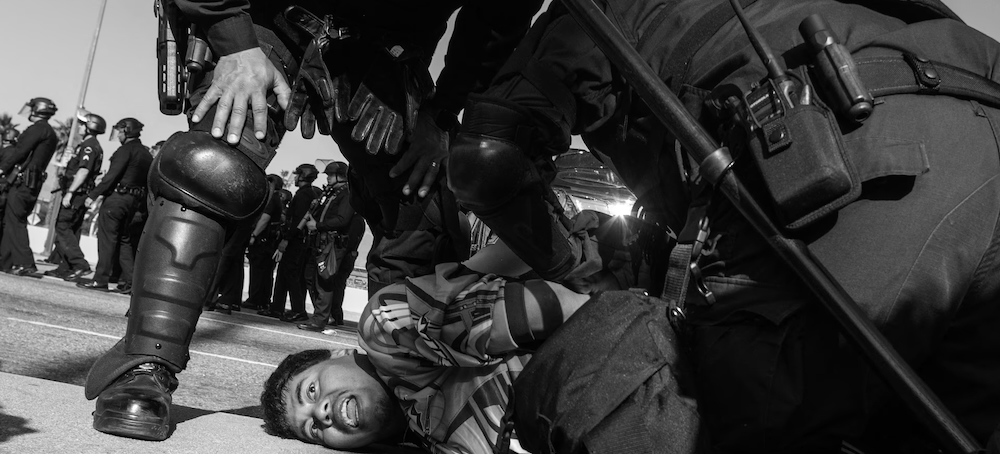
California Highway Patrol officers arrest a demonstrator in the overpass of the 101 freeway as protests continue in response to federal immigration operations in Los Angeles on June 10, 2025. (photo: Apu Gomes/AFP/Getty Images)
 
"A leader who uses military force to suppress his political opposition ought to lose the right to govern" 
 
Adam Serwer / The Atlantic  


For as long as I’ve been alive, American presidents have defined tyrants by their willingness to use military force against their own people in reprisal for political opposition. This was a staple of Cold War presidential rhetoric, and it survived long into the War on Terror era.

Ronald Reagan declared in 1981 that “it is dictatorships, not democracies, that need militarism to control their own people and impose their system on others.” 

His successor, George H. W. Bush, did the same in 1992, talking about American presidents confronting the Warsaw Pact, which had been “lashed together by occupation troops and quisling governments and, when all else failed, the use of tanks against its own people.” 

Bill Clinton, when justifying strikes against the Iraqi dictator Saddam Hussein in 1998, emphasized that Hussein had used his arsenal “against civilians, against a foreign adversary, and even against his own people.” 

George W. Bush repeated that justification when invading Iraq in 2003, saying that Hussein’s government “practices terror against its own people.” Barack Obama, when intervening in Libya on behalf of rebels fighting Muammar Qaddafi, warned that Qaddafi had said “he would show ‘no mercy’ to his own people.”

It would be absurd to say that American presidents have always been principled defenders of freedom and democracy, but their long-shared, bipartisan definition of tyrant is one who oppresses his own. So it’s striking that these warnings about tyrants in distant lands, who were supposedly the opposite of the kind of legitimate, democratic leaders elected in the United States of America, now apply to the sitting U.S. president, Donald Trump. It is a simple but morally powerful formulation: A leader who uses military force to suppress their political opposition forfeits the right to govern. You could call this the “tyrant test,” and Trump is already failing it.

Trump came into office promising to carry out a “mass deportation” of undocumented immigrants. Because of a degraded information environment riddled with right-wing propaganda, many Trump supporters came to think this meant he would target criminals whom the Biden administration allegedly was allowing to rampage freely throughout America. 

Instead, driven by Stephen Miller, immigration authorities have targeted workers, families, and asylum seekers—people who show up to their ICE appointments—for deportation. Agents have raided schools, workplaces, and homes—masked and out of uniform—methods more akin to secret police than civilian law enforcement in a democracy. 

Some deportees have been sent to a Gulag in El Salvador, while others have vanished or been expelled to third-party countries where they face dangerous circumstances. Predictably, these heavy-handed tactics have produced a backlash, most extensively in Los Angeles, where the Trump administration has sent detachments of Marines and the National Guard to discourage American citizens from expressing opposition to these methods.

Although there are circumstances where an intervention by the National Guard might be justified, such a decision typically involves the judgment of local authorities—and what’s happening in Los Angeles now is nothing like Arkansas’s school-segregation crisis in 1957, when President Dwight D. Eisenhower federalized the Guard to protect Black students facing a racist mob trying to prevent them from attending school.

Targeting California is no accident. Republican propaganda consistently paints blue states such as California as unlivable hellholes. 

Some of the protests have been violent and have given way to vandalism, but not at a level that requires a military deployment, regardless of right-wing propaganda outlets’ best efforts to depict L.A. as a city on the brink of destruction. 

American service members have been ordered there not to protect their compatriots but to intimidate them at gunpoint for the sin of opposing the president. On Friday, for the first time, U.S. Marines detained a civilian, in apparent violation of the Posse Comitatus Act. The person in question was an Army veteran headed for the Veterans Affairs building in L.A.

The president and many of his prominent supporters seem eager for escalation. Trump has said that Los Angeles has been “invaded and occupied by illegal aliens and criminals,” and that “violent, insurrectionist mobs” have been “swarming and attacking” immigration-enforcement officers. Vice President J. D. Vance posted on X that “insurrectionists carrying foreign flags are attacking immigration enforcement officers, while one-half of America’s political leadership has decided that border enforcement is evil.”

Miller accused L.A. Mayor Karen Bass, who had pointed out that the city had been more peaceful prior to the administration’s response, of “insurrection.” Homeland Security Secretary Kristi Noem, who has been urging Defense Secretary Pete Hegseth to use the military to detain American citizens, vowed at a press conference to “liberate the city from the socialists and the burdensome leadership that this governor and that this mayor have placed on this country and what they have tried to insert into the city”—just moments before federal officers forcibly removed Senator Alex Padilla of California and pushed him to the ground when he tried to ask questions.

Right-wing media, aware that the administration’s actions and rhetoric resemble those of dictatorships, have been telling their audiences that the protests have all been cooked up by Democrats to trap Trump into acting like a dictator—never mind his obvious fondness for dictatorship. “Democrats are causing mayhem in their cities, so when Trump restores order, they can label him a dictator and stir up even more hatred and violence against him,” the Fox News host Jesse Watters said on Monday. “They’re burning their own cities just to prove to their bloodthirsty base that they’re fighting Trump in the streets, burning their own cities for power.” Someone might be bloodthirsty, but it’s not the Democrats.

If L.A. had been taken over by insurrectionist mobs, the Trump modus operandi would be to pardon them and give them money—though only insurrectionists who try to overthrow the government on Trump’s behalf, of course. Instead, the protests provoked by the administration’s authoritarian tactics appear to be mere pretext for using force against Trump’s political opposition. 

The L.A. police chief, Jim McDonnell, said the city’s police force could handle the protests without assistance, but such a move would deny Trump his excuse for using the military against Americans who have the temerity to oppose him. This has long been a fantasy of Trump’s—he praised China’s crackdown on the Tiananmen Square protest movement as having “put it down with strength.” Last week, he warned that anyone who protested his wasteful, self-worshipping military parade would be met “with very big force.”

How did Republicans go from condemning leaders who threaten their own citizens to becoming sycophants for one? Here, too, we find a holdover of Cold War rhetoric: the use of Third World to describe multicultural communities such as Los Angeles.

In the 1950s, the terms First World, Second World, and Third World emerged as a means to describe Western-aligned nations, Soviet-aligned governments, and emerging nations not allied with either faction, respectively. Third World soon came to be used as a pejorative term for poor, nonwhite countries—full of human beings who could be considered disposable.

And that’s exactly how Trump officials and their allies are referring to communities such as Los Angeles in order to justify using military force. Last night, following the massive “No Kings” protests across the country, Trump posted on his social network Truth Social that he was directing ICE to “expand efforts to detain and deport Illegal Aliens in America’s largest Cities,” which he called “the core of the Democrat Power Center”; he further described immigration as turning America into a “Third World dystopia.”

The post echoed similar language from right-wing-media figures who, last week, began repeating the same rote talking points about the need to ban all “Third World” immigration. The conservative podcaster Charlie Kirk, who spoke at Trump rallies during the 2024 election campaign, displayed on his podcast, as part of an argument for Trump using the military to “take back the streets of LA. Do it and do it fast,” a chart from a white-nationalist website showing the white population of Los Angeles declining. Kirk also made explicit that he wasn’t borrowing just the chart from a white-nationalist website but also its ideological conclusions about the threat that nonwhite people pose. 

“This is the Great Replacement Theory,” Kirk explained. “Remember we talked about how they want to replace white Anglo-Saxon Christian Protestants with Mexican, Nicaraguans, with El Salvadorians.” The term Anglo-Saxon Christian Protestants is wildly archaic, 1930s racism. What’s next in the Republican-aligned podcast world? Rants about swarthy Sicilians and perfidious Jews?

The increased support Trump received in the 2024 election from nonwhite voters hasn’t altered prominent Trump proponents’ view that America is the white man’s birthright and that all others are merely interlopers. “The deeper goal is to reshape America demographically. It is to make America less white, less European by descent,” The Daily Wire’s Matt Walsh declared. “You’re not gonna destroy Western civilization just by winning the next midterms or whatever. You destroy it by importing non-Western people.”

These ideas weren’t coming from just commentators. Attorney General Pam Bondi said L.A. “looked like a Third World country” on Fox News; Miller posted on X that “huge swaths of the city where I was born now resemble failed third world nations. A ruptured, balkanized society of strangers.” If Los Angeles is “balkanized,” that is because it has a long history of being forcibly segregated by race, starting decades before Miller was born. 

But here, Miller’s objection is not a call for integration but an expression of rage that the city is less white than it used to be. On Thursday night, Trump said “illegal aliens” were turning America into a “Third World Nation” and declared, “I am reversing the invasion. It’s called remigration,” using a European far-right term for ethnic cleansing of nonwhite immigrants from European countries, regardless of status or citizenship.

The math here doesn’t take much effort. In the view of these officials and commentators, California (and, by extension, America) has been ruined by immigration from Latin America, Africa, and Asia, which is what makes mass deportation and the use of American military force against their own people necessary. As it happens, this coincides rather neatly with Miller’s expressed view that the repeal of racist restrictions on immigration in the 1960s destroyed the country. 

Both inside and outside the administration, the consensus of prominent Trumpists is that if you are not white, you are a threat to Western civilization. This is how they rationalize Trump failing the tyrant test—the threat of military force is being made against people the administration and its propagandists want you to see as not truly American.

This is how a tyrant thinks. Every dictator who has ever cracked down on political opposition has done so by rendering them internal foreigners in rhetoric and deed, invaders of the body politic who can justly be crushed like insects. 

Those serving in uniform, military or civilian, should ask themselves whether becoming a tyrant’s instrument against their own communities is what they had in mind when they signed up.

Only whites from South Africa need apply - except for my wives present and future.

Monday, June 16, 2025

From massive protests to a puny parade, America really let Donald Trump down | Opinion


All he wanted was to celebrate his birthday with a massive military parade that made him look powerful and beloved. Instead he got a derpy, dull parade overshadowed by massive nationwide protests.

(Gazette Blog editor's note: Thanks to USA Today for publishing this column and in doing so reminding us of the importance of a free press.) 

Portrait of Rex Huppke Rex Huppke
 
Well, Americans, I hope you’re happy with yourselves. You really let President Donald Trump down June 14.

All he wanted was to celebrate his 79th birthday with a massive military parade that made him look powerful, scary and beloved. Instead, thanks to millions of Americans and their stupid First Amendment rights, he got a derpy, dull parade overshadowed by massive nationwide protests denouncing him.

People from Virginia to California and everywhere in between were hoisting signs that said mean things about President Trump like “IF MELANIA DOESN’T HAVE TO LIVE WITH HIM…WHY DO WE?” and “You sucked in Home Alone 2,” referring to the 1992 movie in which Trump had a cameo.

The American Civil Liberties Union, one of the organizers of the "No Kings" protests, said in a statement, “More than five million people nationwide rallied at over 2,100 events across the country, condemning President Trump’s escalating abuses of power.”

Way to go, America. You ruined Trump's parade and made him sad

Defense Secretary Pete Hegseth talks to President Donald Trump during the U.S. Army's 250th birthday parade in Washington, DC, on June 14, 2025.

Nice job, guys. Do you know how hurtful that was for a man who just wanted to have a cool birthday parade that would make him feel like a powerful dictator?

While those protests were massive and made a clear and peaceful point that Americans, only six months into the Trump administration, are fed up, they completely took the shine off the parade in Washington, DC.

The weather there was cloudy with a little rain, the crowd was thin and, while an announcer gave an interesting history of the U.S. Army on its 250th anniversary, the dull pace of tanks and other military vehicles made the event drag.

Troops marched past the VIP section where Trump and administration officials were seated, but they weren’t marching in carefully choreographed lockstep like troops have done in past military parades for notorious authoritarians.

Trump was bored and angry during the parade, while protesters had fun


It all felt a bit phoned in and drab. A New York Times reporter noted: “The energy level at the military parade here is a bit desultory.”

And Trump? He looked like a kid who wanted a Nintendo Switch 2 for his birthday and instead got a desultory military parade.

He sulked. He slouched. At one point, the band played an instrumental version of Creedence Clearwater Revival’s “Fortunate Son,” a famous anti-war song that decried wealthy families able to keep their kids out of the draft during the Vietnam War. That probably made Trump’s bone spurs hurt.

How dare Americans protest instead of bolstering the president's ego

Protesters in Amarillo, Texas, on June 14, 2025, part of nationwide "No Kings" demonstrations against the Trump administration.

Through it all, Defense Secretary Pete Hegseth sat next to the president, looking like a guy about to be held accountable for not making the parade “strong” and “huge” enough.

But it wasn’t all Hegseth’s fault. This was the fault of all the Americans who chose to take our president’s special day and make it about America. You meanies decided that standing up against government-sponsored cruelty against immigrants and vast federal overreach was more important than letting the guy behind the government-sponsored cruelty and the overreaching have a glorious parade that would make everyone think he’s awesome.

For shame, Americans. President Trump has been working tirelessly to enrich himself and not do any of the things he said he would do, other than the be-cruel-to-immigrants thing, and this is how you repay him? By making his parade seem puny and sad while making your own grievances seem widespread and legitimate?

A bad weekend led to Trump going off on liberal cities

Trump was so mad about how the weekend went that on the night of June 15 he announced on social media that “we must expand efforts to detain and deport Illegal Aliens in America’s largest Cities, such as Los Angeles, Chicago, and New York, where Millions upon Millions of Illegal Aliens reside. These, and other such Cities, are the core of the Democrat Power Center, where they use Illegal Aliens to expand their Voter Base, cheat in Elections, and grow the Welfare State, robbing good-paying Jobs and Benefits from Hardworking American Citizens. These Radical Left Democrats are sick of mind, hate our Country, and actually want to destroy our Inner Cities.”

Look what you all did! You made the poor man completely lose his mind and start babbling like a maniac who capitalizes words For No reason!

I hope you’re happy with yourselves.

I certainly am. 😈

Follow USA TODAY columnist Rex Huppke on Bluesky at @rexhuppke.bsky.social and on Facebook at facebook.com/RexIsAJerk


Sunday, June 15, 2025

One of Largest Days of Protest in American History


Indivisible Team info@indivisible.org

Sat, Jun 14, 7:40 PM (17 hours ago)


"Protesters were peaceful, organized, and above all -- they were brave"

With a few rallies and marches still ongoing, we can already say that No Kings Day is one of the largest days of protest in American history. 

From deep red small towns to our largest cities, millions of people turned out to make clear that the American people will not bow to fascism. 

The protesters were peaceful, organized, and above all -- they were brave. 

Trump has made no secret of his willingness to use force to crush dissent. He’s got tanks rolling through DC and marines in Los Angeles where we’ve all seen (and continue to see) police respond aggressively to peaceful protests.

And on top of those authoritarian images, we awoke this morning to the news of horrific political violence in Minnesota, where Democratic Rep. Melissa Hortman and her husband were slain and Democratic Sen. John Hoffman and his wife were wounded. 

It is a frightening time in our history. But in spite of that reality -- or rather, in response to that reality -- over five million people here in the US, along with allies in cities from London to Tokyo, stood united today in the belief that democracy is worth fighting for. 

Please join us on Monday 8pm ET/5pm PT for a national call with No Kings partners on how we continue that fight in the months ahead and build off the energy and momentum of today’s protests. 

The scale of today’s mobilization cannot be overstated. 

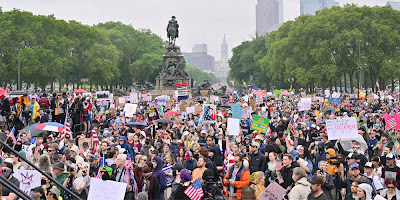
Philadelphia, PA

large crowd shot in Philadelphia

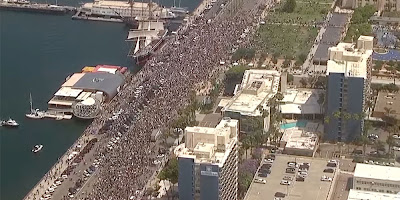
San Diego, CA

Overhead shot of a massive crowd in San Diego

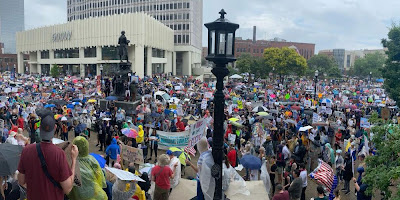
Louisville, KY

Close up of the crowd in Louisville

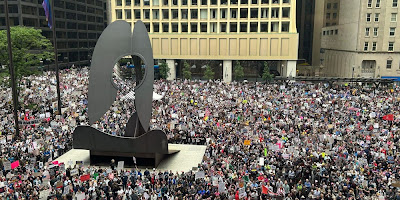
Chicago, IL

overhead shot of massive crowd in Chicago

Hattiesburg, MS

Crowd outside a building

Lambertville, NJ

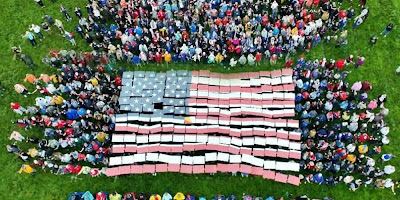
Crowd holds up colored papers to collectively reveal a giant American flag

To get a sense of how much today’s protests eclipsed Trump’s birthday parade, just do a search of virtually any US city on social media. The top results are likely No Kings protests, with videos that show crowd sizes that photos just can’t do justice. 

We’ve said that a massive, nationwide mobilization like today can change the narrative, grow our movement, build our organizing muscles, and deliver a jolt of courage -- something much needed after Trump’s recent attempts to quash dissent with violence.

But a single day of protest -- even historically large protests like today -- will not alone defeat the fascist takeover of our government. 

We need to ensure that the incredible organizing and inspiring courage of today’s protests continue to spread. We need to do the hard work of organizing those who turned out today and those who were watching into a sustained, broad-based movement that’s prepared for the hard work that comes ahead.

Friday, June 13, 2025


"True power comes from the people, and on June 14 we must prove it"


"Aura of inevitability is a lie"


"Trump will only succeed if everyone agrees to believe the lie."

Leah Greenberg

Co-Executive Director

Indivisible 

Over the last six weeks, we’ve gotten the occasional question about why Indivisible, together with our coalition of incredible partners, called for No Kings Day on June 14.

Why another protest? What is it going to accomplish? Shouldn’t we be [insert alternate tactic] instead?

These are good-faith questions, and they stem from very reasonable concerns. The speed, scope, and scale of the MAGA assault -- on our rights, our neighbors, our democracy -- is staggering. The stakes are enormous. There are days when nothing we’re doing feels sufficient to the magnitude of the horrors we face.

Protest is a tactic. And with any tactic, there’s a danger of tactical freeze, of it getting stale, of deploying it without a real strategy in mind. And it’s easy to look at any single protest and ask, “what did that even accomplish? What was the point?”

So I want to take a step back and talk about the role of a peaceful mass mobilization like No Kings in the context of our strategic analysis.

If you’ve been listening to us over the last few months, you’ve heard us talk about the idea of autocratic breakthrough -- a period when a would-be dictator basically sprints to consolidate their power, crush the institutions and people who could push back, and create a chilling climate for everyone else. 

For the would-be dictator, success depends on projecting power and creating an aura of inevitability. They need you to believe that Trump is the new normal, that the MAGA movement will be in power for the long haul, that the only rational move is to go along, keep your head down, and protect your own interests. 

We’ve seen over the last six months what happens when this aura of inevitability goes unchallenged. Institutions -- from state governments to businesses to civil society to higher education to media -- start to fall in line, do what Trump tells them, and/or go silent.

Here’s the thing: The aura of inevitability is a lie. It’s all a lie. Power in American society doesn’t derive from the top down. Trump’s grasp is brittle, and he’s overreaching dramatically. He will only succeed if everyone agrees to believe the lie.

Or, as our friend Reverend Barber says: A king is only a king if we bow down.

Countering the aura of inevitability requires a hundred different tactics and strategies. It looks like making an example of Target for obeying in advance and getting rid of its DEI policies. It looks like protesting and toxifying Elon Musk until he bows out of government. It looks like students at Georgetown making a list of Big Law collaborators and organizing their peers to steer clear. It looks like federal workers refusing to obey illegal or unethical orders. It looks like building the muscles and the relationships for collective action.

In short, it requires a countless number of people in a countless number of places to do something that the Trump regime doesn’t want them to do, or to NOT do something the Trump regime wants them to do. That’s how we shake off the aura of inevitability and halt the autocratic breakthrough.

For that to happen, people need to feel like we’re part of something bigger. We need to understand that we’re part of a movement. We need to feel like we will win.

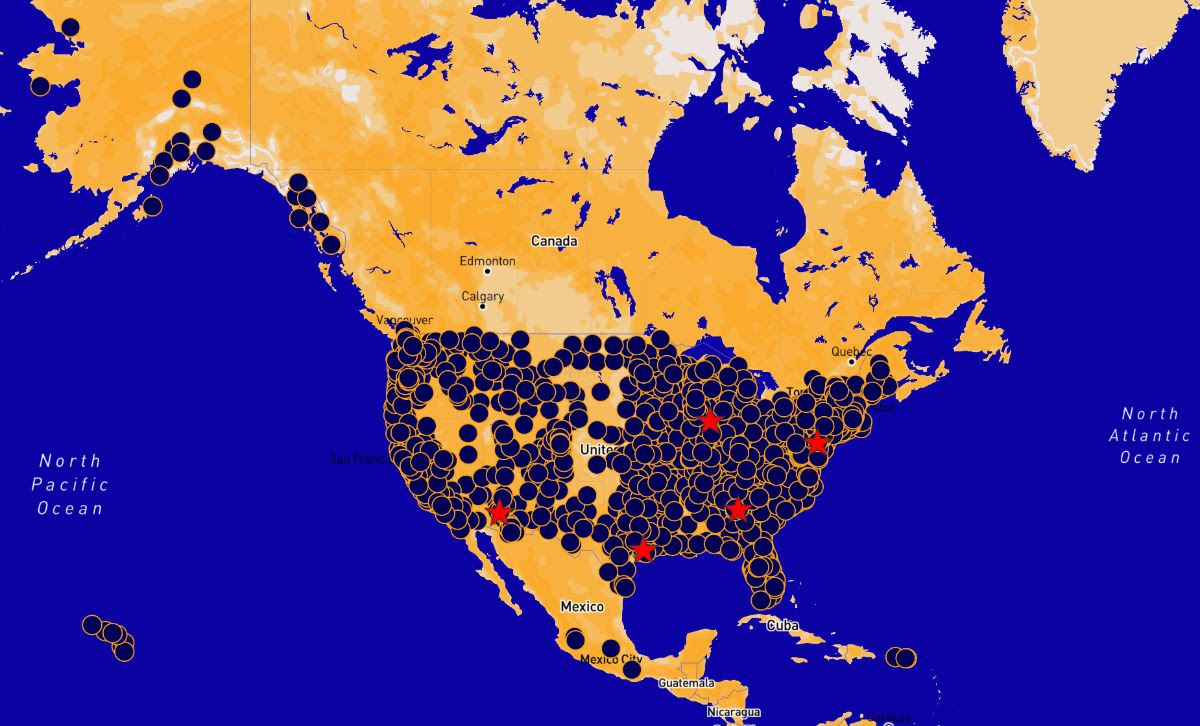
That’s where No Kings comes in. With 1,800 events nationwide, in every state, this will be the single largest protest of this Trump administration.

A map of No Kings events across North America

A single mobilization won’t turn this ship around. But it can do a few very important things:

Change the narrative. A massive show of popular opposition everywhere in the country can disrupt Trump’s effort to project strength. It shows that resistance is big, powerful, growing, and everywhere.

Bring in new people. A mobilization of this scale and scope reaches people who aren’t yet engaged, and -- if done right -- helps to draw them into a cycle of action and relationships on the ground.

Foster community. When you show up, you realize that not only are you not alone -- you’re actually part of something enormous. And that helps to build the shared sense of identity we’ll need for the path ahead.

Spread courage. After Hands Off!, we heard from people in positions of power within institutions -- law firms, universities (one big university, in fact), and elsewhere -- who told us they were emboldened by the protests to push back on pressure from the Trump regime. As we often say, courage is contagious. 

And No Kings comes at an absolutely crucial moment. 

Trump and Stephen Miller’s vicious anti-immigrant crackdown has been escalating over the last few months. The scale of the cruelty and terror they’ve created is almost impossible to put into words. And they have been cynically, intentionally sending their masked, unaccountable ICE forces into blue cities and states, communities where no one wants them. They’ve been working overtime to manufacture chaos, so that they have a pretext to deploy military forces to crack down on dissent for all of us.

Trump’s birthday parade and his attack on LA are all part of the same agenda of fascist theatrics, divide and conquer politics, and the consolidation of power.

Trump wants to look strong. What he doesn’t understand is that true power comes from the people. And on June 14th, we’re going to prove it.

If you haven’t found your closest No Kings protest, please check out our map, register, and then help us get out the word by sharing with friends and family.