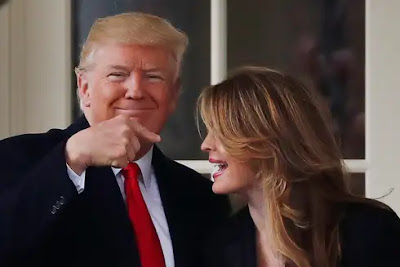
 Tell me master, what dost thou want of me?
"His
buffoonery, chaos and word salad speeches are calculated. Trump is incredibly
cunning and devious."

Donald Trump. (photo: MSNBC)
David Smith
/
Guardian UK
05 June 24
REPUBLISHED BY:
When Donald Trump shared a video that dreamed of a “unified reich”
if he wins the US presidential election, and took nearly a full day to
remove it, the most shocking thing was how unshocking it was.
Trump has reportedly said before that Adolf Hitler did “some good things”,
echoed the Nazi dictator by calling his political opponents “vermin”
and saying immigrants are “poisoning the blood of our country”, and
responded to a white supremacist march in Charlottesville by claiming
that there were “very fine people on both sides”.
The Hitler-Trump analogy is controversial. “Some of Trump’s critics –
including Biden’s campaign – argue that Trump’s incendiary rhetoric and
authoritarian behavior justify the comparison,” the Politico website observed
recently. “Meanwhile, Trump’s defenders – and even some of his more
historically-minded critics – argue that the comparison is ahistorical;
that he’s not a true fascist.”
The former camp now includes Henk de Berg,
a professor of German at the University of Sheffield in Britain. The
Dutchman, whose previous books include Freud’s Theory and Its Use in
Literary and Cultural Studies, has just published Trump and Hitler: A Comparative Study in Lying.
In it, De Berg compares and contrasts Hitler and Trump as political
performance artists and how they connect with their respective
audiences. He examines the two men’s work ethic, management style and
narcissism, as well as quirks such as Hitler’s toothbrush moustache and
Trump’s implausible blond hair.
In a Zoom interview from his office at the university campus, De Berg quotes the American comedian and actor George Burns:
“The most important thing in acting is honesty. If you can fake that,
you’ve got it made.” He adds: “The most important thing in populism is
authenticity. The moment you’re able to fake that, you’re in.”
De Berg, 60, happened to be renewing his study of National Socialism, and rereading Hitler’s autobiographical manifesto Mein Kampf,
just as Trump was first running for the White House in 2015.
“Obviously, there are massive differences,” he acknowledges. “Hitler was
an ideologically committed antisemite who instigated the second world
war and was responsible for the Holocaust in which 6 million Jews died.
“But then I looked at their rhetorical strategies and their public
relations operations and I began to see how similar they are in many
ways. So I thought, OK, why not do a book looking at Hitler from the perspective of Trump?
“We tend to see Hitler
as a genocidal mass murderer, which of course he was, but not so much
as a populist. I thought looking at it through the perspective of Trump
can help us wrap our heads around the idea as to why so many people
actually supported Hitler and vice versa.”
Above all, De Berg argues, Hitler and Trump were and are political
performance artists who speak only vaguely about policies – Make
Germany/America great again – but know how to draw attention using
jokes, insults and extreme language. In this they differ from Joseph Stalin, the Soviet autocrat who was a poor public speaker and preferred to work behind the scenes.
“Their extremist statements are very deliberately meant to provoke a
reaction and to get them into the press. Hitler actually writes quite
openly about this in Mein Kampf and
this of course is the challenge: what do you then do as a journalist or
as an opposing political party when the other person makes these
extreme statements?
“Do you then not report these things, but then the populists will say
whatever they want to say? Or do you contradict them and point out the
lies and the extremism, but in that way you’re only drawing more
attention to the fact that they’re running and to all they’re
proposing?”
Along with its headline-grabbing potential, the extremist language
also plays well with many voters. De Berg says: “Most of their
electorate are dissatisfied with the status quo for a variety of reasons
– globalisation, automation – so they want to change the system and
here you have an anti-establishment candidate who is not politically
correct, who says that we will sort it, who doesn’t come up with all
these ‘cowardly, rotten compromises’.”
Many such voters are ready to blame a scapegoat, “the other”. Hitler
blamed Jews for Germany’s defeat in the first world war; Trump launched
his 2015 campaign demonising immigrants from Mexico and continues to put border security front and centre. “It
decomplexifies the world. Instead of abstract social structures and
historical developments, you have one specific group of people that you
can blame all your problems on.”
One of the touchstone observations from the early Trump years came from the journalist Salena Zito. In September 2016 she wrote in a column for the Atlantic magazine that “the press takes him literally, but not seriously; his supporters take him seriously, but not literally”.
Again De Berg is alive to rhymes with Hitler. “There were a lot of
National Socialists interviewed after the war who said, well, yeah, OK,
Hitler was saying all these extreme things but we realised he was a mass
politician and we thought that he was just saying things that he didn’t
really mean, that he was just exaggerating a little bit. Someone said
the demands in Mein Kampf we took as the dogmas in the Bible – no one
thought that these things would be fulfilled 100%.
“The same is true, dangerously, with the things that Trump says. In
his rallies he outlined a whole range of very problematic things that he
would do when he was going to be president, but that doesn’t mean all
people literally believe that. I don’t think they literally believed
that he was going to build this big concrete wall between Mexico and the
United States. Many of them thought, unconsciously, what he’s really
saying is he will protect America’s traditional identity.
“And that – to use a posh phrase – interpretative openness means that
both the more extreme followers and the less extreme or ‘moderate’
followers can recognise themselves in the speaker’s words. That made
Hitler and makes Trump so difficult.”
Trump’s incoherent, meandering and zigzagging mode of speech
adds to the effect. “Trump goes from the FBI to a judge to the
Democrats to communists and so on. You can then say, well, clearly this
guy is an intellectual nitwit, he can’t talk in a logical, argumentative
way. He could but he realises that this vague way of tying all these
people together actually gives different sections of the electorate
different things they can identify with. Some might not like the FBI,
others might not like immigrants and so on.”
Trump made more than 30,000 false or misleading claims during his four years as president, according to a count by the Washington Post.
Perhaps the most egregious is “the big lie” that he, not Joe Biden, won
the 2020 presidential election, only for it to be stolen due to
widespread fraud. De Berg writes in his book: “The idea behind the
concept of the big lie is that if an untruth is sufficiently extreme,
people are likely to accept it if only because they cannot bring
themselves to believe that anyone could lie in such an outrageous
manner.
“It was Hitler who came up with the concept, writing in Mein Kampf
that ‘the great masses of the people … more easily fall victim to a big
lie [große Lüge] than to a little one, since they themselves lie
in little things, but would be ashamed of lies that were too big. Such a
falsehood will never enter their heads, and they will not be able to
believe in the possibility of such monstrous effrontery and infamous
misrepresentation in others.’”
The spectacle and social glue of mass rallies is also key. In controversial comments to Playboy magazine, the British singer David Bowie
once observed: “Adolf Hitler was one of the first rock stars … Look at
some of his films and see how he moved. I think he was quite as good as
Jagger. It’s astounding. And boy, when he hit that stage, he worked an
audience. Good God! He was no politician. He was a media artist. He used
politics and theatrics and created this thing that governed and
controlled the show for 12 years. The world will never see his like
again.”
Trump’s rallies are typically rollicking affairs,
the atmosphere part circus, part concert, part sports, bringing
like-minded people together as ritualistically as church. In all
weathers they share a collective sense of grievance and also find ways
to have fun. In small towns that often feel left behind by big cities,
they can represent the biggest event of the year and offer the thrill of
live performance in an otherwise digitally saturated age.
De Berg comments: “If you look at the lives of many ordinary Germans during the Weimar Republic
immediately after the first world war, when the economy wasn’t doing
well and there were all sorts of problems, many of them could not afford
to enjoy all sorts of spectacles but they could go to a Hitler rally.
“You can go to a Trump rally as well and that creates a feeling of
solidarity, a community of feeling, which of course is at the same time
the dangerous thing because people then identify with each other. They
lose their individuality, they lose their critical capacity, and at the
same time all together they identify with a political leader, so the
political leader can do whatever he wants.”
There is also something alarmingly familiar about the way in which
the Republican party thought it could co-opt and control Trump, only to
find itself capitulating and being recast in his image. One by one the
party stalwarts have fallen into line, abandoning long-held principles,
while dissenters have been purged.
De Berg continues: “Hitler goes from 2.6% of the vote in 1928,
meaning more than 97% of the electorate don’t want him, to the Nazi
party becoming the biggest party in 1932. Then these conservative
politicians say, OK, we’ve got this political nincompoop here but he’s a
populist and he’s popular, the people like him. If we try and make this
guy vice-chancellor then he can do our bidding.
“Hitler says no, I’m not going to be vice-chancellor, I want to be chancellor, so eventually they give in
but they still think that he is going to do what they want and push
through their policies. One of these conservative politicians memorably
said, ‘We’ve hired him.’ Hitler manipulated them and he becomes
chancellor and from there on in it all goes disastrously wrong with
German society.”
He adds: “One of the most worrying things for me about Trumpism is
the way he has managed to transform what you thought were very rightwing
but ultimately rational politicians into people who have become
basically Trumpists.
“What happened was not that they manipulated Trump but Trump ended up
manipulating them and then, in effect, just taking over the Republican
party. All these people had to renounce all the things they used to
believe in: international free trade agreements, a forward-leaning role
for America in the world.”
There is, the academic warns, method in Trump’s madness: the
buffoonery, chaos and word salad speeches may be more calculated than
they appear. “I would like people to become more aware of how incredibly
consciously Trump is going about doing what he’s doing, how incredibly
cunning and devious he’s been. People should absolutely not
underestimate this guy.”
It
is women who have the most to lose under Trump - the right to control
their own minds and bodies. But in the end, we all lose everything.


 Dr. Anthony Fauci

 Sad!
Sad!


