Join us at our brand new blog - Blue Country Gazette - created for those who think "BLUE." Go to www.bluecountrygazette.blogspot.com

YOUR SOURCE FOR TRUTH

Saturday, November 18, 2023

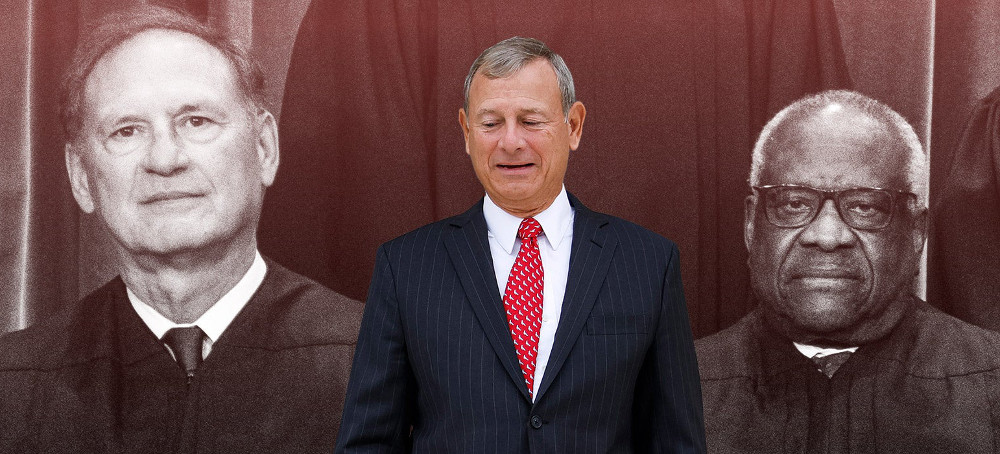
Here's the Thing About That  Trust the same justices who declined to follow the old rules to better adhere to the new ones? Good luck with that strategy.      (photo: AFP)


Dahlia Lithwick / Slate 

On Monday, the justices of the Supreme Court issued an extremely confusing statement laying forth the court’s brand-new ethics code for the justices themselves. These justices would like, through the announcement, to reassure us there is nothing actually “new” about the new code: “For the most part these rules and principles are not new,” the justices write. “The Court has long had the equivalent of common law ethics rules, that is, a body of rules derived from a variety of sources, including statutory provisions, the code that applies to other members of the federal judiciary, ethics advisory opinions issued by the Judicial Conference Committee on Codes of Conduct, and historic practice.” So what is “new,” then, is that the old rules are now binding on the justices?

No! Because of course the new/old rules are not precisely binding on the justices. That’s because the old rules, like the new ones, lack any sort of enforcement mechanism. So if the old rules were advisory principles, to which the old justices could look for guidance in deciding whether or not to adhere to them, so too the new rules, which are binding, will mainly serve as guidance to which the justices may newly look for guidance. Or, as the Associated Press plainly put it: “The code leaves compliance to the justices themselves and does not create any other means of enforcement.”

The most interesting question answered by the promulgation of the new/old rules, therefore, is who it was that was confused about the old rules to such an extent that they needed to be laid down. And as the court notes in its statement regarding the code of conduct:

The absence of a Code, however, has led in recent years to the misunderstanding that the Justices of this Court, unlike all other jurists in this country, regard themselves as unrestricted by any ethics rules. To dispel this misunderstanding, we are issuing this Code, which largely represents a codification of principles that we have long regarded as governing our conduct.

In other words, it is not the justices who have misunderstood the various sources, canons, common law provisions, etc. when they failed to disclose gifts from donors with cases before the court, or when they attended Koch events that granted access to them for high-dollar donors, or even when they failed to recuse in cases in which they had an interest. The confusion, in reading the old rules, was evidently ours and ours alone. In order to dispel a public misunderstanding of the old rules— and why some members of the court declined to abide by them—the court is repromulgating virtually the same rules, which they themselves will enforce, but this time assuring us that we got it wrong the first time when we didn’t think they alone should enforce them. Trust the same justices who declined to follow the old rules to better adhere to the new ones, they urge. This time they really will unilaterally and in secret make better choices. Then and only then will your confusion desist.

Because there is no mechanism by which rule-breaking can be investigated, or adjudicated, the new code serves largely as what one can only describe as a compendium of old whines in new bottles. Come for the whining about bodily attacks on jurists, stay for the whining about how they need book revenue. If all of this material sounds extremely familiar, that’s because the substance of it is all stuff other judges have been doing for years, as the justices have continued to explain on repeat why they can only try to be bound by as much of it as they choose.

The new code further commits to “uphold the integrity and independence of the judiciary” and to “avoid impropriety and the appearance of impropriety in all activities.” This is of course the lodestar of the old rules and of an April statement in which the justices collected all these old rules as part of an old, new pledge to“reaffirm and restate” their commitment to said rules. Surely yet to come will be the graphic novel version of the old rules, the Netflix version, and the collectors’ edition action figurines, each of which will affirm that the rules—once confusing to the public but always crystal clear to the justices—are now crystal clear to everyone, even if still left entirely to the justices’ discretion to enforce on their own, without oversight or actual enforcement powers.

What’s also clear from the new/old rules: The “appearance of impropriety,” a test that has to do with how we the public define impropriety, is also being, once again, left entirely to the court to determine and uphold. In the event that a future justice fails to, say, repay a loan on a recreational vehicle, or says that he took an open seat on a private jet because nobody was using it, we can all rest assured that the impropriety therein is our own. And the tone throughout—the patient parental explanation that this is our stupidity in forcing this issue—is deeply worrisome coming from a chief justice who refused to testify on these very matters last spring and a justice who has said in a newspaper interview that Congress has absolutely no role to play in regulating the court.

Finally, there are lots of places in the new/old code where you will find sections that appear to have been reverse-engineered to paper over the misconduct that we have learned of this year with caveats about “knowingly” and “now in effect.” Old failures to disclose? Bygones. There is a lengthy explanation of why the need to have nine justices on most cases, “the rule of necessity,” will trump the need for an individual recusal. There is language that attempts to clean up judicial participation at political events and Federalist Society dinners, use of staff for judicial book sales, and some financial disclosure loopholes, but the tell, again, is that on these matters, the justices believe the confusion has been yours; they have been perfectly consistent all along.

If there is a lesson, still, to be learned from the ethical revelations of the past year, and the ethics industrial complex that journalism has erected to continue to mine the infractions, it is that newsgathering matters—that when the justices are left to their own ethical devices, misconduct happens, it goes ignored by the other justices, and it becomes weaponized by wealthy entities seeking to alter outcomes in cases, such that an entire infrastructure of corruption goes undetected for years. Being granted a peek into the tent in which judicial monarchists nod sagely and pinkie swear they are still adhering to the rules they ignored does little to assuage a public that still wants to know how Leonard Leo seated three justices and made a ton of bank on a project predicated in ignoring ethical rules.

On Monday, after immense pressure from the public, journalists, good-government groups, and Congress, the court’s answer seems to chiefly be that this is annoying. And that if they explain again that they are following the old rules, we can all go back to the days of undisclosed luxury salmon fishing and big donor meet-and-greets at the Supreme Court historical society and Koch junkets. This entire document reads like a great big “it’s not me, it’s you” to a public that continues to understand that we the public are not, in fact, the primary ethics failing of the Supreme Court.

Props to the justices for signing onto a thing, even if it’s an old thing recast as a new thing, principally drafted with the intention of instructing us that they still can’t be made to do anything. It was probably difficult to get some of the court’s present membership to concede even that the public is hopelessly confused and needs a tune-up. My guess is that this unenforceable new set of old rules will mollify close to nobody. But insofar as it’s phrased to imply, perhaps for the first time since this ethics mess began, that the court is aware of public opinion, it’s a tiptoe in the right direction. Maybe the fact that the court is finally willing to admit that there’s a problem—even while insisting it’s the public with the problem—signals that this is a conversation and not a sermon from the mount. And maybe that’s the best start we can hope for.

Coke Can Clarence's wife Ginni Thomas is laughing at the new code all the way to the bank.

Friday, November 17, 2023

Sellout Supreme Court: One of the most corrupt charades in all of history

e9447126-cd9f-4b47-9730-96bb9690b95e.jpg
Image by Pete Linforth from Pixabay
 
By thomhartmann for Community
Daily Kos
 
 
REPUBLISHED BY:
Blue Country Gazette Blog
Rim Country Gazette Blog
 

“When plunder becomes a way of life for a group of men in a society, over the course of time they create for themselves a legal system that authorizes it and a moral code that glorifies it.” — Frédéric Bastiat (French economist)

Virtually every crisis America is facing right now is either caused or exacerbated by the corruption of our nation’s third branch of government.

A branch of government — the Supreme Court — that this week laid out one of the most absurd charades in its history, pretending to do something about their own corruption and utter lack of ethics with a sham “Code of Conduct.”

They are responsible for our crises of gun violence, the drug epidemic, homelessness, political gridlock, our slow response to the climate emergency, a looming crisis for Social Security and Medicare, the situation on our southern border, even the lack of affordable drugs, insurance, and healthcare.

All track back to a handful of Supreme Court justices who’ve sold their votes to billionaires in exchange for extravagant vacations, luxury yachts and motorhomes, private jet travel, speaking fees, homes, tuition, and participation in exclusive clubs and billionaire networks that bar the rest of us from entry.

— America is the only country in the world that terrorizes its children with active shooter drills in schools, the only country where the leading cause of childhood deaths is bullets, and the only country where mass shootings are a near-everyday occurrence.

Why do Republicans in Congress block every effort to do something and save America’s children’s lives? Because they’re owned with big money contributions and campaign spending by the NRA and gun manufacturers.

And why is that legal? Because five corrupt Republicans on the Supreme Court — several already on the take themselves, although nobody knew it at the time — ruled in Citizens United that, “[W]e now conclude that independent expenditures, including those made by corporations, do not give rise to corruption or the appearance of corruption.”

— The Sackler family spent years making billions by addicting and ultimately killing hundreds of thousands of Americans, but to this day not a single member of that psychopathic family has seen the inside of a prison cell. Why? Because they bought off multiple politicians, including (according to reporting from The Intercept) the Republican Attorneys General Association and the Democratic Governors Association.

There was a time when these bribes — and the opioid deaths they cover up — would have been a felony; today they’re routine because corrupt Republicans on the Supreme Court legalized political bribery.

— Why isn’t America reacting more rapidly to the extreme weather events that are killing Americans from coast-to-coast (and in Hawaii and Alaska)? Why does almost every Republican in Congress refuse to acknowledge basic climate science and instead works to maintain the $600 billion annual subsidies for, and massive profits of, the fossil fuel industry?

Because they’re on the take from that very industry. Courtesy of Citizens United and its predecessors written into law by five corrupt Republicans on the Supreme Court.

— Medicare is being ripped off to the tune of over $140 billion a year, and millions of Americans who bought into the Medicare Advantage privatized insurance scam are routinely denied care, because the insurance industry was able to help write George W. Bush’s 2003 legislation “modernizing” Medicare.

Why does Congress tolerate this? Because they’re on the take from that very industry. Courtesy of Citizens United and its predecessors voted into law by corrupt Republicans on the Supreme Court.

— Cancer-causing pesticides, food additives, PFAS chemicals, and microplastics lace our environment and food supply, creating a cancer crisis unknown in Europe where these are all banned or tightly regulated. Why here? Because Congress refuses to act as long as the industries creating these problems can legally continue their campaign donations and other bribes.

— Republicans in Congress (and Nikki Haley) are pushing hard for a new “Catfood Commission” to figure out ways to cut Social Security benefits and raise the retirement age. Speaker Johnson announced yesterday afternoon that he’s creating the commission over the Thanksgiving holiday and they’ll hold their first hearings in two weeks.

Why would they defy an American public that loves the program just to avoid asking billionaires to pay the same Social Security tax rate as bus drivers?

Because they’re on the take from the billionaires who don’t want to pay their taxes, and the banks that hope the Catfood Commission will develop “Social Security Advantage” as a way of privatizing the system. Courtesy of Citizens United and its predecessors voted into law by corrupt Republicans on the Supreme Court.

— At the same time the pharmaceutical industry is enjoying the largest profits in its history, millions of Americans are cutting pills in half or even going without essential medications because they can’t afford the price-gouging that’s routine in the drug business.

Why won’t Congress act? Because they’re on the take from that very industry. Courtesy of Citizens United and its predecessors voted into law by corrupt Republicans on the Supreme Court.

— Every other developed country in the world has figured out how to give their students quality public school and free or inexpensive college educations. Here in America, private for-profit and religious schools are getting hundreds of billions from Republican-controlled Red states, decimating our public schools, while tens of millions of young people can’t start families or small businesses because they’re crushed by student debt that doesn’t exist anywhere else in the developed world.

Why does America tolerate this? Because the banking industry is making billions in profits off student loans every month and shares some of that lucre with members of Congress, a process legalized by five corrupt Republicans on the Supreme Court.

— A private for-profit prison industry intervenes in every effort to update our immigration and asylum systems as well as attempts to refocus our criminal justice system toward rehabilitation. They can do this by buying off mostly Republican politicians because corrupt Republicans on the Supreme Court legalized political bribery.

— Homelessness stalks America as rent prices skyrocket while more homes remain empty — investment properties bought by foreign and Wall Street speculators — than there are homeless people in our nation. Other countries have largely solved their homelessness crises, but here in America all systemic efforts are paralyzed by big money from the real estate and hedge fund industries.

This is legal because corrupt Republicans on the Supreme Court sold out our country to the wealthy interests that have been courting them since the Reagan era.

For over two decades, Clarence Thomas and his wife have been accepting millions in free luxury vacations, tuition for their adopted son, a home for his mother, private jet and megayacht travel, and entrance to rarified clubs.

Sam Alito is also on the gravy train, and there are questions about how Brett Kavanaugh managed to pay off his credit cards and gambling debts. John Roberts’ wife has made over $10 million from law firms with business before the court; Neil Gorsuch got a sweetheart real estate deal; Amy Coney Barrett refuses to recuse herself from cases involving her father’s oil company.

None of this is illegal because when five corrupt Republicans on the Court legalized members of Congress taking bribes they legalized that same behavior for themselves.

This week, the Supreme Court tried to put a tiny fig leaf over the bloated, corpulent, naked corpse of their own obscene corruption. They call it a “Supreme Court Code of Conduct,” but it’s a pathetic joke.

It contains no enforcement provisions, no way for anybody to file complaints or blow the whistle, no consequences for violations, no system for investigations, no mechanism for informing the public, no specifics about what “corrupt behavior” means, and no penalties whatsoever even when behavior is so clearly corrupt it’s obvious to everybody.

At best, it’s a PR stunt; at worst, it’s the latest example of how arrogant the six Republicans running the Court have become about their own “right” to stay on the take and extend that largesse to every Republican politician in the country.

They’re responding, of course, to Senator Sheldon Whitehouse’s efforts on the Senate Judiciary Committee to subpoena a few of the billionaires and political fixers who’ve been grooming Republican justices for decades. He wanted to start by questioning Harlan Crow and Leonard Leo.

Republicans on the Judiciary Committee, who are just fine with having six corrupt Republicans on the  Supreme Court so long as their corruption works to the GOP’s advantage, slapped 88 proposed amendments onto Whitehouse’s subpoena request, successfully blocking his efforts for the moment.

Every one of those Republican senators has received millions in billionaire and corporate money, along with their own “right” to enjoy the private jets and mega-yachts of their morbidly rich “supporters.”

So how is it that if you bribe a store clerk or a bank teller you go to prison, but if you bribe a politician, you get a tax break? When was bribery of politicians and Supreme Court justices legalized in America?

There was a time, after all, when politicians — both Democrats and Republicans — passed laws that conformed to the desires of the majority of Americans instead of the special interests.

From the end of the Republican Great Depression right up until the Reagan Revolution — from 1933 to 1981 — the American middle class had about a half-century of uninterrupted political and economic progress.

— Democrats passed the right to unionize, which built the American middle class, the world’s first. They passed unemployment insurance, the right to unionize, and workplace safety rules to protect workers.

— Social Security largely ended poverty among the elderly, and Medicare provided them with health security.

— A top income tax rate between 74% and 91% throughout that period kept wages strong for working people and prevented the corrosive wealth inequality we see today. We didn’t get our first billionaire until after the Reagan revolution dropped those top tax rates down to 27 percent.

— We built colleges that were free or affordable, gleaming new nonprofit hospitals, the world’s finest system of public schools, and roads, bridges, rail, and airports from coast to coast.

— We cleaned up the environment with the Environmental Protection Agency, cleaned up politics with the Federal Elections Commission, cleaned up corporate backroom deals with the Securities and Exchange Commission. We outlawed banks from gambling with our deposits via the Glass-Steagall law.

But it all came to a screeching halt with the Reagan Revolution. How and why?

Instead of building the middle class, Reaganomics gutted it. Instead of educating young people, it indebted them. Instead of supporting workers, the GOP’s “right to work for less” scheme took away their dignity and their pay.

Today both our nation’s infrastructure and our workforce are in shambles because of 40 years of disinvestment and neglect.

What made that possible?  Why did that happen?

It all comes back to legalized political bribery.

Our modern era of legalized political bribery began in the decade after Richard Nixon put Lewis Powell — the tobacco lawyer who wrote the infamous 1971 “Powell Memo” outlining how billionaires and corporations could take over America — on the Supreme Court in 1972.

In the 1976 Buckley v. Valeo decision, the Court ruled that political money wasn’t just cash: they claimed it’s also “free speech” protected by the First Amendment that guarantees your right to speak out on political issues.

In the 200 preceding years — all the way back to the American Revolution of 1776 — no politician or credible political scientist had ever proposed that giving money to a politician in exchange for favors or votes was anything other than simple bribery.

The “originalists” on the Supreme Court, however, claimed to be channeling the Founders of this nation, particularly those who wrote the Declaration of Independence and the Constitution, when they said that “money was the same thing as free speech.” In that claim, Republicans on the Court were lying through their teeth.

In a letter to Samuel Kerchival in 1816, President and author of the Declaration of Independence Thomas Jefferson explicitly laid it out:

“Those seeking profits, were they given total freedom, would not be the ones to trust to keep government pure and our rights secure. Indeed, it has always been those seeking wealth who were the source of corruption in government.”

In this, he was making the same argument that the Framers of Pennsylvania made when writing their constitution in 1776. As Kevin Phillips notes in his masterpiece book Wealth and Democracy: A Political History of the American Rich, a Sixteenth Article of the revolutionary-era Pennsylvania Bill of Rights declared:

“An enormous proportion of property vested in a few individuals is dangerous to the rights, and destructive of the common happiness of mankind, and, therefore, every free state hath a right by its laws to discourage the possession of such property.”

But Republicans on the Supreme Court weren’t reading the Founders. They were instead listening to the billionaires who helped get them on the court in the first place. Who had bribed them with position and power and then kept them in their thrall with luxury vacations, “friendship,”and gifts.

Two years after the 1976 Buckley decision, the Republicans on the Supreme Court struck again, this time adding that the “money is speech and can be used to buy politicians” argument applied to corporations as well as to billionaires.  Lewis Powell himself wrote the majority opinion in the 1978 Boston v Bellotti decision.

Justices White, Brennan, and Marshall dissented:

“The special status of corporations has placed them in a position to control vast amounts of economic power which may, if not regulated, dominate not only our economy but the very heart of our democracy, the electoral process.”

But the dissenters lost the vote, and political corruption of everything from local elections to the Supreme Court itself was now virtually assured.

Notice that ruling came down just two years before the Reagan Revolution, when almost all forward progress in America came to a screeching halt.

It’s no coincidence.

And it’s gotten worse since then, with the Court doubling down in 2010 with Citizens United, overturning hundreds of state and federal “good government” laws dating all the way back to the late 1800s.

Thus, today America has a severe bribery problem.

It’s bizarre that the Court would keep intact anti-bribery laws across every facet of American life except politics, but that’s exactly what they did. Bribery is still illegal in business, it’s illegal in interactions with the police, but according to five corrupt Republicans on the Supreme Court it’s perfectly legal to bribe politicians.

No other developed country in the world has this problem, which is why every other developed country has a national healthcare system, free or near-free college, and strong unions that maintain a healthy middle class. It’s why they can afford pharmaceuticals, are taking active steps to stop climate change, and don’t fear being shot when they go to school, the theater, or shopping.

We’re the only major country in the world right now that is experiencing legislative gridlock on this scale. And we’ve been experiencing it for four decades.

This cannot continue. If America is to survive as a democratic republic, we must end the legal bribery of our politicians.

And that starts with the work Sheldon Whitehouse and his Democratic colleagues are doing on the Senate Judiciary Committee to reform the Supreme Court and hold its most corrupt members to account.

How appropriate: A fake curtain for a duplicitous court.

Thursday, November 16, 2023

National abortion ban definitely on 2024 ballot

no image description available

The Heritage Foundation has set out an ambitious totalitarian agenda for the next Republican president, whoever it might be. Don’t think that women’s bodies are exempt from their plans, not by a long shot. They’ve been working on a plan to use a 19th-century law written to prevent women from obtaining contraceptives, allowing the next Republican administration to outlaw most abortions.

The 1873 Comstock Act prohibits the mailing of contraceptives, “lewd” writings, and any “instrument, substance, drug, medicine, or thing” that could be used in an abortion. While it’s been dormant since the U.S. Supreme Court’s Griswold v. Connecticut decision in 1965, the law is still on the books. It has experienced a revival in the 21st century GOP. Wing-nut U.S. District Judge Matthew Kacsmaryk cited it when he ruled last spring to block the Food and Drug Administration from allowing mifepristone, the pill used in more than half of U.S. abortions, to be sent through the U.S. mail. That is still being litigated.

Now that 1873 is back in vogue, the Heritage Foundation argues that the next president can act unilaterally to do just what Kacsmaryk ordered. Comstock "unambiguously prohibits mailing abortion drugs," and a Republican president should "enforce federal law against providers and distributors of [abortion] pills."

The Biden administration disagrees. As long as the medication is being sent to someone living in a state where abortion is legal and intends to use it legally, there is no violation of Comstock, the Justice Department advised in a recent memo.

That’s unlikely to be an interpretation a Republican administration would support. "If Trump were elected, not only would I not be surprised, but I would expect the administration to direct DOJ to overturn its guidance on the Comstock Act and rule that shipping mifepristone through the U.S. Postal Service is a violation of that statute," Lawrence Gostin, a Georgetown Law professor, told Axios.

The Supreme Court could get there first. The drug is still available, despite Kacsmaryk’s best efforts, because the Supreme Court has allowed it to be, staying his rulings as the lower courts consider an appeal. The Department of Justice and a manufacturer of the drug asked the court to intervene in a September appeal. It hasn’t put the case on its docket. Yet.

That’s the legal side of it. On the political side, boy do Democrats need to be talking about this! A law from 1873 being used to end abortion nationally, by presidential fiat? That’s extreme stuff. Who’s to say that contraception won’t be next?

Then when Democrats win back the House, Senate, and White House in 2024 on the abortion issue, repealing the Comstock Act needs to be at the top of the legislative agenda.

RELATED STORIES:

Trump and the Heritage Foundation's fascist agenda

​​Where do the 2024 presidential candidates stand on abortion? Take a look

Justice Department is moving quickly in wake of Trump judge's outrageous order against mifepristone

Wednesday, November 15, 2023

TOOTHLESS: Supremes forget to include enforcement in new conduct code

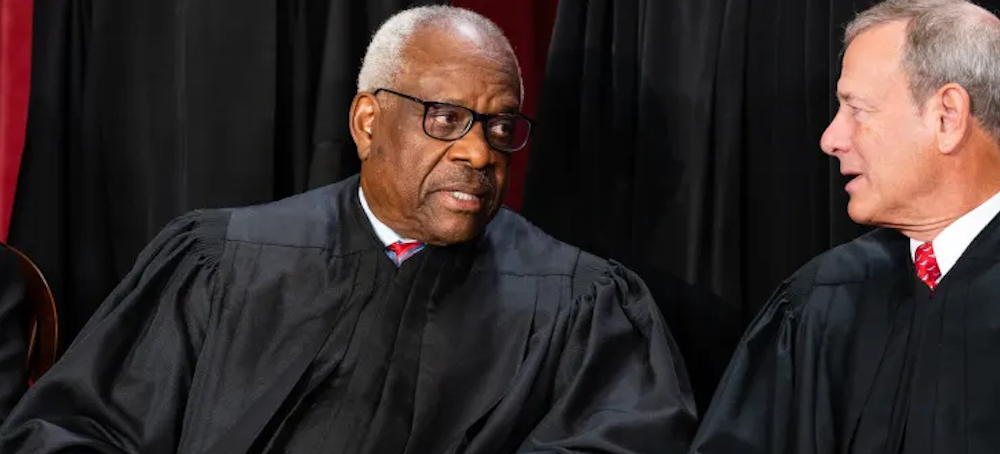
The Supreme Court Has Adopted a Conduct Code, but Who Will Enforce It?  Is the black backdrop a coincidence, or does it represent the enforcement section of the new code of conduct?  Associate Justice Clarence Thomas, left, talks to Chief Justice John Roberts during the formal group photograph at the Supreme Court in Washington, DC, US, on Friday, Oct. 7, 2022. (photo: Eric Lee/Bloomberg)
 
 
Joshua Kaplan, Justin Elliott, Brett Murphy and Alex Mierjeski / ProPublica 
 
ALSO SEE: Supreme Court Publishes Ethics Code, With No Teeth

The Supreme Court on Monday released a code of conduct governing the behavior of the country’s most powerful judges for the first time in its history. But experts said it was unclear if the new rules, which do not include any enforcement mechanism, would address the issues raised by recent revelations about justices’ ethics and conduct.

The nine-page code, with an accompanying five pages of commentary, was signed by all the sitting justices and covers everything from the acceptance of gifts, to recusal standards, to avoiding improper outside influence on the justices. The step followed months of reporting by ProPublica detailing undisclosed gifts to Supreme Court justices from wealthy political donors.

The code does not specify who, if anyone, could determine whether the rules had been violated.

The new Supreme Court code’s lack of any apparent enforcement process is “the elephant in the room,” said Stephen Vladeck, a law professor at the University of Texas who studies the court. “Even the most stringent and aggressive ethics rules don’t mean all that much if there’s no mechanism for enforcing them. And the justices’ unwillingness to even nod toward that difficulty kicks the ball squarely back into Congress’ court.”

Nevertheless, some leading observers of the court described the creation of an explicit, written code as a landmark in the court’s 234-year history.

“The Supreme Court’s promulgation of a code of conduct today is of surpassing historic significance,” former federal appellate judge J. Michael Luttig told ProPublica. “The court must lead by the example that only it can set for the federal judiciary, as it does today.”

A statement released by the court on Monday accompanying the code said it was formulated to dispel “the misunderstanding that the Justices of this Court, unlike all other jurists in this country, regard themselves as unrestricted by any ethics rules.” It said the code “largely represents a codification of principles that we have long regarded as governing our conduct.”

A series of ProPublica stories this year detailed a pattern of behavior by Supreme Court justices that legal ethics experts said was far outside the norms of conduct for other federal judges. ProPublica disclosed that Justice Clarence Thomas has accepted undisclosed luxury travel from Dallas billionaire Harlan Crow and a coterie of other ultrawealthy men for decades. Crow purchased Thomas’ mother’s home and paid private school tuition for a relative Thomas was raising as his son. Thomas also spoke at donor events for the Koch network, the powerful conservative activist group. Separately, ProPublica revealed that Justice Samuel Alito accepted a private jet trip to Alaska from a hedge fund billionaire and did not recuse himself when that billionaire later had a case before the court.

Reporting from other outlets, including The Washington Post and The Associated Press, has added to the picture. The New York Times revealed that Thomas received a loan from a wealthy friend to purchase an expensive RV. A Senate investigation later found Thomas did not repay the loan in full.

Federal judges below the Supreme Court have long been subject to a written code of conduct, the foundations of which were set down a century ago following a major ethics scandal in the judiciary. Lower court judges are subject to oversight by panels of other judges, who review allegations of misconduct.

The high court’s new code of conduct is separate from an existing federal law that requires all federal judges including the justices on the Supreme Court to annually report income, assets and most gifts on a publicly available disclosure form. The law, which passed after the Watergate scandal, has been at the center of the controversies involving Thomas’ undisclosed gifts. Thomas and Alito have argued they were not required to disclose the luxury travel, and Thomas’ lawyer has said that “any prior reporting errors were strictly inadvertent.”

The new document largely echoes the code that applies to lower court judges. Many of its prescriptions are lofty but vague. It requires the justices to “act at all times in a manner that promotes public confidence in the integrity and impartiality of the judiciary.” It prohibits justices from soliciting gifts, practicing law or sitting on cases where their “impartiality might reasonably be questioned.” It states that the justices should not engage in “political activity,” but it does not define what that means.

Court observers are likely to spend weeks parsing the differences between the new code and that of the lower courts. Small changes were made without explanation. For instance, lower court judges are prohibited from lending “the prestige of the judicial office to advance” their own private interests. The justices are merely prohibited from “knowingly” doing so.

Whether any of the conduct that sparked the push for a formal ethics code would now be prohibited seems to remain open for interpretation. Take Thomas’ appearances at Koch network events. A federal judge told ProPublica that if he’d done the same as a lower court judge, it would’ve violated prohibitions against fundraising and political activity and he would’ve been subject to a disciplinary proceeding. It’s unclear if the high court’s new code would bar such activities or if each justice would answer such questions for him or herself.

Sen. Sheldon Whitehouse, D-R.I., who has introduced a bill that would require the Supreme Court to adopt an enforceable code of conduct, said in a statement that the new code fell short of what is needed.

“The honor system has not worked for members of the Roberts Court,” he said. “This is a long-overdue step by the justices, but a code of ethics is not binding unless there is a mechanism to investigate possible violations and enforce the rules.”

Whitehouse’s bill advanced out of the Senate Judiciary Committee in July, but it has since stalled in the face of GOP opposition. It would create an enforcement mechanism for the court’s code of conduct and set up a process where panels of appellate judges would investigate potential ethics violations.

It’s unclear whether the court’s release of the code will affect the ongoing Senate investigations into justices’ relationships with businessmen and others involved in undisclosed travel and gifts. For months, the Senate Judiciary Committee has been seeking information from Crow and others about undisclosed gifts to Thomas.

Last week, Senate Judiciary Democrats deferred an effort to subpoena Crow in the face of intense Republican opposition on the committee. Sen. Dick Durbin, D-Ill., the panel’s chair, said last week the committee would continue its efforts to authorize subpoenas in the near future.

The court’s new ethics standards are in many ways more lenient than those governing employees of the executive and legislative branches. There are still few restrictions on what gifts the justices can accept. Members of Congress are generally prohibited from taking gifts worth $50 or more and would need preapproval from an ethics committee to take many of the gifts Thomas and Alito have accepted.

Jeremy Fogel, a retired federal judge in California who had publicly called for the Supreme Court to adopt an ethics code, said Monday that he was “heartened to see that the justices unanimously have recognized the need for an explicit code of conduct.”

“Whether it will make a difference in the justices’ day-to-day actions or in public perceptions of the court remains to be seen,” Fogel said.

"Sometimes my nose gets this long?"

CARTOON: A Man of Means by No (Visible) Means

no image description available

A cartoon by Mike Luckovich

Rim Country Gazette Blog

Tuesday, November 14, 2023

Enemies are 'vermin': Donald Trump's alarming Veterans Day address mirrors Nazi propaganda

CLAREMONT, NEW HAMPSHIRE - NOVEMBER 11:  Republican presidential candidate former President Donald Trump delivers remarks during a campaign event on November 11, 2023 in Claremont, New Hampshire. The defense is scheduled to start presenting its case on Monday in Trump's fraud case. (Photo by Scott Eisen/Getty Images)

In a Veterans Day speech that was both shocking and sickening, Donald Trump used terminology straight from the Nazi playbook, describing his opponents as “vermin” and promising that he would “root out” this internal threat. His speech drew on explicitly antisemitic themes as he promised a return to the worst horrors of the past century.

“We pledge to you that we will root out the communists, Marxists, fascists, and the radical left thugs that live like vermin within the confines of our country, that lie and steal and cheat on elections,” Trump said. He followed by saying that the threat from Russia, China, and North Korea was “less sinister, dangerous, and grave than the threat from within.” Trump repeated these words in a post on his Truth Social platform.

This language directly mirrors that of both Hitler and Mussolini, who used the term “vermin” to describe their opponents and to dehumanize Jews ahead of the Holocaust. Trump’s use of “vermin” came in a speech that not only included language from another antisemitic conspiracy theory but also featured Trump explicitly expressing his admiration for the “iron hand” of authoritarian rulers.

Calling opponents “vermin” isn’t just shocking and dehumanizing; it is a term that was explicitly at the center of the Nazi’s antisemitic rhetoric. The Nazi state produced “documentaries” in which Jews were called the “vermin of mankind.” Nazi cartoonists depicted Jews as rats scurrying to escape from genocide.

In his speech, Trump also revived another theme used to support the rise of Nazism in saying that veterans had been “backstabbed and betrayed.” The “stabbed in the back” narrative not only was used to rally the military to Hitler’s cause but was also attributed to a conspiracy of international Jews.

Trump’s use of these narratives is not just an attempt to dehumanize his opponents. These are explicitly, overtly antisemitic themes at a time when events in the Middle East have generated a rising tide of violence and open expressions of hate that seemed impossible only weeks ago.

This is far from the first time that Trump has used terminology lifted directly from Hitler’s speeches and writing. In October, Trump said that undocumented immigrants were “poisoning the blood of the country,” a phrase that echoes Adolf Hitler’s statement in “Mein Kampf” in which he warns that contamination from other races was killing Germany through “blood poisoning.”

Trump is not being subtle. He’s not disguising his intent. He is using the same language that Hitler used in promising his followers a purge of all those they saw as unworthy. And he’s doing it while proclaiming that Hungary has no crime because “very tough strong guy” Viktor Orbán “didn’t allow millions of people to invade his country” like other European leaders, and China has no drug problem because Chinese President Xi Jinping “controls 1.4 billion people with an iron hand.”

So how did the “paper of record” report on all this? This is how The New York Times headlined this event.

After an uproar, the Times has changed that headline to “In Veterans Day Speech, Trump Promises to ‘Root Out’ the Left,” still avoiding using the term Trump used to describe opponents and still refusing to make the obvious comparison. A New York Times reader would have to search to find the article since it didn’t come close to the front page on either Sunday or Monday. Even then, they would find no notice that Trump’s language came with an ugly and terrifying historical context.

Compare this with the headlines from The Washington Post:

This comes right after the Times turned coverage of Trump’s fraud trial over to a fashion writer who did get a front-page article in which she described the Trumps’ color palette and called Ivanka Trump “the picture of gentle, pulled-together professionalism and good will.”

It’s reassuring to know that no matter how many times The New York Times gets everything wrong about the rise of fascism, at least they’ll have exquisite articles describing the uniforms.

  Trump's got the moves down.  Wonder if he practices in front of a mirror.

Monday, November 13, 2023

DAN RATHER AND ELLIOT KIRSCHNER: Trump 2.0 - A Horrific Sequel

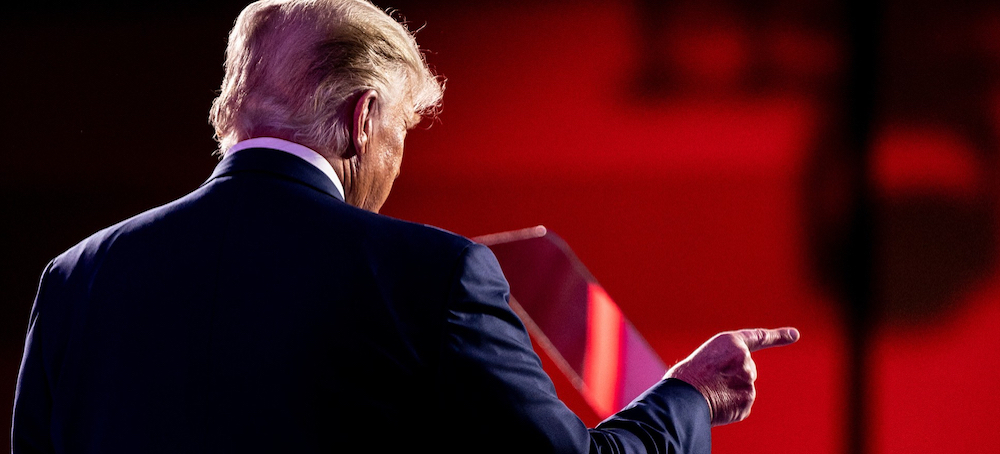
 Trump 2.0: A Horrific Sequel  Donald Trump. (photo: Erin Schaff/NYT/Redux)


Dan Rather and Elliot Kirschner / Substack 

Lately, much of the attention of the Washington establishment, and the media ecosystem that feeds it, has been focused on debating (or diminishing) the electoral prospects of President Biden. There is no shortage of diving boards from which to plunge into the punditry.

One jumping-off point is a series of polls that show Biden in dire straits. These are accompanied by the predictable news reports that quote Democratic “elected officials,” “party leaders,” “campaign strategists,” or even “people close to Biden,” who decline to go on the record when they echo the prevailing wisdom that he is in trouble.

Then there is a rash of third-party candidates threatening to further splinter an already fractured electorate. For example, West Virginia Senator Joe Manchin’s decision not to seek reelection is being framed as both an omen of Biden’s weakness and a threat, because Manchin could represent yet another possible rival for the presidency. Meanwhile, the decisive victories of Democrats across multiple state elections last week have already disappeared in the news cycle’s rearview mirror.

At this point in the campaign season, it is typical for an incumbent president to face this level of scrutiny, second-guessing, and soul searching. Usually, the opposition party is far from deciding on a nominee, and horse race coverage of the current occupant of the Oval Office is catnip for pundits looking for things on which to opine. Furthermore, it is easier to judge an incumbent than a challenger, because we have a lot of data points for how the former would perform in the job of president of the United States — a role without parallel in the world.

But all of these conventions should be thrown out the door for 2024. For starters, while there is a pantomime of a primary campaign going on for the Republican nomination, it has about as much uncertainty as a Harlem Globetrotters game. There is a frontrunner so far ahead that he feels no need to even show up for the debates. And he has paid no price for skipping them. Furthermore, we don’t have to guess what it would be like to have him as president. We’ve already lived through that nightmare once.

But here is where things get even more grim. If Trump were to be reelected, it would be worse, much worse, than the first time. That’s not idle speculation or fantastical conjecture. Trump’s not hiding the truth that he would end American democracy.

We’ve already seen how lies about the 2020 election have become a litmus test for Republican elected officials — including the new speaker of the House. And a recent Washington Post report details how Trump and his allies plan to use the Department of Justice to go after his political rivals, in the kind of revenge politics one finds in dictatorships. Then, in an interview with the Spanish language news service Univision, Trump doubled down on weaponizing the DOJ to attack his opponents.

In a Veterans Day rant in New Hampshire, Trump called upon the authoritarian playbook of dehumanizing political opponents. He railed against “the radical left thugs that live like vermin within the confines of our country” and added, “The threat from outside forces is far less sinister, dangerous and grave than the threat from within.”

Of course, Trump has always been a master of projection. His eagerness to weaponize the DOJ stems from his misplaced sense of victimhood — his belief that he has been targeted with his numerous indictments. The legal jeopardy he faces stems from his attempts to tear down American democracy once. In his rage, he promises to escalate. That has been his playbook in business and politics.

Trump is who he is. And that means it is all the more important for the press not to normalize this election. Yes, there will be polls. And yes, there is a horse race. And yes, reporters can and should cover Biden and his policies with objectivity, to the extent humanly possible. But there should be no diminishing what the other candidate intends to do if he regains the White House. There should be no acceptance of the fact that large swaths of one of our two major political parties are denying the results of a free and fair election.

Recently, reporters are becoming bolder in demanding Republicans state that the 2020 election wasn’t stolen. That is a positive trend and should be followed up with questions about Trump’s attacks on democracy and the rule of law.

This is not simply an election between a Democrat and a Republican or an incumbent and a challenger. This is not primarily about weighing polls and voter enthusiasm in battleground states. This should not be reduced to comparing advertising dollars or voter registration numbers. This is about a vote that will decide the future of our nation in ways unlike any since the Civil War.

Trump isn’t hiding his intentions. There is no excuse for minimizing the threat he poses. What’s at stake in the upcoming election is the continuity of America’s precarious experiment in democracy.

"He moves in darkness as it seems to me -  like an old-stone savage armed."  - Robert Frost in "Mending Wall."