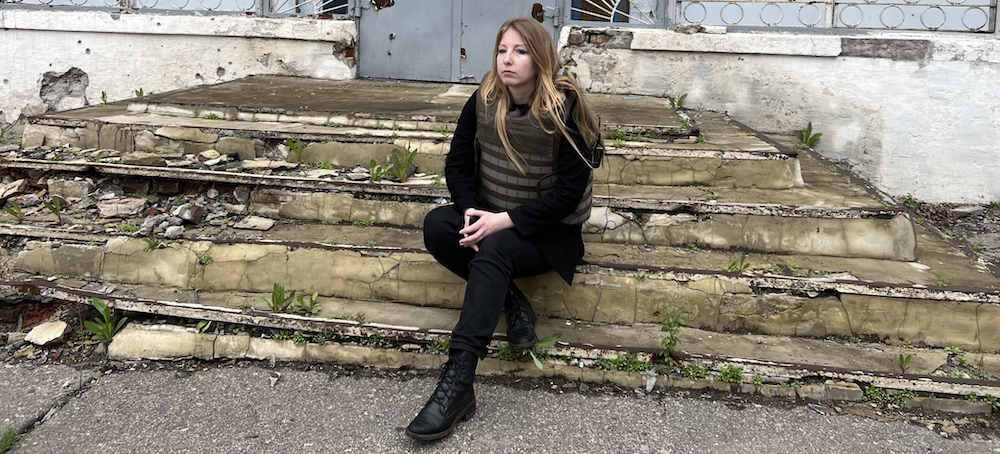
 Victoria Amelina. (photo: Twitter)
04 July 23
Kate Tsurkan
/
The Kyiv Independent
"EDITOR'S NOTE: Be aware as you read this article that its
subject, celebrated Ukrainian author turned war crimes researcher,
Victoria Amelina died Sunday from injuries she sustained when a Russian
S-300 missile struck a crowded pizza restaurant in Kramatorsk, Ukraine
on 27 June 2023. In all the attack injured 47 killing 12, including 3
children. Victoria Amelina becomes the thirteenth victim to die.
Victoria was accompanying delegation of Colombian writers and
journalists, they too were subject to the effects of the blast."
Victoria Amelina | Poem About a Crow
In a barren springtime field
Stands a woman dressed in black
Crying her sisters’ names
Like a bird in the empty sky
She’ll cry them all out of herself
The one that flew away too soon
The one that had begged to die
The one that couldn’t stop death
The one that has not stopped waiting
The one that has not stopped believing
The one that still grieves in silence
She’ll cry them all into the ground
As though sowing the field with pain
And from pain and the names of women
Her new sisters will grow from the earth
And again will sing joyfully of life
But what about her, the crow?
She will stay in this field forever
Because only this cry of hers
Holds all those swallows in the air
Do you hear how she calls
Each one by her name?
###
Russia’s full-scale invasion of Ukraine has
galvanized Ukrainians into action, compelling them to figure out how
they can contribute to their country’s victory. Oftentimes, it has
called for a radical departure from the known comforts of their daily
lives.
That’s exactly what happened to Ukrainian writer Victoria Amelina.
Soon after Feb. 24, 2022, Amelina started volunteering in
humanitarian aid warehouses in her native Lviv, a city in the west of
Ukraine that welcomed thousands of internally displaced Ukrainians. She
herself provided refuge to people who had fled war-affected regions.
The atmosphere in Lviv during the first weeks of Russia’s all-out war was fraught with fear.
The windows in the apartment of Amelina’s mother were shattered when a
Russian missile struck the nearby Lviv tank repair plant, and less than
a month into the war, the first deaths in Amelina’s circle of friends
started to become known.
“We thought that anything could happen back then,” Amelina, 37, told
the Kyiv Independent. “Even a Russian offensive from Belarus with Lviv
as the main target seemed possible.”
She was walking along Zamarstynivska Street, where the Polish lawyer
Raphael Lemkin who coined the term “genocide” once lived, when she
realized that she wanted to do more to advance the Ukrainian war effort.
Amelina is one of Ukraine’s most celebrated young literary figures
and a common presence at literary festivals both in Ukraine and abroad.
However, she didn’t want to just write texts about the war or speak
about it at international events. In late March 2022, Amelina made the
decision to train to become a war crimes researcher.
“I don’t think law and human rights are fields reserved for people
with law degrees. Law is about human beings ultimately, or at least it
should have people at the center; this is what makes law similar to
literature,” Amelina explained.
Amelina reached out to the Ukrainian human rights organization Truth
Hounds, which has been working for the past eight years to document
human rights violations and crimes not only in Ukraine but elsewhere in
eastern Europe and Central Asia.
Training began with an initial theoretical course that took two days
to complete, accompanied by a week-long supervised field mission. The
overall training period concluded by the end of May, and there were many
nights spent reviewing the Geneva conventions and the Rome Statute to
the howl of the air raid sirens.
As of mid-March, the Prosecutor General’s Office has recorded over
80,000 war crimes allegedly committed by the Russian military in Ukraine
since the start of the full-scale invasion. The task of investigators
is already monumental and will only become more challenging as the
Ukrainian military continues to recapture territory.
Due to the number of crimes, Ukrainian officials are working in
coordination with trained civilian organizations, both local and
international, in an effort to document these crimes. War crimes
researchers pass along their findings to the Prosecutor General’s
Office, the International Criminal Court (ICC), and other relevant legal
bodies.
Meanwhile, Ukrainian officials have been meeting with representatives
of the ICC and coordinating with EU officials, as well as over 30
countries, to establish a war crimes tribunal that would someday bring
justice to Ukraine’s victims.
A missing colleague
Amelina’s foray into working as a war crimes researcher happened to
coincide with the disappearance of her colleague Volodymyr Vakulenko, a
celebrated children’s literature writer who had remained in the village
of Kapitolivka near Izium in Khakiv Oblast to care for his disabled son.
“I just knew there would be thousands of war crimes even without this particular case,” Amelina said.
According to Kharkiv Oblast police, on March 24, 2022, Russian forces took Vakulenko away by force in a car with the Russian war symbol “Z”.
The entire Ukrainian literature community was desperately holding
onto hope that Vakulenko would be found alive after liberation, despite
the odds.
As a member of the Ukrainian branch of PEN, the cultural and human
rights non-governmental organization that supports writers worldwide,
Amelina had been doing everything she could to raise awareness about
Vakulenko’s case.
“I couldn’t stop thinking about him,” she said, a sentiment shared by the rest of the Ukrainian literature community.
Truth Hounds started planning their first trip to Kharkiv Oblast as
soon as the Ukrainian counteroffensive in the area began in September.
Amelina volunteered to join them, pulling out of a literary festival in
Sweden that she was supposed to attend at that time.
During the field mission in Kharkiv Oblast with Truth Hounds, Amelina
wanted to check in on Vakulenko’s parents, who were also in
Kapitolivka, as soon as possible. However, the war crimes research team
found three torture chambers in the city of Balakliia alone and spent
several days documenting war crimes in Verbivka and Izium.
The Ukrainian literature community’s hopes were extinguished on Nov.
28 when DNA analysis confirmed the body of Volodymyr Vakulenko was in
grave number 319 of the infamous mass graveyard in the forest near
Izium.
Serhiy Bolvinov, the head of the investigation department of the Kharkiv Oblast police, told BBC Ukraine
in December 2022 that investigators had established the presence of two
9 mm caliber bullets in Vakulenko’s body, which “probably” could be
bullets that were fired from a Makarov pistol.
The diary that Vakulenko started keeping shortly after the start of
the full-scale invasion has remained a testament to his memory and what
Ukrainians like him had to endure during the Russian occupation. Once
Amelina made it to Vakulenko’s parents, she and his father searched for
the diary, which they knew he had managed to bury near a cherry tree in
the yard before the Russians came for him the last time.
“As a writer, I feel this gesture and it hurts me a lot: It is the
last attempt of a writer to speak and be heard, read,” Amelina told BBC
Ukraine in December 2022.
Vakulenko’s diary is now kept in the Kharkiv Literary Museum for
posterity. His final entry ended with: “Everything will be Ukraine! I
believe in victory.”
A prerequisite for lasting peace
“Every survivor of occupation is unique. Most people are happy to
talk to us,” Amelina said. Many of them show their thanks by providing
her and other war crimes researchers with parting gifts – especially
food. She has received walnuts, apples, and other food items from
people’s gardens.
“One man even offered me a bottle of Russian beer from the occupation times but I decided against trying it,” she added.
According to Amelina, each field mission with Truth Hounds typically
lasts about a week. During that time, she is able to talk to two to
three people per day, and some testimonies can take up to six hours to
record. One meeting often provides a lead on the next, with survivors
mentioning other people – such as friends, family members, or neighbors –
who were detained or tortured.
Before each testimony, war crimes researchers need to make certain
that victims are stable enough to psychologically relive the hell
they’ve endured.
“You don't talk to someone who is crying or on the verge of tears,” Amelina said.
“Ideally, you have to grasp what it is that gives them strength. For
example, if you’re talking to a woman who lost her son but has
grandchildren, it’s smart to talk about them for a bit. Regardless of
the technique, empathy is key – you have to care enough so the person
comes out of it stronger than before.”
There is no discernible difference between war crimes committed in
Kharkiv, Kherson, or any other oblast in Ukraine, Amelina said. Russian
forces have shown no hesitation in resorting to torture and murder,
targeting Ukrainian civilians from all walks of life, including
teachers, doctors, children's book writers, and even children.
The devastating impact of Russia’s crimes are revealed not only in
the testimonies of survivors but also in the landscapes of the
once-occupied territories of Ukraine, which still bear the signs of
their brutality. When it comes to documenting the destruction of
Ukraine’s cultural heritage – including libraries, museums, and other
institutions – war crimes researchers simply need to look around.
As for the questions posed to survivors, some organizations send
researchers out into the field with preestablished questionnaires.
According to Amelina, she prefers to work without them.
“We just start from the beginning, from life before the war. For
example: ‘Were you born here?’, ‘How long have you lived here?’, ‘How
long have you worked in the library?’, ‘Did you expect the invasion to
begin?’, ‘How did you first encounter the military?’ It all depends.
These are just examples,” Amelina said.
“When you catch a phrase like, ‘After we saw the dead POWs’ or
something along those lines you start digging deeper,” she added.
According to Amelina, the questions that follow should always be
open-ended, such as how the military officers were dressed, what they
looked like, how they spoke, and so on – it’s important for war crimes
researchers not to lead on the victims and let them speak naturally.
“We just need the truth,” Amelina said.
Despite the often difficult nature of fieldwork, there can be the
occasional heartfelt moment. Amelina recalled one such instance when she
was recording the testimony of a man in Kherson Oblast. He was
describing to her the harrowing account of his kidnapping and torture at
the hands of Russian occupying forces, while his children ran around
them, playing and laughing.
Amelina was deeply moved by his children's ability to find joy and
laughter even amidst the difficult circumstances of war. After she
finished recording their father’s testimony, the children approached
her, and she offered them some candy, telling them that their father was
a hero.
She acknowledges that the children were probably too young to
understand the significance of her words, and would probably not
remember them in the future. Nevertheless, she felt it was important to
say it for their parents' benefit. "I said it more for their mom and dad
to hear," Amelina explained.
There are some people who are too frightened to speak with war crimes
researchers. Other survivors agree to speak but later refuse to sign
the release papers which permit to pass their testimony to Ukrainian law
enforcement, the International Criminal Court, or even just for
safekeeping in historical archives.
“Such instances feel like a defeat to me,” Amelina said. “It means I failed to help that survivor in achieving justice.”
Although the work of a war crimes researcher can be arduous, taxing,
and potentially traumatizing, Amelina remains steadfast in her
conviction that justice will eventually be served to Russian war
criminals.
“This is a prerequisite for lasting peace, healing survivors and
witnesses’ trauma, and completing Ukraine’s democratic transformation.
We need to stay healthy and live long enough to witness all the trials,”
she explained.
Words for war
Amelina hasn’t entirely put her literary career on hold – she still writes and occasionally attends literary festivals abroad.
Ukrainian writers understand that it is vital to continue promoting
their culture, given that Russia’s genocidal war has committed a
multitude of crimes in an effort to erase it, such as destroying
cultural heritage sites, burning Ukrainian books, looting priceless
artifacts from museums, and imposing Russian curriculums in schools of
the occupied territories.
However, Amelina acknowledged that initially, it was difficult for
her to reconcile the stark contrast between discovering torture chambers
in liberated territories one day and speaking in front of an audience
of curious readers the next. Even walking around tranquil cities
sometimes took on an unexpectedly distressing quality.
“You cannot stop thinking that it’s better to stay on the pavement
and avoid grass as there could be mines,” Amelina said. “Even in London
or Berlin.”
Many foreigners come up to her at international literary events
asking how she deals with the trauma of a war with no foreseeable end in
sight.
“I tell them that they help me, because they listen to me,” she said.
War crimes testimonies are a far cry from the flourishing poems and
prose that Amelina is known for. When speaking to the survivors of
Russian occupation there is only the need to document hard facts.
However, Amelina's writing has long exhibited a profound sense of
empathy, and perhaps that’s what makes her particularly well-suited to
assist survivors of Russian war crimes in amplifying their voices.
Russia's war has made its way into Amelina's own writing, as it has
for most writers in Ukraine over the past nine years, especially since
the start of the full-scale invasion. Currently, she is focused on
penning a non-fiction book that delves into the tireless work of
journalists, human rights activists, lawyers, and volunteers who
document Russian war crimes.
“It’s impossible to write about anything other than war now,” Amelina said. “There’s just no other way.”








 Ended affirmative action