Join us at our brand new blog - Blue Country Gazette - created for those who think "BLUE." Go to www.bluecountrygazette.blogspot.com

YOUR SOURCE FOR TRUTH

Saturday, May 7, 2022

JORDAN SMITH/THE INTERCEPT: The Fact-Free Logic of Supreme Court Justice Samuel Alito

The Fact-Free Logic of Supreme Court Justice Samuel Alito  

Protesters demonstrate in support of abortion rights outside the U.S. Supreme Court in Washington, D.C., on May 3, 2022. (photo: Al Drago/Bloomberg/Getty Images) 


In his zeal to overturn Roe and do away with abortion rights, the Supreme Court justice relies on deceptive arguments and a regressive read of the law.

As a matter of fact, Supreme Court Justice Samuel Alito is wrong.

In a leaked draft of the court’s majority opinion in the Mississippi case Dobbs v. Jackson Women’s Health Organization, Alito writes that Roe v. Wade and its successor Planned Parenthood v. Casey must be overturned — an extraordinary move that would topple precedent in order to constrict, rather than expand, constitutional rights.

The missive is aggressive and self-righteous and reads like the greatest hits of those who disfavor the right to bodily autonomy. There’s the linking of abortion to eugenics, for example. “Some such supporters have been motivated by a desire to suppress the size of the African American population,” Alito writes. “It is beyond dispute that Roe has had that demographic effect.” The ahistorical comparison misses the fact that an individual choosing to abort their own pregnancy is not analogous to forced sterilization by the state to alter the American gene pool.

And there’s the claim that because the word “abortion” isn’t found in the Constitution, the right to it doesn’t exist. “The Constitution makes no reference to abortion, and no such right is implicitly protected by any constitutional provision,” Alito writes. This completely ignores the historical significance of the 14th Amendment, a Reconstruction-era addition meant to ensure individual liberty, including the right to decide whether and with whom to form a family. “Most Americans understand the plain truth reflected in these protections,” Elizabeth Wydra, president of the Constitutional Accountability Center, said in a statement. “A person cannot truly be free, and is not truly an equal member of society, if they do not get to decide for themselves this most basic question of bodily autonomy.” Alito’s opinion, she said, “frighteningly bulldozes past the Constitution.”

Alito also dismisses the notion that there are any clearly identifiable reliance issues at stake in discarding abortion rights. In this context, the concept of reliance posits that when expectations have been built around the stability of a particular law or judicial pronouncement, those interests should be protected and the precedent underpinning them upheld. In addressing the issue, Alito comes off as if perplexed: The court knows how to evaluate “concrete” reliance issues like those implicated in “property and contract rights,” Alito writes, but assessing an “intangible” reliance is a whole other story. “That form of reliance depends on an empirical question that is hard for anyone — and in particular, for a court — to assess, namely, the effect of the abortion right on society and in particular on the lives of women.”

Yet again, Alito is wrong — and there’s plenty of research to prove it.

A Mountain of Evidence

In an amicus brief filed in the Dobbs case, 154 economists and researchers took direct aim at the how-could-we-possibly-know-what-abortion-has-done-for-society nonsense. The brief details a substantial body of research demonstrating that access to legal abortion has had significant social and economic impacts, increasing education and job opportunities for women and reducing childhood poverty.

The expansion of abortion access after Roe reduced the overall birthrate by up to 11 percent. For teens, the drop was 34 percent; teen marriage was reduced 20 percent. Research has revealed that young women who used abortion to delay parenthood by just a year saw an 11 percent increase in hourly wages later in their careers. Access to abortion for young women increased the likelihood of finishing college by nearly 20 percentage points; the probability that they would go on to a professional career jumped by nearly 40 percentage points. All these effects, the economists noted, were even greater among Black women.

“Abortion legalization has shaped families and the circumstances into which children are born,” the economists wrote. Abortion legalization reduced the number of children living in poverty as well as the number of cases of child neglect and abuse. “Yet other studies have explored long-run downstream effects as the children of the Roe era grew into adulthood,” reads the brief. “One such study showed that as these children became adults, they had higher rates of college graduation, lower rates of single parenthood, and lower rates of welfare receipt.”

In other words, the effect of the abortion right on society is not remotely “intangible.” There is decades’ worth of evidence showing that abortion access has positively impacted women and their families. “But those changes are neither sufficient nor permanent: abortion access is still relevant and necessary to women’s equal and full participation in society,” the economists wrote, challenging Mississippi’s argument in the Dobbs case that contraception and employment policies like parental leave have essentially made abortion unnecessary. Indeed, nearly half of all pregnancies in the United States are unintended and nearly half of those pregnancies end in abortion. “These statistics alone lead to the inevitable (and obvious) conclusion that contraception and existing policies are not perfect substitutes for abortion access.”

Deceptive and Dangerous

I was a 19-year-old sophomore at the University of Maryland when I found out I was pregnant. I freaked out; I did not want to be pregnant. I knew I needed an abortion, but I didn’t have the money. I gathered up a bunch of change and called my mom from a pay phone. She didn’t miss a beat when I told her I was pregnant. “No, you’re not,” she said. She sent the money that day.

It was 1991, a year before Planned Parenthood v. Casey set the stage for the overwhelming number of restrictions on abortion access to come. Many were sold as a way to protect people’s health or a state’s interest in potential fetal life, but they were largely based on junk science. For me, once I had the money, the access was easy. I went on with my life, and I have never regretted my decision. Abortion was the reason I was able to stay in school, go on to graduate school, and develop my career.

But while I had a relatively easy time exercising the right conferred by Roe, that is far from a universal experience. For many, Roe was always just a promise on paper. And for decades, those who disfavor reproductive freedom have worked diligently with their conservative elected allies to make abortion all but inaccessible for millions of people living in large swaths of the country. I’ve watched this happen over the nearly two decades that I’ve covered assaults on reproductive health access. The burden has fallen disproportionately on people of color, those with low incomes, those living in more rural areas of the country, young people, immigrants, and LGBTQ+ people. Doing away with Roe is only going to exacerbate those inequities. Thirty-six million people of reproductive age live in the 26 states that will outlaw abortion, or are likely to, once Roe falls. It is “unconscionable; it is unjust,” Alexis McGill Johnson, president and CEO of Planned Parenthood Federation of America, said on a Tuesday press call.

No court decision can stop abortion, “period, point blank,” she said. “People with resources will travel to get the care they need, they always have. Others will self-manage their abortions. And there will be people forced to carry pregnancy against their will.”

Fatima Goss Graves, president and CEO of the National Women’s Law Center, was blunt. “To say that we are in unprecedented and truly terrifying times would be a gross understatement,” she said on the call. Losing the right to abortion would mean we no longer have a Constitution that “recognizes our fundamental autonomy and equality.”

Indeed, Alito’s arguments in the draft opinion are deceptive and dangerous. And his regressive read of the law places other rights firmly in the crosshairs — including the right to contraception and to marriage equality. In his zeal to overturn Roe, Alito not only dismisses the decades of work toward realizing the ideal of equality, but also the very notion of equality itself.

“A person cannot truly be free, and is not truly an equal member of society, if they do not get to decide for themselves this most basic question of bodily autonomy.”


Friday, May 6, 2022

MOLLY JONG-FAST/THE ATLANTIC: My Mother Was Wrong; Time to Take to the Streets Again

My Mother Was Wrong 'The feminists who fought for Roe wanted to believe that their victory was forever.' (photo: Fred W. McDarrah/Getty)

The feminists who fought for Roe wanted to believe that their victory was forever. Now their granddaughters are poised to have fewer rights than they did.

We may have made a lot of mistakes, but at least we gave you Roe. I can’t even count the number of times my mother said some version of this to me. It was her way of explaining an earlier generation’s approach to feminism, and what she would say to me when she was trying to make sense of her own legacy. Maybe it wasn’t a normal thing for a mother to say to a daughter, but my mother isn’t a normal mother. She is Erica Jong, a second-wave feminist, a famous novelist, and a woman who throughout her career constantly grappled with what she and her cohort had accomplished and what they hadn’t.

They hadn’t managed to pass the Equal Rights Amendment. They had failed on fair pay. The too-long list of things that had once seemed possible would continue to sting for decades. During the Reagan and Bush eras, my mother felt complete despair at the way conservatism rebounded politically and culturally. She’d say she was a member of the whiplash generation, “raised to be Doris Day, yearning in our 20s to be Gloria Steinem, then doomed to raise our midlife daughters in the age of Nancy Reagan and Princess Di,” as she put it in her memoir, Fear of Fifty.

Keep in mind that my mother, like some other second-wave feminists, had huge blind spots because she had grown up wealthy and white in a blue city in a blue state. Sometimes she’d get really drunk at dinner and grumble about all the things feminists couldn’t get done for their daughters (meaning me), but she would always comfort herself with the reality that they had gotten one major thing right. My mother and all the women who fought alongside her gave my generation Roe v. Wade. They gave us the bodily autonomy we should have already had. They gave us the opportunity to choose what happens in our own uterus. It was an essential gift, and an irreversible one. Or so we thought.

Americans now see that we won’t always have the rights Roe enshrines. Indeed—according to a draft Supreme Court opinion that leaked last night, originally published by Politico—we may not have Roe for very much longer at all.

I always believed that the three justices appointed by Donald Trump would move to overturn Roe, but seeing it actually unfold, reading the words of the draft decision, provoked a generational kind of shock: “We hold that Roe and Casey must be overruled.” Each line is like something out of my mother’s generation’s worst nightmare. Forty-nine years after the greatest feminist victory of the 20th century, Samuel Alito writes: “Roe was egregiously wrong from the start. Its reasoning was exceptionally weak, and the decision has had damaging consequences. And far from bringing about a national settlement of the abortion issue, Roe and Casey have enflamed debate and deepened division.” It’s worth pointing out here that in 1973, five years before I was born, when women had far fewer rights—when they couldn’t even get a credit card without the permission of their husband or father—Roe was decided 7–2, with five Republican-appointed justices in support. The world has become profoundly more pro-choice than it was in 1973; even Catholic countries like Ireland have legalized abortion. Yet here in America, the clock is spinning backwards with stunning and terrifying speed.

It’s not that my mother’s generation hasn’t feared this outcome before. Six days after the 1989 swearing-in of president George H. W. Bush, my mother wrote in The New York Times, “Now that the Supreme Court has agreed to hear an attack on Roe v. Wade, it is painfully apparent that two decades of feminist achievement can be swept away with one wave of a judicial or Presidential hand. Women and men who thought all this was settled long ago, who naively assumed that women’s bodies would never again be political battle grounds, have had to wake up and take notice.” Sixteen years later, in October 2005, Bush’s son would appoint the man who would write the draft opinion that proves how naive we have been.

“The inescapable conclusion is that a right to abortion is not deeply rooted in the Nation’s history and traditions,” Alito writes. But that’s not really true. Forty-nine years encompasses a lot of history and tradition. I am 43 years old. I have never lived in an America without Roe. I have never lived in a country where more than half of the population does not have agency over their own body. It appears that I will live in that world starting in June, and so will 167 million other women.

So what now? The internet is a sea of enraged comments. Online activism can be powerful—but it is not enough. A CNN poll from January shows that only about 30 percent of Americans want Roe overturned. The large majority of Americans don’t want this. And now is the time for them to exercise a right we still have—the right to peacefully protest.

Those who support Roe’s protections must show lawmakers and justices that they are about to do something very unpopular. Last night, peaceful protesters gathered in front of the Supreme Court to chant, “Hey hey, ho ho, Sam Alito’s got to go.” By 11 p.m., hundreds of people had assembled. But hundreds of people can’t do this alone. This leaked document should become a rallying cry. The opinion is still a draft. We don’t know with certainty where all the justices will land. Democrats still control Congress, and the presidency. There are still things they could do. Congress can legislate; President Joe Biden can use his executive powers.

My mother is 80 now. She doesn’t write much anymore. But the term whiplash generation feels more apt than ever. She is about to watch her granddaughter grow up in a world without the rights she secured for herself, and for her daughter. Today, we have a glimpse of history not yet written. A seismic change in America is coming, and it is coming quickly. But it isn’t too late. Not yet.

"The large majority of Americans don’t want this. And now is the time for them to exercise a right we still have—the right to peacefully protest."

Thursday, May 5, 2022

JILL LEPORE / THE NEW YORKER: Of Course the Constitution Has Nothing to Say About Abortion


There is no mention of the procedure in a four-thousand-word document crafted by fifty-five men in 1787. This seems to be a surprise to Samuel Alito.

Within a matter of months, women in about half of the United States may be breaking the law if they decide to end a pregnancy. This will be, in large part, because Supreme Court Justice Samuel Alito is surprised that there is so little written about abortion in a four-thousand-word document crafted by fifty-five men in 1787. As it happens, there is also nothing at all in that document, which sets out fundamental law, about pregnancy, uteruses, vaginas, fetuses, placentas, menstrual blood, breasts, or breast milk. There is nothing in that document about women at all. Most consequentially, there is nothing in that document—or in the circumstances under which it was written—that suggests its authors imagined women as part of the political community embraced by the phrase “We the People.” There were no women among the delegates to the Constitutional Convention. There were no women among the hundreds of people who participated in ratifying conventions in the states. There were no women judges. There were no women legislators. At the time, women could neither hold office nor run for office, and, except in New Jersey, and then only fleetingly, women could not vote. Legally, most women did not exist as persons.

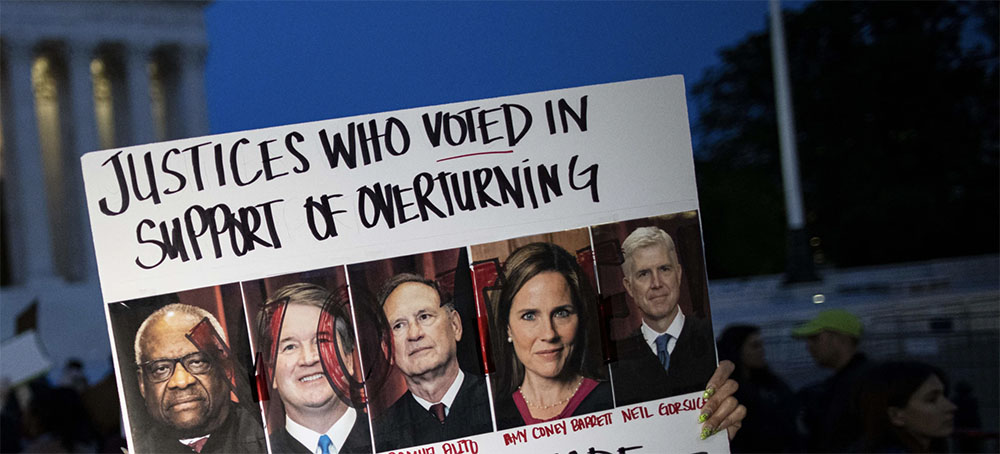
Because these facts appear to surprise Alito, abortion is likely to become a crime in at least twenty states this spring. “The Constitution makes no reference to abortion, and no such right is implicitly protected by any constitutional provision,” Alito wrote, in a leaked draft of the Supreme Court’s majority opinion in Dobbs v. Jackson Women’s Health Organization. The draft decision, which Politico published on Monday night, would overturn Roe v. Wade, the 1973 decision legalizing abortion. Chief Justice John Roberts, promising an investigation, has not denied its authenticity. Five Justices have reportedly voted in accordance with the draft: Alito, Brett Kavanaugh, Amy Coney Barrett, Clarence Thomas, and Neil Gorsuch. Justices Stephen Breyer, Sonia Sotomayor, and Elena Kagan are sure to dissent. Roberts is not likely to concur. One theory has it that whoever disclosed the draft is trying to make it more difficult if not impossible for Roberts to recruit a defector from the majority. But, of course, this remains unknown.

About as wholly speculative as the question of who leaked this decision is the history offered to support it. Alito’s opinion rests almost exclusively on a bizarre and impoverished historical analysis. “The Constitution makes no express reference to a right to obtain an abortion, and therefore those who claim that it protects such a right must show that the right is somehow implicit in the constitutional text,” he argues, making this observation repeatedly. Roe, he writes, was “remarkably loose in its treatment of the constitutional text” and suffers from one error above all: “it held that the abortion right, which is not mentioned in the Constitution, is part of a right to privacy, which is also not mentioned.”

Women are indeed missing from the Constitution. That’s a problem to remedy, not a precedent to honor.

Alito cites a number of eighteenth-century texts; he does not cite anything written by a woman, and not because there’s nothing available. “The laws respecting woman,” Mary Wollstonecraft wrote in “A Vindication of the Rights of Woman,” in 1791, “make an absurd unit of a man and his wife, and then, by the easy transition of only considering him as responsible, she is reduced to a mere cypher.” She is but a part of him. She herself does not exist but is instead, as Wollstonecraft wrote, a “non-entity.”

If a right isn’t mentioned explicitly in the Constitution, Alito argues, following a mode of reasoning known as the history test, then it can only become a right if it can be shown to be “deeply rooted in this Nation’s history and tradition.” As I have argued, the history test disadvantages people who were not enfranchised at the time the Constitution was written, or who have been poorly enfranchised since then. Especially important is the question of who was enfranchised at the time of the ratification of the Fourteenth Amendment, in 1868, the nation’s second founding, since many arguments defending abortion rights (and many other rights, too) turn on the equal-protection and due-process clauses of that amendment. Here, too, Alito is baffled to discover so little about abortion and women. Referring to the advocates for Jackson Women’s Health Organization and to amicus briefs like one signed by the American Historical Association, Alito writes, “Not only are respondents and their amici unable to show that a constitutional right to abortion was established when the Fourteenth Amendment was adopted, but they have found no support for the existence of an abortion right that predates the latter part of the 20th century—no state constitutional provision, no statute, no judicial decision, no learned treatise.”

He might have consulted the records of the U.S. Senate from the debate over the Fourteenth Amendment, when Jacob Howard, a Republican senator from Michigan, got into an argument with Reverdy Johnson, a Democrat from Maryland. Howard quoted James Madison, who had written that “those who are to be bound by laws, ought to have a voice in making them.” This got Johnson terribly worried, because the Fourteenth Amendment uses the word “person.” He wanted to know: Did Howard mean to suggest that women could be construed as persons, too?

MR. JOHNSON: Females as well as males?

MR. HOWARD: Mr. Madison does not say anything about females.

MR. JOHNSON: “Persons.”

MR. HOWARD: I believe Mr. Madison was old enough and wise enough to take it for granted that there was such a thing as the law of nature which has a certain influence even in political affairs, and that by that law women and children are not regarded as the equals of men.

Alito, shocked—shocked—to discover so little in the law books of the eighteen-sixties guaranteeing a right to abortion, has missed the point: hardly anything in the law books of the eighteen-sixties guaranteed women anything. Because, usually, they still weren’t persons. Nor, for that matter, were fetuses.

I don’t happen to think Roe was well argued. I agree with Ruth Bader Ginsburg’s early analysis—that grounding the right in equality rather than privacy might have been a sounder approach. I’m not even a hard-liner on the question of abortion; I find it morally thorny. But, when Samuel Alito says that people who believe abortion is a constitutional right “have no persuasive answer to this historical evidence,” he displays nothing so much as the limits of his own evidence. “The page of history teems with woman’s wrongs,” as the nineteenth-century abolitionist Sarah Grimké once put it. It does not teem with women’s rights. To use a history of discrimination to deny people their constitutional rights is a perversion of logic and a betrayal of justice. Would the Court decide civil-rights cases regarding race by looking exclusively to laws and statutes written before emancipation?

At the close of the opinion, Alito congratulates both himself and the Court that, with this ruling, they are enfranchising women. “Our decision . . . allows women on both sides of the abortion issue to seek to affect the legislative process by influencing public opinion, lobbying legislators, voting, and running for office,” he writes. “Women are not without electoral or political power.” True, women are no longer without electoral power. But they were without it for almost the entirety of the history on which Alito grounds his analysis of the Constitution and its provisions. You don’t need a leaked document to learn that.

“The page of history teems with woman’s wrongs,” as the nineteenth-century abolitionist Sarah Grimké once put it. It does not teem with women’s rights.

Wednesday, May 4, 2022

PENNYFARTHING: Alito's opinion nixing Roe v. Wade draws heavily on old-timey, witchcraft-believing rape advocate

Let’s face it: This Republican-packed Supreme Court was always going to overturn Roe v. Wade. The only question was which B.S. justification it was going to use to do it. I was a little worried they’d cite Godzilla vs. Mothra or one of Ginni Thomas’ texts as precedent just to shove it in our faces, but what actually happened is arguably worse.

The GOP’s decades-long campaign to turn all childbearing-aged women into agency-free Easy-Bake Ovens has now reached its stunning denouement with the leak of Slimin’ Sammy Alito’s draft majority opinion eviscerating 1973’s landmark Roe v. Wade decision. Alito’s opinion is horrifying on its face, but it’s even more problematic upon closer inspection, what with its name-dropping of an old-timey English dude best known for executing witches and blithely defending rape.

From Jezebel:

In case you needed any further proof that the modern anti-abortion movement is an outgrowth of many centuries of virulent misogyny and violence against women, Justice Samuel Alito’s leaked opinion draft striking down Roe v. Wade relies heavily on a 17th century English jurist who had two women executed for “witchcraft,” wrote in defense of marital rape, and believed capital punishment should extend to kids as young as 14.

“Two treatises by Sir Matthew Hale,” Alito wrote in his argument to end legal abortion across America, “described abortion of a quick child who died in the womb as a ‘great crime’ and a ‘great misprision.’ See M. Hale, Pleas of the Crown.”

So how many of you woke up this morning thinking you were guilty of “great misprisions”? Not many, I’ll wager. But clearly, a great many of you are up to your blowsy neck wattles in them. 

How interesting that Alito would cite Pleas of the Crown! That’s the text, published in 1736, 60 years after Hale’s death, that defended and laid the foundation for the marital rape exemption across the world.

Pleas of the Crown? Were there no relevant passages from Archie Comics? Honestly, at this point, I’d trust Mr. Weatherbee’s legal judgment far more than Clarence Thomas’. 

For instance, there’s this kernel of homespun wisdom from the noble Sir Hale’s full-throated defense of rape: “For the husband cannot be guilty of a rape committed by himself upon his lawful wife for by their mutual matrimonial consent and contract the wife hath given up herself in this kind unto her husband which she cannot retract.”

Now there’s a moral paragon for you! Say, is this kind of thing actually supposed to convince anyone, or is this just the “fuck you, we can do what we want” sort of message we all expected from Boof Kavanaugh and his band of merry Squees? I used to think Supreme Court decisions needed to be based on sound arguments from unimpeachable sources, but after seeing Alito’s big bowl of bonkers I kind of want to drop Hitler’s plum strudel recipe into my next loan application just to see what happens. I mean, why not? We’re just making it all up as we go now, right?

Meanwhile, it’s worth noting that Hale also sentenced two women to death following “one of the most notorious of the 17th century English witchcraft trials.” And now his desiccated antediluvian finger is wagging at witchy women from beyond the grave, thanks to Sam Alito and his personal Wayback Machine. 

So maybe it’s time to do something about it. In the wake of all this, it may be hard to decide whether to donate to Democratic candidates, Planned Parenthood, or choice advocacy groups. I can’t answer that for you, of course, but ActBlue is a good place start, as is EMILY’s List

You know what to do.


Tuesday, May 3, 2022

The Supreme Court's Legitimacy Is Already Lost

Regardless of Roe falling, the leaks, and the court’s disregard for the public it is supposed to serve, have gone too far.

If the Supreme Court indeed strikes down Roe v. Wade and Planned Parenthood v. Casey this June, as the draft opinion leaked to and published by Politico tonight suggests it will, years of conventional wisdom about the court and its concerns for its own legitimacy will be proved wrong. Every single court watcher who spoke in terms of baby steps, incrementalism, or “chipping away” at one of the most vitally important precedents in modern history will have been wrong. Those who suggested the court would never do something so huge and so polarizing just before the November midterms will have been wrong. And the people who assured us that Brett Kavanaugh and Amy Coney Barrett were moderate centrists who cared deeply about the appearance of a nonideological and thoughtful court—well, yeah. They will have been wrong too.

If this draft opinion becomes precedent of the court, the results will be catastrophic for women, particularly for women in the states that will immediately make abortion unlawful, and in those places, particularly for young women, poor women, and Black and brown women who will not have the time, resources, or ability to travel out of state. The court’s staggering lack of regard for its own legitimacy is exceeded only by its vicious disregard for the real consequences for real pregnant people who are 14 times more likely to die in childbirth than from terminating a pregnancy. The Mississippi law—the law this opinion is upholding—has no exception for rape or incest. We will immediately see a raft of bans that give rights to fathers, including sexual assailants, and punish with evermore cruelty and violence women who miscarry or do harm to their fetuses. The days of pretending that women’s health and safety were of paramount concern are over.

For all the shock that has been expressed at what is truly a shocking opinion, polling suggests that the American public may turn its shock into legitimate political anger. CNN polling from January showed that just 30 percent of Americans wanted the court to overturn Roe v. Wade, and 52 percent said that should Roe be overturned, they would want their state to become a safe haven for women seeking abortion. Thirty-five percent said they would be angry if the ruling were overturned, compared with just 14 percent who said they would be happy.

But in his draft opinion, Justice Sam Alito wants America to know he doesn’t care about voters’ feelings. “We cannot allow our decisions to be affected by any extraneous influences such as concern about the public’s reaction to our work,” Alito writes. “We do not pretend to know how our political system or society will respond to today’s decision overruling Roe and Casey. And even if we could foresee what will happen, we would have no authority to let that knowledge influence our decision.”

Ironically, whoever decided to leak the opinion cared very much about the political implications of the impending decision. It is one of the most brazenly political acts to ever come out of the court, actually. It is perhaps the most emphatic confirmation that there are simply no rules left at an institution that is supposed to be the one making the rules, but is instead currently under unprecedented public scrutiny for its very absence of binding rules. The same Supreme Court that blames journalists for its sinking polling numbers and refuses to be bound by ethics rules wants you to know that it doesn’t answer to politics. But it surely produces politics.

In other words, in addition to Alito’s sneering references to “abortionists” and eugenics and his gleeful mockery of the authors of both Roe and Casey, anyone who believed the court would pretend to have any solicitude whatsoever—for women, for public opinion, for its own reputation as a moderate branch—was well and truly kidding themselves. This draft opinion, whatever may be done to it in the days to come, is Exhibit A for anyone who believed that time or history or respect for their colleagues or the justices who came before them would moderate the five justices in this current majority, a majority that ought to know it stole its way into a majority but again refuses to even feign self-moderation in the face of that fact. We knew this when Texas’ S.B. 8 law banning abortion after six weeks was decided on the shadow docket in September, and when the court let it stand again this winter. We knew it when we watched the Dobbs arguments last fall. Roe had already been effectively overturned then—we have just had trouble catching up.

It is hard to keep this in perspective tonight, in light of the shattering ruling it portends, but there are real and enduring consequences to the fact that the draft opinion was leaked. There are real and enduring consequences to the fact that someone told Politico what the vote count was, that “four of the other Republican-appointed justices—Clarence Thomas, Neil Gorsuch, Brett Kavanaugh and Amy Coney Barrett—had voted with Alito in the conference held among the justices after hearing oral arguments in December, and that line-up remains unchanged as of this week.” There are real and enduring consequences to the fact that we now seem to know what Chief Justice John Roberts wants to do, already. The implications for trust and confidence in secret proceedings for the nine justices are stunning. The leaks from the court around Justice Neil Gorsuch declining to wear a mask at oral arguments this winter were a dry run for today’s. Whatever norm had been keeping the justices from showing us their Real Housewives of 1 First Street antics is now gone as well.

The court will surely suffer for this shattering self-own to its own legitimacy. But the rule of law and the public will suffer as well. The three Republican-appointed justices who authored the plurality opinion in Casey knew very well what would happen to the court if it disregarded and disparaged the American public, the Constitution, and itself. Be afraid for what’s coming next in terms of personal autonomy and liberty, for LGBTQ protections and the right to contraception, yes. But be equally afraid for the abstraction of an independent and principled judiciary. No matter what happens next, that’s already lost.

.

Monday, May 2, 2022

GOP CLOWN CAR: Madison Cawthorn having fun with alcohol and lingerie

DK-CawthornCrossDresser.jpg
Madison Cawthorn photographed wearing women's lingerie at wild-looking party.

Politico, Michael Kruse, 4/22/2022

Photographs obtained by POLITICO appear to show Madison Cawthorn, the embattled Republican congressman from North Carolina who recently accused his GOP colleagues of inviting him to orgies, wearing lingerie in what appears to be a party setting.

Cawthorn, 26, was raised in a conservative Baptist community in Henderson County, North Carolina, and has staked his political persona on arch-traditional Christian principles and the insistence of the importance of a kind of hypermasculinity. His comments about “the sexual perversion” in Washington made on a podcast, which he later admitted were exaggerated, drew the public disapproval and disavowal of Minority Leader Kevin McCarthy as well as other Republican leaders including those in his North Carolina congressional caucus.

The revelation of the two photos is the latest in a series of unflattering headlines for the freshman member of Congress in the run-up to the primary in his first re-election bid. The primary in North Carolina is May 17. Cawthorn has seven Republican opponents who see him as vulnerable.

Once again, Madison becomes the gift that keeps giving Republicans headaches. We know that Cawthorn’s hypermasculinity, wrapped in the cloth of Republican Jesus, has been one of his shining features for the White Evangelical communities of Western North Carolina and beyond. 

Revelations about his behavior, from speeding, driving with a revoked driver’s license, and more, are starting to take its toll on his approval. Maybe something as abhorrent as dressing in lingerie while partying with happy women will be the final straw. But then again, maybe not.

Stay tuned for the next edition of GOP CLOWN CAR.  It's only a matter of time until another Bozo emerges.