Join us at our brand new blog - Blue Country Gazette - created for those who think "BLUE." Go to www.bluecountrygazette.blogspot.com

YOUR SOURCE FOR TRUTH

Sunday, May 6, 2018

Water War Will Decide the Fate of 1 in 8 Americans

The dried lakebed of Lake Mead. (photo: Ethan Miller/Getty Images)

By Eric Holthaus, Grist
 
ake Mead is the country’s biggest reservoir of water. Think of it as the savings account for the entire Southwest. Right now, that savings account is nearly overdrawn.

For generations, we’ve been using too much of the Colorado River, the 300-foot-wide ribbon of water that carved the Grand Canyon, supplies Lake Mead, and serves as the main water source for much of the American West.

The river sustains one in eight Americans — about 40 million people — and millions of acres of farmland. In the next 40 years, the region is expected to add at least 10 million more people, as the region’s rainfall becomes more erratic.

An especially dismal snowpack this past winter has forced a long-simmering dispute over water rights to the fore, one that splits people living above and below Lake Mead.

It’s a messy, confusing situation, so here’s an overview of who’s involved and what’s at stake:

Users of Colorado River water below Lake Mead — including the cities of Phoenix, Los Angeles, Las Vegas (collectively referred to as the “lower basin”) — rely on the reservoir as a lifeline. The people in the lower basin exist partly at the mercy of what happens in the upper basin, an area encompassing the snowcapped peaks of Wyoming, Utah, Colorado, and northern New Mexico, the source region of the river.

Big water users in the upper basin — Salt Lake City, Denver, Albuquerque, among others — are also getting nervous because snowpack in the Rockies has been dwindling, and there’s no physical way for them to store the water they depend on.

There are no big reservoirs in the Rockies.

In recent weeks, tensions are rising after states in the upper basin sent a strongly worded letter to one of the river’s biggest users, the Central Arizona Water Conservation District, or CAWCD, which supplies water to Tucson and Phoenix. The upper basin states accused the utility of manipulating the complex system that governs Lake Mead in order to get more water. The Arizona utility denied the charges.

An upper basin city — Pueblo, Colorado — then pulled out of a regional conservation program, further threatening the spirit of long-term cooperation throughout the Colorado River basin. Denver has threatened to do the same. The quick escalation shows just how fragile the system really is.

In an email to Grist, Kathryn Sorensen, director of Phoenix’s Water Services Department, says the city “does not and has never supported CAWCD’s attempt to draw additional water” from the Colorado River. She said that the only way forward “is through collaboration among all stakeholders in the basin.”

The whole thing feels like the beginnings of a water war fought with cryptic, wonky tweets. As longtime Western water journalists Luke Runyon and Bret Jaspers recently wrote, “public shaming is how water managers police themselves.”

What’s happening could be seen as the slow death of an era of easy living, the unwinding of a nearly 100-year-old series of multi-state compacts (collectively called “The Law of the River”) that’s been widely viewed as too permissive. Over-reliance on the Colorado River has helped pave the way for rapid population growth across the region, from Southern California to Denver, which may now, ironically, begin to pose a threat to those same cities.

For many reasons, Arizona is last in line for the Colorado River’s water, and the state is already preparing for the mandatory restrictions that could be less than two years away. The latest official projections from the U.S. Bureau of Reclamation, the federal agency that manages the Colorado River system, shows that Lake Mead is likely to dip below the critical threshold of 1,075 feet above sea level late next year. That could trigger the first official “call on the river” — a legally-mandated cutback for certain users aimed at avoiding an all-out free-for-all.

In Phoenix, a worst-case scenario is now looking more and more likely. In just a few years from now, if (or, when) Lake Mead dips below 1,075 feet, the city may find itself in a position where it stops building new subdivisions, the state’s agricultural economy comes crashing to a permanent halt, and a fit of well-drilling begins to deplete the local groundwater.

And then there’s always climate change. On the world’s current emissions trajectory, sharply warming temperatures boost the odds of a megadrought in the Southwest sometime later this century to more than 99 percent. Such a drought would last a generation. Nearly all trees in the Southwest could die. The scale of the disaster would have the power to reshape the course of U.S. history.

For now, the spat over the Colorado River offers a glimpse into water politics in an era of permanent scarcity. The low snowpack in the upper basin states means that inflows into Lake Mead will be just 43 percent of normal this year, raising the stakes for conservation programs throughout the West. In the midst of long-running drought, 2017 was the most successful year for water conservation in decades — which is evidence that when there’s less water around, people can make things work.

“We must all find a way to collectively use less water while respecting the Law of the River,”Sorensen says. “That’s of course a tricky proposition because the Law of the River is basically the most complex governance structure ever created by human beings.”

Saturday, May 5, 2018

Why Republicans Attack Children

Parkland student activists. (photo: Firenews)

By George Lakoff, Medium
 
adical conservatives have found a new target for their anger, scorn, and ridicule: Children. Conservative attack dogs have made a point of specifically berating, harassing and insulting the young victims of the school shooting in Parkland, Florida.

Eloquent young students like Emma Gonzalez and David Hogg, whose voices have captivated the nation, draw venomous responses from conservative pundits. Fox News host Laura Ingraham went so far in her attack on Hogg that she’s now lost most of her advertisers and may even lose her show.

Why do conservatives viciously target these young people who have already suffered so much? For one thing, it’s clear that the powerful voices of these young Americans express the truth in a way that resonates with tens of millions of people.

But there’s another reason why conservatives have such a negative response to the voices of young people — a reason deeply ingrained in the conservative political brain. Conservative political thought is governed by a very specific hierarchy, a hierarchy in which children must always be subservient to adults. So, the sight of young people raising their voices to call for change is an existential threat to the conservative moral hierarchy — just as the sight of women, people of color, or LGBTQ people standing up for their rights is always met with fear and derision by conservatives.

This hierarchy (see chart below) explains most Republican political thought. Nearly every piece of conservative legislation is designed to impose this hierarchy on the entire country and to return to some mythical golden past that was great for a few but repressive for the majority of Americans.

Many intelligent people are rushing around trying to figure out why conservatives support Trump, and what ideas unite conservatives as a political force. This was the exact question I set out to answer in the mid-1990s when I wrote a book called Moral Politics. The answer, after years of study, became clear. Conservatives and progressives have two very different concepts of our nation, concepts rooted in very different understandings of morality. And in the conservative system of morality, which I mapped out two decades ago, children are not allowed to speak up to adults.

When conservatives attack students like Emma and David, they aren’t just attacking them because they disagree with their stance on gun massacres. They’re also attacking them because conservatives don’t believe children have a right to raise their voices, period. And their reason for believing this explains nearly every other aspect of conservative thought.

It’s time to stop asking “why” conservatives think the way they do and start figuring out what the American majority can do to make sure their dominance over our political system comes to a swift and final end.

Friday, May 4, 2018

Abbreviated pundit roundup: "Bless you, Rudy Giuliani, you glorious fool."


A noun, a verb, and a damning admission. Donald Trump’s lawyer Rudy Giuliani couldn’t help worsening the situation for his already legally imperiled client by appearing on TV this week to dig the hole a little deeper. Here’s Paul Waldman’s take at The Week:
Bless you, Rudy Giuliani, you glorious fool.
This is where we are: When one of the president's lawyers tells the truth, it's blockbuster news. That's what happened Wednesday night when Giuliani, a relative newcomer to President Trump's ever-rotating legal team, went on Hannity for what should have been another softball interview. To everyone's surprise, Giuliani announced that President Trump reimbursed his attorney Michael Cohen the $130,000 Stephanie Clifford (a.k.a. Stormy Daniels) was paid to keep silent about an affair she says she had with Trump. Which means that Giuliani admitted that Trump lied about this, the White House lied about it, and Cohen didn't exactly lie about it, but carefully chose his words to fool everyone into thinking something that was false. Good work, Rudy!
Don’t miss Harry Litman’s analysis at The New York Times. Litman is a former United States attorney and deputy assistant attorney general:
This is not a big, clean Trumpian lie. It is messy and convoluted and falls apart when you spell it out: Trump didn’t know about the specifics, but he did repay because he did know about the general arrangement, but he didn’t really know because it’s just the sort of things lawyers do for clients and Mr. Cohen didn’t want to burden him since he’s a busy man. Got that?
Good luck bearing up under an aggressive cross-examination on all this. It may, in fact, come to that, because among the many problems with Mr. Giuliani’s story is that it makes him a witness to important facts in both the Cohen and Trump investigations.
It also, of course, indicates that Mr. Trump was lying when he said he had no knowledge that Mr. Cohen had paid Ms. Daniels. Presumably the calculation of Team Trump is that his base exacts no cost for even the baldest of lies, even one offered as the final you-can-believe-me truth after months of prevarication.

Adam Davidson at The New Yorker:

It’s impossible to know precisely what Giuliani thought he was doing in his various television appearances this week. I suspect he believed that it would be better for Trump, legally, if the Stormy Daniels payoff was cast as a private matter that Trump paid out of his pocket, as having nothing to do with the election and, therefore, nothing to do with campaign-finance laws.
One problem, though, was that Trump had said publicly that he knew nothing about the payoff. Aha!, Giuliani seems to have thought, we can say that Cohen’s monthly retainer from Trump was designed for just this sort of thing: to allow Cohen to take care of problems without bothering Trump with them. It would explain everything: the payoff that Trump didn’t know about but also authorized, the fact that Trump now seems to know about the payoff that he didn’t know about, and the idea that this was not a campaign-related expense. This is precisely the kind of too-clever idea that a lawyer should put to his colleagues before presenting publicly. Did Giuliani allow anyone around him to challenge the logical inconsistencies in his argument? (The Washington Post reporter Robert Costa has said that Trump and Giuliani are “running” their own strategy.) How can it be that the Stormy Daniels payment has been the subject of public debate for months, and yet Trump’s defense team still hasn’t settled on how it is arranging the known facts? The reason is this: everyone around Trump sees his role as performing publicly on Trump’s behalf, to earn the big man’s fickle favor. A shared narrative, repeated with discipline, would guarantee that Trump would find the performance boring and look to someone more forceful and creative.
Michael Daly at The Daily Beast says Giuliani sounds like a mob lawyer:

In interviews and in his book, Comey has said that Trump’s demand for loyalty reminded him of a mob boss. Giuliani, the onetime mob buster, has now ended up speaking like a mob mouthpiece.
As Giuliani should have learned when he did not get the job he wanted, Trump’s notion of loyalty is indeed enough like that of a mob boss that it carries no obligation for the Big Guy to be reciprocal.
Some people are a one-way street. Trump is a one-way boulevard.
As always, don’t miss Eugene Robinson’s piece:

That unpleasant odor wafting from the direction of the White House is the sour smell of panic, as the president’s lies threaten to unravel — and the law closes in.
To close on a different note, on the topic of gun control, Rep. Eric Swalwell has a piece at USA Today that’s worth a read:

Reinstating the federal assault weapons ban that was in effect from 1994 to 2004 would prohibit manufacture and sales, but it would not affect weapons already possessed. This would leave millions of assault weapons in our communities for decades to come.
Instead, we should ban possession of military-style semiautomatic assault weapons, we should buy back such weapons from all who choose to abide by the law, and we should criminally prosecute any who choose to defy it by keeping their weapons. The ban would not apply to law enforcement agencies or shooting clubs. [...]
Our courts haven’t found a constitutional right to have assault weapons, anyway. When the Supreme Court held in 2008 that the Second Amendment protects an individual right to possess a firearm, Justice Antonin Scalia wrote that this right “is not unlimited” and is “not a right to keep and carry any weapon whatsoever in any manner whatsoever and for whatever purpose.”

Thursday, May 3, 2018

Trump is desperately afraid of something in Michael Cohen's files—and it's not Stormy Daniels


NEW YORK, NY - DECEMBER 12: Michael Cohen, personal lawyer for President-elect Donald Trump, gets into an elevator at Trump Tower, December 12, 2016 in New York City. President-elect Donald Trump and his transition team are in the process of filling cabinet and other high level positions for the new administration. (Photo by Drew Angerer/Getty Images)
What Rudy Giuliani revealed in his Tuesday night interview was astounding, his post interview follow-up made it worse, and his Wednesday morning attempts to walk things back, only underlined the problem. Not only did Donald Trump know about the payments to Stormy Daniels, but Trump and Cohen
“They funneled through a law firm, and the president repaid it,” Mr. Giuliani told Sean Hannity, the Fox News host
That’s an amazing statement to be coming from the mouth of an attorney—one who thinks he’s actually making the situation better.

But more than that, Giuliani admitted that Trump paid Michael Cohen far more than the $130,000 that went to Stormy Daniels. Trump paid Cohen “$460,000 or $470,000” at a rate of $35,000 a month. While, according to Giuliani, Cohen was “doing no work” for Trump. In addition, Donald Trump’s campaign has already paid out at least $288,000 to Cohen to cover his legal expenses.

So Donald Trump has paid Michael Cohen over $750,000 since the campaign ended—for nothing.

Which suggests this is a very big nothing. So big in fact, that Trump won’t talk about it to his own attorneys.

The raid on Cohen’s office, though it wasn’t conducted by Special Counsel Robert Mueller, was clearly the tipping point for Trump. It’s the point at which he began backpedaling hard from previous promises to talk to the Russia investigation, and the point at which he raised his attacks on Mueller and the Depart of Justice to a whole new level.

In his unhinged interview with Sean Hannity—Michael Cohen’s other client—Giuliani had an off-hand excuse for why Cohen was getting many times what he paid Daniels for “doing no work.”

“Some time after the campaign is over, they set up a reimbursement, $35,000 a month, out of his personal family account,” Mr. Giuliani said. He added that over all, Mr. Cohen was paid $460,000 or $470,000 from Mr. Trump through those payments, which also included money for “incidental expenses” that he had incurred on Mr. Trump’s behalf.
Don’t be surprised it that “$35,000 a month” turns out to be in the form of four checks for $8,750, delivered weekly. Possibly from multiple accounts. All to keep the payments to Cohen as hush-hush as possible.

But it’s absolutely clear that Donald Trump is desperate about the nothing that Michael Cohen did for him. Those half a million or so in “incidentals.” The question is whether those incidents have names that are also on forms alongside “David Dennison,” or whether the files that Cohen is getting paid to protect contain something even more damaging.

Wednesday, May 2, 2018

Arizona's Tinder Fire Sparked by Illegal Campfire, Officials Say

By Sean Breslin

8 hours ago

weather.com


At a Glance

  • A large wildfire in north-central Arizona was started by an abandoned illegal campfire, authorities said.
  • Dubbed the Tinder Fire, the blaze has destroyed several structures, officials said.
  • About 1,000 Coconino County homes were ordered to evacuate as the flames moved quickly.
A wildfire burning in north-central Arizona was sparked by an abandoned campfire in an area where burning was banned because of the dangerous fire conditions, officials said.

By Wednesday morning, the so-called Tinder Fire had burned nearly 18 square miles in Arizona's Coconino National Forest. The inferno remains 0 percent contained, and rapid growth near residential areas forced officials to evacuate about 1,000 homes in several Coconino County neighborhoods, the Arizona Republic said.

So far, authorities said 30 structures were burned by the blaze, but they didn't say where those buildings were, or if they were homes.

Sheltered at either a local casino or a nearby fairground, evacuees shared their stories of fleeing the fire while they waited for more information about where the destroyed homes were located. Needless to say, the inferno is a big topic of conversation and any time someone in the shelters or local restaurants have any information, others are interested to hear it.

"Ultimately, Mother Nature is in charge, but you don’t want to lose what you worked a long time for," Gina Lindsey, who owns a home in Chandler, told the Arizona Republic.

Nearly 600 firefighters and personnel are assigned to battle the Tinder Fire, which was sparked east of Clints Well on Friday.

A state of emergency was approved Monday by Gov. Doug Ducey.

Jeff Weaver: "Bernie Would Have Won. Period."

Bernie Sanders. (photo: Antonella Crescimbeni)

By Alex Thompson, VICE
 
he 2016 presidential election never ends. Hillary Clinton wrote a book about it. So did James Comey. Reporters and political scientists have written a shelf full of them, and there's more coming. Historians will have their turn soon enough.

Now add to the list Jeff Weaver, Bernie Sanders’ campaign manager, whose 2016 tell-all was obtained early by VICE News before its release next month.

While those legacy-focused books aim at reputation management while sharing campaign gossip and airing grievances — this book has those, too — this one is written with the future in mind. Namely, a possible 2020 presidential campaign.

“Run, Bernie, Run!” are the final words of Weaver’s book, "How Bernie Won: Inside the Revolution That’s Taking Back Our Country—and Where We Go From Here," a title that suggests Bernieworld doesn’t think the revolution is over.

Indeed, Weaver thinks Sanders has the “neoliberal,” “corporatist” Democrats on the run. There’s reason to think he may be right, as many 2020 contenders are now embracing liberal positions that Sanders has held for decades, like Medicare for all, tuition-free college, and even public option banking at post offices.

But Weaver thinks Bernie’s still the one to take on Trump.

“I also believe he is the strongest candidate to reclaim the White House in 2020 in this moment in history,” Weaver writes — adding the standard caveat that Sanders hasn’t yet decided to run.

Before the 2020 race officially starts in about six months, however, Weaver wants to talk 2016 and what he thinks people either got wrong or missed. Most notably, he wants to rewrite some of the conventional wisdom about Hillary Clinton, race, the media, and, of course, Bernie Bros.

Here are some of the highlights of the book, which is officially out May 15. (You can buy it here.)

“We caught her cheating”
Weaver isn’t quite over the rough primary fight (neither is Clinton, for that matter) and rehashes instances when he felt the Clinton campaign played cheaper and dirtier than politics-as-usual. From flouting debate rules to colluding with the DNC to spreading disinformation online, Weaver argues that Clinton didn't win the nomination fair and square.

Weaver’s recollections are further informed by emails that WikiLeaks published during the election from the DNC and Clinton campaign chairman John Podesta.

“[G]etting the questions in advance was cheating,” Weaver writes about how CNN commentator Donna Brazile leaked debate questions to the Clinton camp beforehand (a revelation from the Podesta emails).

He recounts another instance when “we caught her cheating” at a debate by huddling with her campaign staff during a break. “We had photographic evidence that during a critical debate following a surprise loss in Michigan, the front-runner for the Democratic nomination was cheating,” he writes. The mainstream media’s response, he complains, was “radio silence.”

He's also especially critical of Clinton ally David Brock, who ran the Correct the Record super PAC (Weaver says campaign aides called it “Distort the Record”). The super PAC regularly spent at least a $1 million to flood comment sections on sites like Facebook and Reddit and regularly shopped around opposition research on Sanders while allowing the Clinton campaign to maintain deniability.

Weaver recounts Bernie’s quip to Time magazine about Brock in 2016: “I don’t think you hire scum of the Earth to be on your team just because the other side does it.”

Let’s not and say we did
The primary race was so tense at one point that the traditional congratulatory call after the South Carolina primary was handled by him and top Clinton aide Huma Abedin instead of the candidates themselves.

Weaver recounts that he called Abedin to find out the best way to call Clinton after the election results came in. Abedin said Clinton would likely be traveling, and when Weaver insisted, she replied, “If it’s OK with you, let’s just count the call we're having right now as the congratulatory call.” She said. “And if anyone asks, we will certainly say that Bernie called.”

FDR’s fifth term?
Forget Obama’s third term. Weaver says one of his biggest regrets regarding strategy was not trying harder to cast Sanders as the heir to Franklin Roosevelt’s Democratic Party in contrast to the more moderate Clinton version.

“What was not sufficiently articulated by us was that in many ways Bernie was running for FDR’s fifth term,” he writes. “Bernie Sanders represented a rediscovery of the values of the Democratic Party’s modern roots and an articulation of the unfinished business of the New Deal. By contrast, the neoliberals are a recent aberration.”

Perhaps the FDR angle will be more pronounced in a 2020 campaign.

Bernie Bros are fake news
Not surprisingly, Weaver says the most persistent caricature of the Bernie supporter is a myth. He takes on what he calls the “Berniebros meme advanced by the media and echoed by the Clinton campaign.”

“There is no doubt that there were some supporters who posted offensive and hateful content,” Weaver concedes, adding the campaign tried “to tamp it down.”

What’s irks Weaver more, however, is that this meme devalued the real support Bernie had from minority communities and fed the narrative that Sanders could only win white dudes.

“Soon it was being said that all Bernie supporters were racist, misogynistic, 21-year-old men. There were no women, no people of color. Just Berniebros,” he wrote.

Perhaps with an eye on 2020, Weaver attempts to debunk this narrative, emphasizing Sanders’ interactions with black and Latino activists on the campaign trail, including “dedicated cadres of African-American surrogates” in the South Carolina primary, including Dr. Cornel West, former NAACP head Ben Jealous, and actor Danny Glover.

He also recounts a moment when campaign aides watched a four-minute ad for Sanders featuring Erica Garner, the daughter of Eric Garner, the black man choked to death by police on the street in New York City for allegedly selling loose cigarettes, whose "I can't breathe" plea became a rallying cry against police violence.

“He’s not scared to go up against the criminal justice system. He’s not scared,” Garner says of Sanders in the ad while recounting the death of her father. Weaver recalls when he first watched the ad with campaign colleagues: “As I looked around at the rest of the staff, I understood what the expression ‘not a dry eye in the house’ really meant.”

Weaver even publishes internal campaign poll data from the Nevada caucus showing Sanders beating Clinton among Latino voters (a claim the Clinton campaign called “bullshit” at the time). “This reality went to the heart of their false narrative that Bernie had no support from voters of color,” Weaver writes.

There was some truth to the narrative that black voters largely preferred Clinton during the primary race, but Weaver argues it had more to do with Clinton’s decades of experience in Democratic politics rather than a racial tone-deafness from Bernie.

Weaver goes on to accuse the Clinton campaign of pushing this race narrative for their own benefit. “This fact, that Bernie was winning with young people of all races, was ignored by most of the media,” he says after recalling Sanders' surprise win in the Michigan primary when he tied Clinton with black voters under 40. “It ran counter to the Clinton campaign’s self-serving message.”

And of course, Bernie would have ...
Weaver also ends the book with a message echoed as an anthem by many Sanders supporters after Trump took the election: “Finally, let me be upfront about what I am sure is painfully obvious,” Weaver writes.

“Bernie would have won. Period.”

Tuesday, May 1, 2018

Socialist: Once-derided label gains fresh currency


image title

ASU expert says socialist movement is an emerging global trend in politics

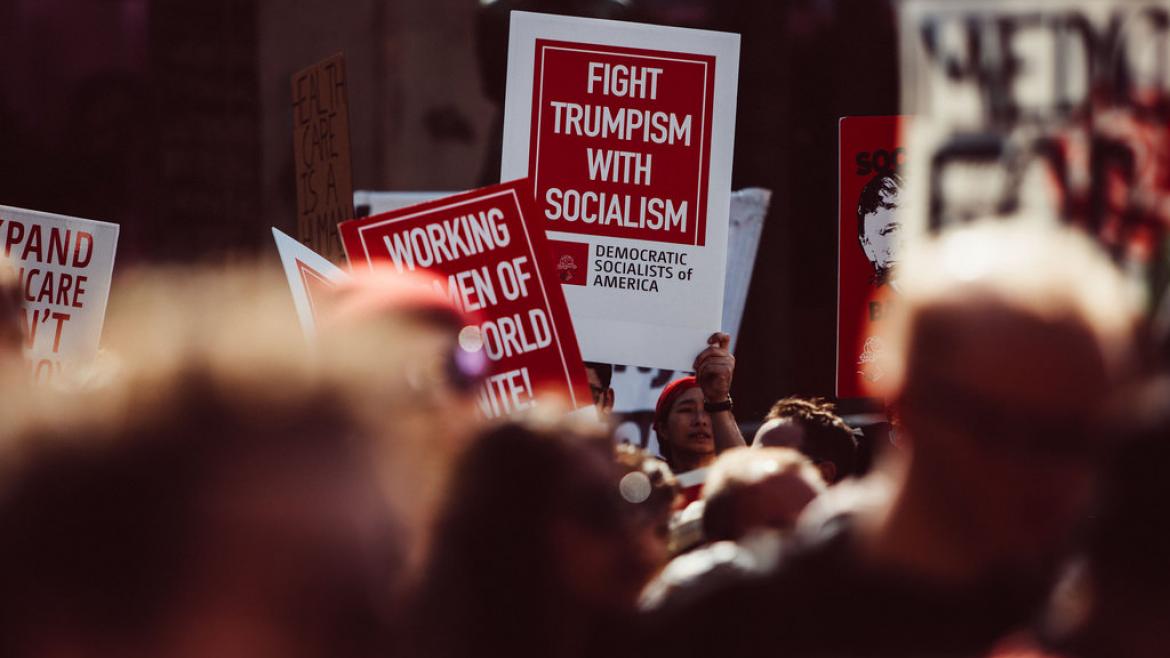
These are good times to be a socialist. In the not-so-distant past, that moniker was wielded as a slur to decimate a left-leaning political opponent or to besmirch their character. Not so much anymore.The Democratic Socialists of America are seeing swelling membership numbers, and dozens of political candidates across the country are openly running in the November midterms as socialists. According to a variety of news reports, the uptick mostly can be attributed to millennials, who blame capitalism for sticking them with heavy student debt, high rents, unaffordable medical care and what they view as an unequal justice system.

To get up to speed on this emerging political trend, ASU Now consulted with Daniel Pout, an instructor at Arizona State University’s School of Politics and Global Studies.
Man in stripped shirt smiling
Daniel Pout
Question: "Socialist" was once considered a dirty word in politics. Now many people and candidates are embracing the label. To what would you attribute this turnaround?

Answer: The movement you describe is part of a trend that is happening across the world, certainly in Europe and America, where we are moving from the traditional competition between center-right and center-left parties that fundamentally agreed on how to organize economically and socially towards a competition between the political center and its periphery.

You can see this in the coalition between Angela Merkel's Christian Democratic Union and her party's former rivals, the Social Democratic Party. This coalition government maintains the status quo against the rise of the more radical Left Party, Green Party and Alternative for Germany. Here in the United States, the election of Donald Trump and the success of Bernie Sanders, who has described himself as a socialist, is a sign that American voters, like their European counterparts, are ready to investigate alternatives to the status quo liberal capitalist/welfare state consensus that was reached in Western countries following the end of World War II.

I put this willingness to consider alternatives down to dissatisfaction with how governments handled the global financial crisis, as well as the increased access to alternative political viewpoints as the media landscape develops.

Q: What is a socialist?

A: A socialist is someone that works towards a political system where the working class, as a collective whole, own the means of production in society. In the last few decades in Europe, this was often achieved through state ownership of large enterprises. So, when I was a child in the United Kingdom, the telephone company, railways, coal mines, steel works, airlines and car manufacturers, among other industries, were all owned by the government, which represented the interests of the people (it might go too far to say the interests of the working class).

The British Labour Party, which at its founding was very much a socialist party, abandoned this policy of public ownership, one that was enshrined in its own constitution, in the mid-1990s. In doing so, it abandoned socialism. Recently, socialism has become associated with robust welfare states and universal health care.

Q: This appears to be a movement fueled by millennials, many who are drawn to the Democratic Socialists of America's promise to combat income inequality, injustice and corrupt politics. Are they naïve to think this or are these different times?

A: Income inequality and injustice are important issues and the fight against them is a worthy cause. I would expect that many people care about these issues. The important question here is, how to go about addressing them?

Socialism’s answer is to organize as a class and to collectively wrest control of the means of production in order to affect a more equitable distribution of the resources that the working class is absolutely indispensable in creating. Liberal capitalists might point to world trade and the opening up of markets. Look at China, they might say: Openness to international capital and goods flow has eradicated extreme poverty and built cities that are as wealthy as New York and Los Angeles. Liberal capitalism has been the prevailing doctrine in the world since World War II but, as I say above, people are interested in exploring alternatives. Socialism is one alternative.

Q: The Democratic Socialists of America appear to want to stay within the Democratic Party and simply want to offer some diversity. Will this ultimately help or hinder the Democratic Party going forward?

A: In Britain, the party rank and file gained control of the Labour Party and elected an openly socialist leader, Jeremy Corbyn. His Shadow Cabinet resigned en masse and everyone said that this was the end of the Labour Party. The media and political experts said that the party had made themselves unelectable and had taken the party back to the years when Thatcher trounced them in every election. Yet in the most recent polls, the party that Jeremy Corbyn leads is tied with the governing Conservative Party at 40 percent.

While Britain has a different history, it has followed a similar political story as the United States since the Reagan and Thatcher years. On that basis, and learning from Sanders’ success here, I predict that if the Democratic Party offers an alternative to the political status quo, they would see enhanced success.

Top photo courtesy of Pixabay