Join us at our brand new blog - Blue Country Gazette - created for those who think "BLUE." Go to www.bluecountrygazette.blogspot.com

YOUR SOURCE FOR TRUTH

Thursday, October 6, 2011

House passes bill to clear up C.C. Cragin confusion


Inspection of the pipeline from Cragin Dam to Payson, like this 2008 job, is complicated by the fact that it crosses territory — and turf — controlled by two different federal agencies. (Photo courtesy Salt River Project)

Payson officials hope to replace or repair parts of the water pipeline from the Cragin Dam to the town, to prevent more leaks like this one from 2007. (Photo courtesy Salt River Project)

By JOSHUA ARMSTRONG
Cronkite News Service

WASHINGTON – The House on Monday approved a bill aimed at clearing up six years of what one Arizona lawmaker called a “ridiculous jurisdictional battle” over control of the C.C. Cragin Dam and Reservoir Project in Coconino County.

The dispute has stalled pipeline projects that draw water from the dam for towns like Payson, a 15,000-person town in Gila County, which relies on Cragin for its water.

“This is simply not a tenable situation,” Rep. Paul Gosar, R-Flagstaff, said on the House floor immediately before lawmakers approved the bill Monday on a voice vote.

Gosar sponsored the measure, which puts the Forest Service in charge of land use on the project and gives the Bureau of Reclamation final say on Cragin operations.

In 2005, ownership of the dam was transferred from Salt River Project to the Department of the Interior, which oversees the Bureau of Reclamation. But the Forest Service maintained that it had authority over the dam, which is in a national forest, and had an agreement with Salt River Project to maintain it.

It was never clear who had final jurisdiction, and as the question lingered, repairs and upgrades were held up.

Payson got $10.6 million in federal stimulus funds for a water pipeline project connected to the reservoir, but the town has not been able to break ground. The town has acquired all the piping and has nearly finished engineering on the project, said Buzz Walker, Payson’s water superintendent.

Payson Mayor Kenny Evans said the snafu and later political bickering in Washington has hurt his town’s employment by stalling the stimulus-funded water pipeline.

“If we can get through all the bluster and posturing, this bill would pass the Senate and the president would sign it in a heartbeat,” Evans said in a phone interview Monday. “We have people (in Washington) who want to fight rather than fix.”

But Monday’s vote was not the end of the issue. As the measure awaits Senate approval, repairs and construction on Cragin’s pipes and infrastructure are still stuck in standby mode.

And the bill was not the first of its kind: Sen. John McCain, R-Ariz., and former Rep. Ann Kirkpatrick, D-Flagstaff, sponsored legislation in previous sessions of Congress, but Gosar’s is the first to make it to a floor vote.

A similar measure by McCain this session has been approved in committee and is waiting for a Senate floor vote.

Although the House bill has faced no outward opposition, Gosar said there’s no guarantee the issue will come to a swift close.

“You never say never until you see the signature on the dotted line,” he said.

Evans bemoaned the fact that the Obama administration awarded the town stimulus money in an attempt to create jobs, but that bickering by administration agencies have kept the town from reaching that goal.

“The fight has been about who gets to be the gatekeeper, who gets to say ‘yes’ or ‘no,’ and that’s really sad,” he said.

The Cragin bill passed on the same day the House approved a measure to increase the number of communities receiving power from the Hoover Dam in 2017. The measure would create a pool of 5 percent of Hoover Power’s capacity, which would be allocated to new customers.

The new pool would largely be created from expanded capacity that is not now included in Hoover’s contracts with its three state customers – Arizona, Nevada and California. The bill would not likely have a material change for the utilities in those states, said Steve Hulet, SRP’s manager of supply and trading.

Medicare Open Enrollment plan data goes live

In advance of the new, earlier annual enrollment period, people with Medicare could begin reviewing plan benefit and cost information as of last Saturday, Oct. 1. The Centers for Medicare & Medicaid Services (CMS) launched access to its popular web-based Medicare Plan Finder that allows beneficiaries, their families, trusted representatives, and senior program advocates to look at all local drug and health plan options that are available for the 2012 benefit year.

“With Open Enrollment coming early this year, it is important that people with Medicare take advantage of the next couple weeks to review their current coverage and compare it with the options that are available for next year,” said CMS Administrator Donald M. Berwick, M.D. “The information that’s available now on the Plan Finder will also help caregivers, health providers, and partners that support and counsel seniors and people with disabilities in selecting the best plan for their needs.”

The annual enrollment period begins earlier this year, on October 15th, and runs through December 7th. People with Medicare will have seven weeks to review Medicare Advantage and Part D prescription drug coverage benefits and plan options, and choose the option that best meets their unique needs. The earlier open enrollment period also ensures that Medicare has enough time to process plan choices so that coverage begins without interruption on January 1, 2012.

This year, as beneficiaries look over their available plan options, they will see better value in the Medicare Advantage (Part C) and Prescription Drug (Part D) plan benefits. All beneficiaries will have access to Medicare-covered preventive services at zero cost-sharing, including an Annual Wellness Visit. Those in the Part D coverage gap, or donut hole, will continue to receive 50 percent discounts on covered brand name drugs thanks to the Affordable Care Act. On average, Medicare Advantage premiums will be four percent lower in 2012 than in 2011, and plans expect enrollment to increase by 10 percent. Average premiums for Part D prescription drug plans will also decrease to $30 in 2012, about 76 cents less compared to the average 2011 premium. The premium amount is based on bids submitted by Part D plans for the 2012 plan year. Benefits in 2012 remain consistent with those offered in 2011.

People can use the Plan Finder – available at www.Medicare.gov –by inserting their home zip code to find out which Medicare Advantage (Part C) and Prescription Drug (Part D) plans are available in their areas. If the zip code search shows multiple counties it will prompt users to select one county to continue the search. For 2010, the Plan Finder was the most popular tool on www.Medicare.gov, with more than 280 million page views. Also available online is Medicare’s Formulary Finder, which allows beneficiaries to insert their prescribed medications and zip code to see a display of plans offered locally that cover their drugs.

Due to provisions in the Affordable Care Act, Medicare will begin to financially reward Medicare Advantage plans which achieve high quality ratings. Part D plans will also continue to receive quality ratings. Beginning October 12, the Medicare Plan Finder will include each plan’s quality star rating for 2012. For the first time this year, people who use the Plan Finder will also see a gold star icon designating the top rated 5-star plans, and will continue to see warnings for those plans who consistently are poor performers. “We encourage all Medicare beneficiaries enrolled in private plans to know their plan’s overall star rating and to consider enrolling in plans with high ratings,” said Jonathan Blum, CMS Deputy Administrator and Director, Center for Medicare. When comparing plans, beneficiaries should consider the plan’s quality in addition to its costs, coverage, and other conveniences. On October 15, people with Medicare will be able to make informed decisions when they select their plan for the coming year.

More information is available at www.healthcare.gov , a new web-based portal brought to you by the U.S. Department of Health & Human Services.

Tuesday, October 4, 2011

SV Vet Clinic settles biohazardous waste violation

BREAKING NEWS
BREAKING NEWS
BREAKING NEWS

 PHOENIX (Oct. 4, 2011) – The Arizona Department of Environmental Quality and Arizona Attorney General’s Office announced today that Star Valley Veterinary Clinic, P.C. has agreed to a $65,000 settlement in a consent judgment for biohazardous medical waste violations in the Town of Star Valley in Gila County.

The clinic will pay a $5,000 penalty and conduct a $60,000 Supplemental Environmental Project in which veterinarian services will be used to treat animals for the Humane Society of Central Arizona. In addition, information will be provided about the proper management and disposal of biohazardous medical waste in the animal care industry.

An inspection by ADEQ’s Solid Waste Inspection and Compliance Unit in June 2009 determined that the clinic had disposed of untreated biohazardous medical waste syringes contaminated with blood in regular solid waste containers that were dumped in the Gila County landfill between 1999 and 2009.

The clinic received a notice of violation from ADEQ in September 2009 for improperly packaging, storing, labeling, and disposing of untreated biohazardous medical waste.

“These are serious violations that went on for many years,” said ADEQ Director Henry Darwin. “But this is also a very creative settlement that will allow many abandoned pets and other animals in the Payson area to receive medical treatment while at the same time educating animal owners about the proper disposal of this medical waste.”

"All veterinary clinics and other medical providers need to rigorously comply with state standards to protect the health of our citizens and our environment," Attorney General Tom Horne said.

The consent judgment is subject to court approval.

Monday, October 3, 2011

Arizona's monsoons generate 'pluvial parade'

Photos courtesy U.S. Fish & Wildlife
By Marian Lyman Kirst
High Country News

This summer, Arizona – like much of the Southwest — experienced what weather mavens call a "meteorological singularity," a weather event that happens every year around the same time. The phenomenon is the Arizona monsoon, a seasonal shifting of winds that moves moisture northward from the Pacific and Gulf of Mexico in July, August, and September. The wet, wayfaring winds hit Arizona's mountains and shoot upward toward the heavens where they cool and cloud castle into thunderstorms that produce week-long bursts of rain. It's then, when temperatures drop and the air freshens with the damp scent of desert sage, that Arizona hosts a pluvial parade of animal curiosities: lizards, snakes, toads, arachnids, beetles, emerging from underground lairs, arboreal dens and grass-girdled egg cases to eat, hunt, cruise for mates, socialize, and add to the monsoon's eldritch symphony with their chorus of croaks and chirps.

There are many reasons for this riot of activity, says Carl Olson, Associate Curator for the University of Arizona's entomology department. "All animals have evolved to be active in certain windows, some by day, some by night, some at dusk," and some during monsoon season. This is partly because the monsoon moderates climate extremes, Olson says, “making hot temps more tolerable because of increased humidity." Plus, it ‘s “the real season of plant growth, so more food is available to pick and choose from." And with the plants come the plant-eaters and, in turn, the eaters of the plant-eaters. It's all part of the "magic of monsoon season," Olson says.

Arizona ranks 3rd in the country for biodiversity and boasts one of the nation's most diverse invertebrate assemblages. "We have at least 40 species of scorpions, quite a few species of centipedes, spiders, wasps, and bees, and ants by the bugila 2shel load." That wealth attracts hoards of scientists, collectors, and poachers who wait and watch for the winds to shift and then descend upon the monsoon's cavalcade of creatures for scientific, commercial, and -- in the case of the entheogen-producing Sonoran Desert toad (Bufo alvarius) -- recreational, ends (Entheogens are psychoactive substances smoked for their “spiritual” and hallucinatory effects).

For most people, though, the monsoon season is that weird time of year when more likely than not, they will see some of Arizona's most remarkable creatures, many of which are nocturnal or spend most of the year below ground.

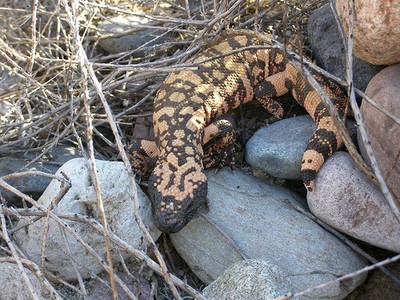
Gila monsters, Arizona's lumbering, Halloween-colored lizards, are some of the most noticeable players. They emerge from desert burrows to drink from and bathe in rain pools, and often wander into people's yards and gardens. When the monsoonal chill becomes too much to bear, Gilas hole up in sheds and vinegaroon momgarages (see video). Marc Hammond, co-owner of Animal Experts Inc., a Tucson-based company that specializes in capturing and re-locating unwanted animal houseguests, says Gila-related calls always peak with the monsoon.

Gilas, which prey on rodents, bird eggs, and insects, can whip their necks around with rattlesnake speed and their venom is nearly as potent. What's more, Gilas are loathe to let go of something onto which they've latched, preferring, instead, to gnaw for a bit so their grooved teeth can channel venom into the wound. But Gila encounters rarely degenerate to the point where a person, and the obstinate Gila attached to them, end up in the hospital: "It's almost impossible to get accidentally bitten by a Gila monster," Hammond says. "You would have to provoke it or put your hand in its burrow." Curious pets and kids, who don't know to keep their distance, are the most common Gila-bite victims. If, for some reason, you do get bitten, says Hammond, the best way to remove the lizard is to submerge it in water or cover its nose with an ammonia-soaked rag until it lets go.

Because Gilas are a protected in Arizona, and are ecosystem specialists, living and feeding in very specific areas, animal control experts rvinegaroonarely relocate them to new areas, preferring, instead, to sweep them just off the property. Gilas "are an important part of the ecosystem," Hammond says, "so we don't like to move them far because we don't know what will happen to them" in a place with which they are unfamiliar.

Another common monsoon creature is the giant vinegaroon (Mastigoproctus giganteus), a species of whip scorpion. Vinegaroons are large, nocturnal arachnids that look like a mad scientist's mix between scorpion and spider. Despite their wonderfully monstrous appearance, these creatures are harmless to humans, lacking both venom and stinger. However, when threatened, vinegaroons can emit a concentrated spray of acetic acid (vinegar), hence their name. Like all arachnids, vinegaroons have eight legs, but they only use the back six to walk. The first two legs are modified to act as feelers, and the whip-like tail is actually a sensorblister beetley organ.

Vinegaroons are “classic first monsoon animals,” says Dr. Justin Schmidt, an entomologist with the University of Arizona. The adults hunker in an underground cell and wait for the first rains to fall. Once they do, the vinegaroons crawl to the surface and into the night to hunt bark scorpions and cockroaches. They are active “on any night that has high humidity,” Schmidt says, “and will stay active the entire season unless they eat their fill and can store no more fat and protein in their now corpulent bodies,” at which point they return to their burrows until the following summer.

Other fascinating monsoon critters include blister beetles and Couch's spadefoot toad (Scaphiopus couchi). Blister beetles are stout-bodied, often black or metallic-hued insects with a medieval-style arsenal: when squeezed or attacked, the beetles secrete a liquid loaded with cantharidin, a skin-blistering agent. Beetles from the genus Epicauta are monsoon regulars. The adults spend the season feeding on foliage while the predatory larvae seek out grasshopper eggs, their baby-food of choice.

Couch's spadefoot toads spend most of their lives hibernating underground. But they surface after summer storms to feed and breed in the rain pools. Their croaking choruses are reported to sound eerily similar to the bleating of dying lambs.

As October approaches, this year's monsoon season is coming to an end. But keep your eyes peeled for these and other monsoonal beasts as they embark on their final aboveground adventures before slipping, digging, and slithering back into the earth. 

High Country News
hcn.org

All things spooky on sale at Library Bookstore

During the month of October, The Library Friends of Payson Bookstore is featuring all things spooky. Stop by and select a book for a chilling read.

You will find Mysteries prominently displayed in the Bookstore. For the entire month of October, buy one mystery book at our already low price and get a second one free. It’s a wonderful way to get into the mood for Halloween.

In keeping with the “spooky reads” theme, mystery writers such as: Patricia Cornwell, Mary Higgins Clark, Faye or Jonathan Kellerman, Stephan King, Dean Koontz, Tom Clancy, and John Grisham will be featured in October 2 for 1 sale. This is an excellent opportunity to plan ahead for great winter reading.

Crafters who are anxious to get an early start holiday projects will want to stop by the Bookstore soon. All year Bookstore volunteers put aside holiday craft books and now it’s time to put them on display. Don’t miss this chance to discover new ideas for this holiday season.

The Bookstore recently received a large donation of books about railroads and trains. They will be on display during October. This is the perfect opportunity to purchase gifts for railroad fans.

Bookstore prices range from $3.00 to $1.00 for hardback books based on copyright dates. Stock changes rapidly, therefore, the savvy shopper stops by frequently. Bookstore volunteers are always happy to see you.

The LFOP Bookstore is located to the right of the circulation desk just inside the Payson Public Library, 328 N. McLane Road. For more information visit the Library Friends of Payson website at www.libraryfriendsofpayson.org

Deepest moral question: are we in it together?

By Robert Reich
Robert Reich's Blog
readersupportednews.org

30 September 11 - We dodged another shut-down bullet, but only until November 18. That’s when the next temporary bill to keep the government going runs out. House Republicans want more budget cuts as their price for another stopgap spending bill.

Among other items, Republicans are demanding major cuts in a nutrition program for low-income women and children. The appropriation bill the House passed June 16 would deny benefits to more than 700,000 eligible low-income women and young children next year.

What kind of country are we living in?

More than one in three families with young children is now living in poverty (37 percent, to be exact) according to a recent analysis of Census data by Northeastern University’s Center for Labor Market Studies. That’s the highest percent on record. The Agriculture Department says nearly one in four young children (23.6) lives in a family that had difficulty affording sufficient food at some point last year.

We’re in the worst economy since the Great Depression – with lower-income families and kids bearing the worst of it – and what are Republicans doing? Cutting programs Americans desperately need to get through it.

Medicaid is also under assault. Congressional Republicans want to reduce the federal contribution to Medicaid by $771 billion over next decade and shift more costs to states and low-income Americans.

It gets worse. Most federal programs to help children and lower-income families are in the so-called "non-defense discretionary" category of the federal budget. The congressional super-committee charged with coming up with $1.5 trillion of cuts eight weeks from now will almost certainly take a big whack at this category because it’s the easiest to cut. Unlike entitlements, these programs depend on yearly appropriations.

Even if the super-committee doesn’t agree (or even if they do, and Congress doesn’t approve of their proposal) an automatic trigger will make huge cuts in domestic discretionary spending.

It gets even worse. Drastic cuts are already underway at the state and local levels. Since the fiscal year began in July, states no longer receive about $150 billion in federal stimulus money — money that was used to fill gaps in state budgets over the last two years.

The result is a downward cascade of budget cuts – from the federal government to state governments and then to local governments – that are hurting most Americans but kids and lower-income families in particular.

So far this year, 23 states have reduced education spending. According to a survey of city finance officers released Tuesday by the National League of Cities, half of all American cities face cuts in state aid for education.

As housing values plummet, local property tax receipts are down. That means even less money for schools and local family services. So kids are getting larger class sizes, reduced school hours, shorter school weeks, cuts in pre-Kindergarten programs (Texas has eliminated pre-Kindergarten for 100,000 children), even charges for textbooks and extra-curricular activities.

Meanwhile the size of America’s school-age population keeps growing notwithstanding. Between now and 2015, an additional 2 million kids are expected to show up in our schools.

Local family services are being cut or terminated. Tens of thousands of social workers have been laid off. Cities and counties are reducing or eliminating their contributions to Head Start, which provides early childhood education to the children of low-income parents.

All this would be bad enough if the economy were functioning normally. For these cuts to happen now is morally indefensible.

Yet Republicans won’t consider increasing taxes on the rich to pay for what's needed – even though the wealthiest members of our society are richer than ever, taking home a bigger slice of total income and wealth than in seventy-five years, and paying the lowest tax rates in three decades.

The President’s modest proposals to raise taxes on the rich – limiting their tax deductions, ending the Bush tax cut for incomes over $250,000, and making sure the rich pay at the same rate as average Americans – don't come close to paying for what American families need.

Marginal tax rates should be raised at the top, and more tax brackets should be added for incomes over $500,000, over $1,500,000, over $5 million. The capital gains tax should be as high as that on ordinary income.

Wealth over $7.2 million should be subject to a 2 percent surtax. After all, the top one half of 1 percent now owns over 28 percent of the nation's total wealth. Such a tax on them would yield $70 billion a year. According to an analysis by Yale’s Bruce Ackerman and Anne Alstott, that would generate at least half of $1.5 trillion deficit-reduction target over ten years set for the supercommittee.

Another way to raise money would be through a tiny tax (one-half of one percent) tax on financial transactions. This would generate $200 billion a year, and hardly disturb Wall Street's casino at all. (The European Commission is about to unveil such a tax there.)

All this can be done, but only if Americans understand what's really at stake here.

When Republicans recently charged the President with promoting "class warfare," he answered it was "just math." But it’s more than math. It’s a matter of morality.

Republicans have posed the deepest moral question of any society: whether we’re all in it together. Their answer is we’re not.

President Obama should proclaim, loudly and clearly, we are. 

(Robert Reich is Chancellor's Professor of Public Policy at the University of California at Berkeley. He has served in three national administrations, most recently as secretary of labor under President Bill Clinton. He has written thirteen books, including The Work of Nations, Locked in the Cabinet, Supercapitalism, and his most recent book, Aftershock. His "Marketplace" commentaries can be found on publicradio.com and iTunes. He is also Common Cause's board chairman.) 

Saturday, October 1, 2011

Town leaders want us to participate in TV sham


Got an e-mail from a Payson town councilor yesterday asking me to participate in a sham – the town’s appearance on a TV show called “Insights with Terry Bradshaw” which “takes viewers across the country exploring some of America’s ‘hidden gems.’” Apparently the show has been convinced that Payson is a “hidden gem.”

The gang e-mail, which was also sent out by at least one other councilor, invites recipients to come out on Tuesday, Oct. 4 and pretend to be doing things you normally don’t do – like pretending you’re fishing in Green Valley Park and strolling down Main Street pretending you’re shopping. It will give the TV show people the impression that we really have a vibrant town full of enthusiastic people who really give a damn about Main Street and all the other stuff.

Here’s my response to the e-mail:

“Sounds like we're putting on a show. Shouldn't we be who we really are and do what we really do? There's too much bluster and not enough substance in this town these days. Too many promises. Not enough facts or information to back them up. I'm sorry but I long for the Bob Edwards council.”

I mentioned the Edwards council because that was back when people were encouraged to get involved for the right reasons. To participate on committees and task forces addressing real issues of concern to the community.

The reference to bluster vs. substance is, of course, a reference to the grandiose plans of Payson Mayor Kenny Evans which the local newspaper refuses to substantiate by asking him the tough questions like where is he getting $450 million to build a campus for ASU – or, if they don’t come, what makes him think he can just go out and get us a “world class university” like Harvard or Oxford or Cambridge. Give me a break!

I’m sorry folks, but I won’t be there Tuesday. I’m sure the town’s Cameron Davis and the chamber’s John Stanton are breathing simultaneous sighs of relief.  I'd really enjoy the expressions on their faces when I walked up to them with my fishing pole and giant, blow-up fish, but I’ve got better things to do than to pretend I’m something I’m not on a TV show where, we can safely assume, all the other featured “hidden gems” have pretended they’re something they’re not.

Good lord, folks, is that what our culture has become these days – everybody watching stupid TV shows that aren’t even real?

And I have to say I am disappointed in Terry Bradshaw. Why the hell is he doing a show like this? The man was a respected football player and now he’s running a circus sideshow.

But there’s still time for Bradshaw to fix this. When he comes to Payson he could show all the empty storefronts. He could attend a town council meeting where the citizens no longer show up in quantity to participate. He could send his camera crew down almost any street and reveal all the FOR SALE signs on the houses. He could show the packed Wal-Mart parking lot, the real heartbeat of Payson.

It’s not that we’re any different from any other small town. It’s just that we don’t have to be dishonest about who and what we are.  And what are we going to say to people when they decide to move to our "hidden gem," fishing poles in tow.

If you choose to participate just to be on TV, that’s your business. But remember: someday you’ll be standing at the pearly gates explaining to the Big Guy why you deserve to get in. I just hope he doesn’t bring up your appearance on “Insights with Terry Bradshaw.” 

There will be no getting around it because, being the Big Guy, he's sure to show you an instant replay.

(Editor's note: If you want a little light entertainment, rent Chevy Chase's "Funny Farm."  It will very much remind you of what Payson is asking its residents to do on Tuesday.)